Laboratoire de Microbiologie Signaux et Microenvironnement, Normandie Université, Université de Rouen EA 4312, IUT Evreux, Evreux, France.
Sensors (Basel). 2012;12(3):3484-97. doi: 10.3390/s120303484. Epub 2012 Mar 12.
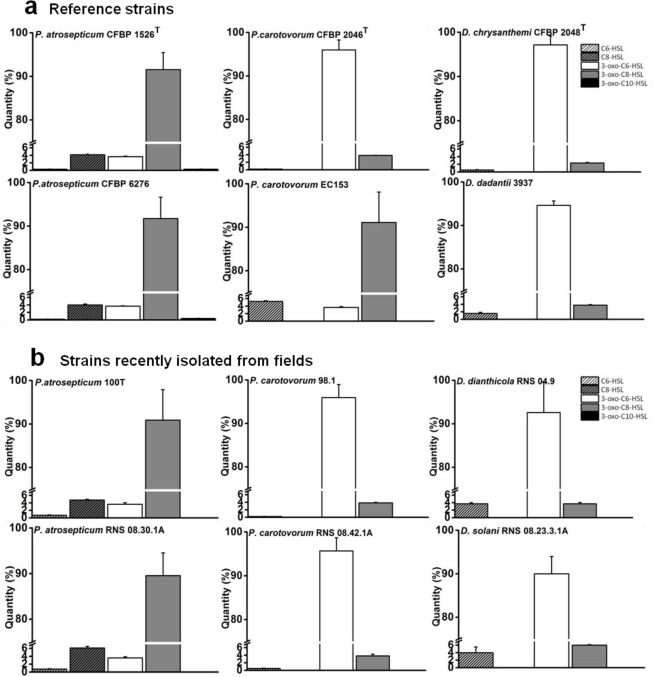
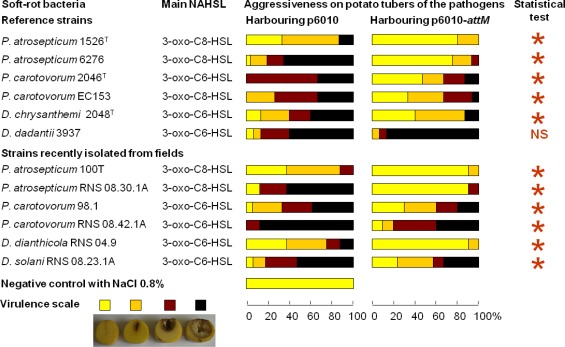
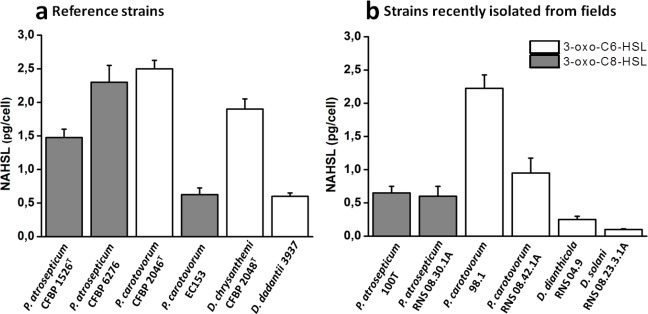
Soft-rot bacteria Pectobacterium and Dickeya use N-acyl homoserine lactones (NAHSLs) as diffusible signals for coordinating quorum sensing communication. The production of NAHSLs was investigated in a set of reference strains and recently-collected isolates, which belong to six species and share the ability to infect the potato host plant. All the pathogens produced different NAHSLs, among which the 3-oxo-hexanoyl- and the 3-oxo-octanoyl-L-homoserine lactones represent at least 90% of total produced NAHSL-amounts. The level of NAHSLs varied from 0.6 to 2 pg/cfu. The involvement of NAHSLs in tuber maceration was investigated by electroporating a quorum quenching vector in each of the bacterial pathogen strains. All the NAHSL-lactonase expressing strains produced a lower amount of NAHSLs as compared to those harboring the empty vector. Moreover, all except Dickeya dadantii 3937 induced a lower level of symptoms in potato tuber assay. Noticeably, aggressiveness appeared to be independent of both nature and amount of produced signals. This work highlights that quorum sensing similarly contributed to virulence in most of the tested Pectobacterium and Dickeya, even the strains had been isolated recently or during the past decades. Thus, these key regulatory-molecules appear as credible targets for developing anti-virulence strategies against these plant pathogens.
软腐病菌果胶杆菌和迪凯亚属利用 N-酰基高丝氨酸内酯(NAHSLs)作为扩散信号来协调群体感应通讯。在一组参考菌株和最近收集的分离株中研究了 NAHSLs 的产生,这些分离株属于六个物种,并且具有感染马铃薯宿主植物的能力。所有病原体都产生了不同的 NAHSLs,其中 3-氧代己酰基和 3-氧代辛酰基-L-高丝氨酸内酯至少代表了总产生 NAHSL 量的 90%。NAHSLs 的水平从 0.6 到 2 pg/cfu 不等。通过在每种细菌病原体菌株中电穿孔群体感应淬灭载体,研究了 NAHSLs 在块茎软化中的作用。与携带空载体的菌株相比,所有表达 NAHSL 内酯酶的菌株产生的 NAHSLs 量都较低。此外,除了迪凯亚属的 Dickeya dadantii 3937 外,所有菌株在马铃薯块茎测定中诱导的症状水平都较低。值得注意的是,攻击性似乎与产生的信号的性质和数量无关。这项工作强调了群体感应在大多数测试的果胶杆菌和迪凯亚属中同样有助于毒力,即使这些菌株是最近或过去几十年中分离出来的。因此,这些关键的调节分子似乎是针对这些植物病原体开发抗毒力策略的可靠目标。