McDonald Alison, Harris John, Macmillan Debbi, Dempster John, McConnell Gail
Strathclyde Institute of Pharmacy and Biomedical Sciences, University of Strathclyde, 161 Cathedral Street, Glasgo, G4 ORE, UK.
Biomed Opt Express. 2012 Jun 1;3(6):1266-73. doi: 10.1364/BOE.3.001266. Epub 2012 May 4.
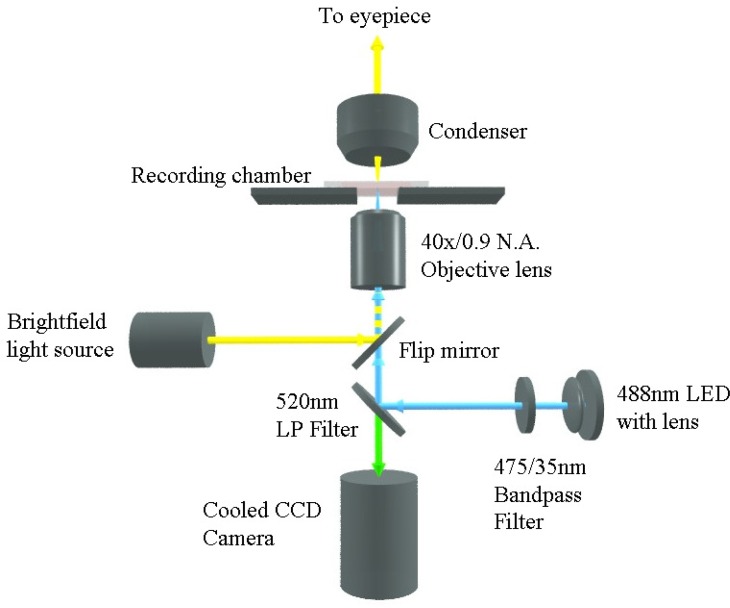
We have investigated the possibility that variations in the level of intracellular Ca(2+) in excitable cells might be induced as an artifact of the incoherent illumination that is being used to monitor transient responses. In order to avoid the fluctuations in power of an arc lamp source, a microscope using a light emitting diode that was calibrated accurately at low power levels, was constructed to provide good control over the dose of light applied to the biological specimen. We report here that higher powers of illumination increased the probability of occurrence of Ca(2+) transients even in the sub-mW range normally used to measure such transients in epi-fluorescence work, suggesting that caution should be exercised when designing experiments and interpreting data.
我们研究了一种可能性,即可兴奋细胞内钙离子(Ca(2+))水平的变化可能是由于用于监测瞬态反应的非相干照明所产生的假象。为了避免弧光灯光源功率的波动,构建了一台使用发光二极管的显微镜,该显微镜在低功率水平下经过精确校准,以便能很好地控制施加到生物样本上的光剂量。我们在此报告,即使在通常用于落射荧光工作中测量此类瞬变的亚毫瓦范围内,更高的照明功率也会增加Ca(2+)瞬变发生的概率,这表明在设计实验和解释数据时应谨慎行事。