Center of Experimental Orthopaedics, Saarland University Medical CenterHomburg/Saar, Germany.
Stem Cell Res Ther. 2012;3(3):22. doi: 10.1186/scrt113.
Transplantation of genetically modified human bone marrow-derived mesenchymal stem cells (hMSCs) with an accurate potential for chondrogenic differentiation may be a powerful means to enhance the healing of articular cartilage lesions in patients. Here, we evaluated the benefits of delivering SOX9 (a key regulator of chondrocyte differentiation and cartilage formation) via safe, maintained, replication-defective recombinant adeno-associated virus (rAAV) vector on the capability of hMSCs to commit to an adequate chondrocyte phenotype compared with other mesenchymal lineages.
The rAAV-FLAG-hSOX9 vector was provided to both undifferentiated and lineage-induced MSCs freshly isolated from patients to determine the effects of the candidate construct on the viability, biosynthetic activities, and ability of the cells to enter chondrogenic, osteogenic, and adipogenic differentiation programs compared with control treatments (rAAV-lacZ or absence of vector administration).
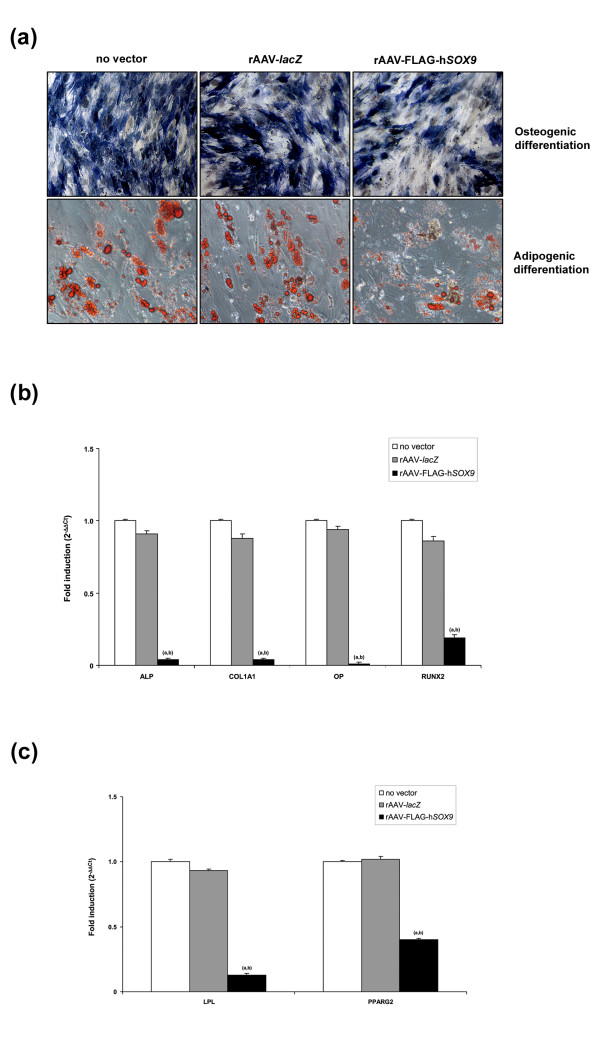
Marked, prolonged expression of the transcription factor was noted in undifferentiated and chondrogenically differentiated cells transduced with rAAV-FLAG-hSOX9, leading to increased synthesis of major extracellular matrix components compared with control treatments, but without effect on proliferative activities. Chondrogenic differentiation (SOX9, type II collagen, proteoglycan expression) was successfully achieved in all types of cells but strongly enhanced when the SOX9 vector was provided. Remarkably, rAAV-FLAG-hSOX9 delivery reduced the levels of markers of hypertrophy, terminal and osteogenic/adipogenic differentiation in hMSCs (type I and type X collagen, alkaline phosphatase (ALP), matrix metalloproteinase 13 (MMP13), and osteopontin (OP) with diminished expression of the osteoblast-related transcription factor runt-related transcription factor 2 (RUNX2); lipoprotein lipase (LPL), peroxisome proliferator-activated receptor gamma 2 (PPARG2)), as well as their ability to undergo proper osteo-/adipogenic differentiation. These effects were accompanied with decreased levels of β-catenin (a mediator of the Wnt signaling pathway for osteoblast lineage differentiation) and enhanced parathyroid hormone-related protein (PTHrP) expression (an inhibitor of hypertrophic maturation, calcification, and bone formation) via SOX9 treatment.
将具有准确软骨分化潜能的基因修饰的人骨髓间充质干细胞(hMSC)移植可能是增强患者关节软骨损伤愈合的有力手段。在这里,我们评估了通过安全、持续、复制缺陷的重组腺相关病毒(rAAV)载体递送 SOX9(软骨细胞分化和软骨形成的关键调节因子)对 hMSC 向适当软骨细胞表型分化能力的影响,与其他间充质谱系相比。
rAAV-FLAG-hSOX9 载体被提供给从未分化和谱系诱导的 MSC,这些 MSC 是从患者中新鲜分离出来的,以确定候选构建体对细胞活力、生物合成活性以及进入软骨形成、成骨和脂肪形成分化程序的能力的影响,与对照处理(rAAV-lacZ 或无载体处理)相比。
在转导 rAAV-FLAG-hSOX9 的未分化和软骨分化细胞中观察到转录因子的明显、长期表达,导致与对照处理相比,主要细胞外基质成分的合成增加,但对增殖活性没有影响。所有类型的细胞都成功地实现了软骨分化(SOX9、II 型胶原、蛋白聚糖表达),但当提供 SOX9 载体时,这种分化得到了强烈增强。值得注意的是,rAAV-FLAG-hSOX9 的递送降低了 hMSC 中肥大、终末和成骨/脂肪分化的标志物水平(I 型和 X 型胶原、碱性磷酸酶(ALP)、基质金属蛋白酶 13(MMP13)和骨桥蛋白(OP),以及成骨相关转录因子 runt 相关转录因子 2(RUNX2)的表达减少;脂蛋白脂肪酶(LPL)、过氧化物酶体增殖物激活受体 γ 2(PPARG2)),以及它们进行适当的成骨/脂肪分化的能力。这些作用伴随着 β-连环蛋白(成骨细胞谱系分化的 Wnt 信号通路的介质)水平的降低和甲状旁腺激素相关蛋白(PTHrP)表达的增强(肥大成熟、钙化和骨形成的抑制剂)通过 SOX9 处理。