Dipartimento di Scienze Farmacologiche e Biomolecolari, Università degli Studi di Milano, Milan, Italy.
Malar J. 2012 Jul 2;11:219. doi: 10.1186/1475-2875-11-219.
Sardinia is a Mediterranean area endemic for malaria up to the last century. During a screening study to evaluate the anti-plasmodial activity of some aromatic plants traditionally used in Sardinia, Myrtus communis (myrtle, Myrtaceae), Satureja thymbra (savory, Lamiaceae), and Thymus herba-barona (caraway thyme, Lamiaceae) were collected in three vegetative periods: before, during and after flowering.
The essential oils were obtained by steam distillation, fractionated by silica gel column chromatography and analysed by GC-FID-MS. Total oil and three main fractions were tested on D10 and W2 strains of Plasmodium falciparum in vitro. Larvicidal and adulticidal activities were tested on Anopheles gambiae susceptible strains.
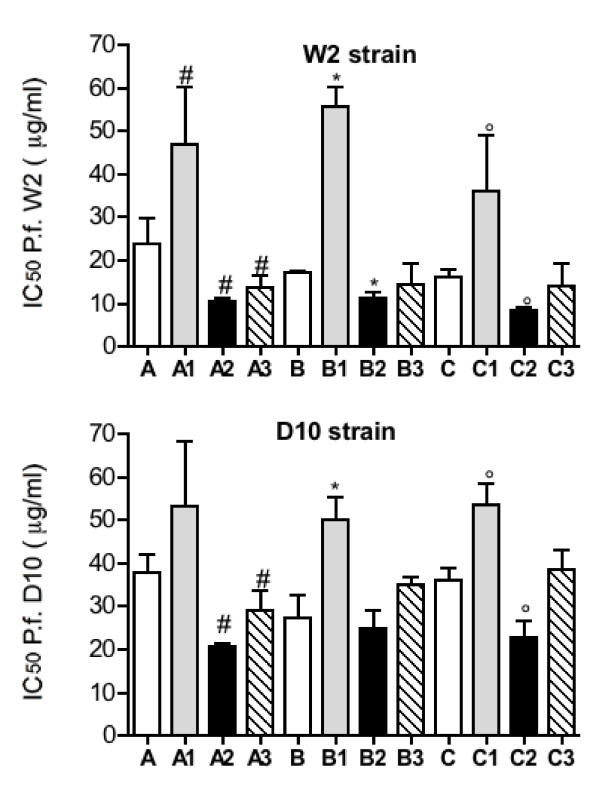
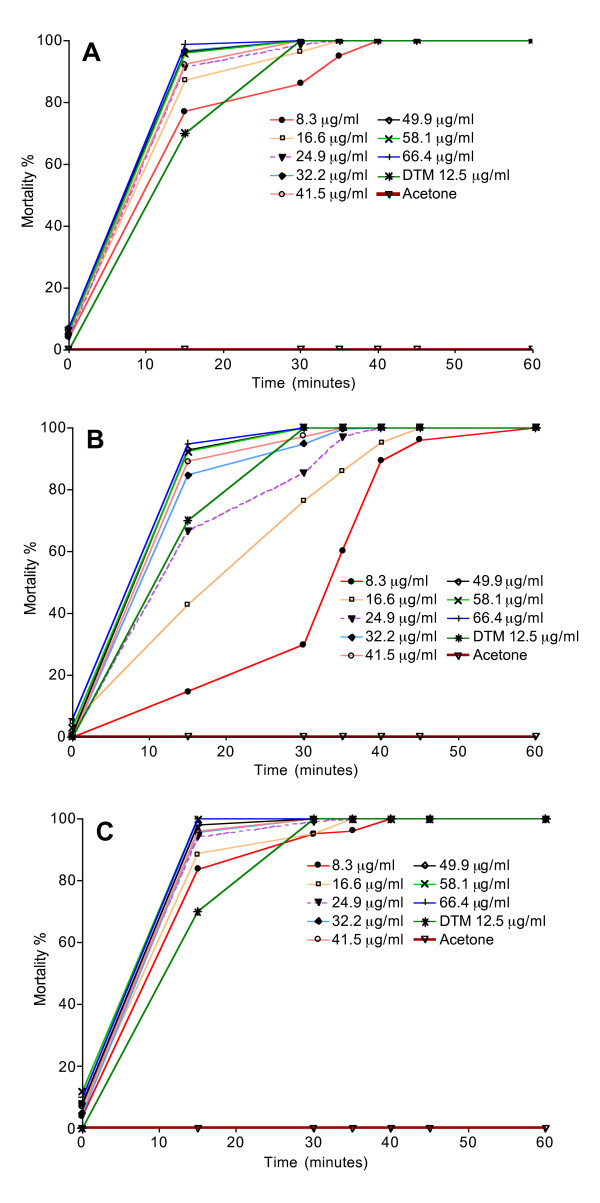
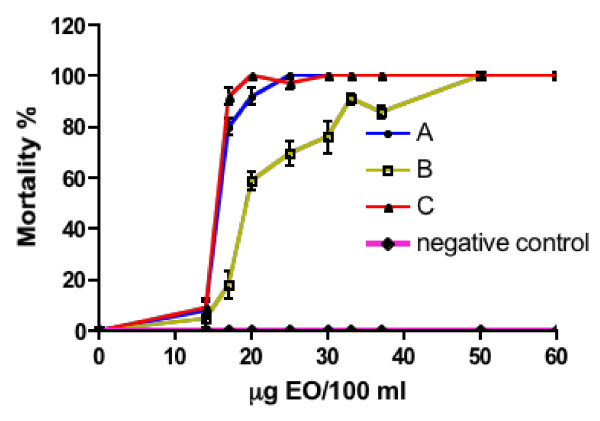
The essential oil of savory, rich in thymol, was the most effective against P. falciparum with an inhibitory activity independent from the time of collection (IC50 17-26 μg/ml on D10 and 9-11 μg/ml on W2). Upon fractionation, fraction 1 was enriched in mono-sesquiterpenoid hydrocarbons; fraction 2 in thymol (73-83%); and fraction 3 contained thymol, carvacrol and terpinen-4-ol, with a different composition depending on the time of collection. Thymol-enriched fractions were the most active on both strains (IC50 20-22 μg/ml on D10 and 8-10 μg/ml on W2) and thymol was confirmed as mainly responsible for this activity (IC50 19.7 ± 3.0 and 10.6 ± 2.0 μg/ml on D10 and W2, respectively). The essential oil of S. thymbra L. showed also larvicidal and adulticidal activities. The larvicidal activity, expressed as LC50, was 0.15 ± 0.002; 0.21 ± 0.13; and 0.15 ± 0.09 μg/ml (mean ± sd) depending on the time of collection: before, during and after flowering, respectively.
This study provides evidence for the use of essential oils for treating malaria and fighting the vector at both the larval and adult stages. These findings open the possibility for further investigation aimed at the isolation of natural products with anti-parasitic properties.
撒丁岛是一个地中海地区,直到上个世纪一直流行疟疾。在一项评估一些传统上在撒丁岛使用的芳香植物抗疟活性的筛选研究中,采集了桃金娘(桃金娘科)、牛至(唇形科)和百里香(百里香科)在三个生长期的精油:开花前、开花中和开花后。
通过水蒸气蒸馏法获得精油,通过硅胶柱色谱法进行分离,并通过 GC-FID-MS 进行分析。总油和三个主要馏分在体外对恶性疟原虫 D10 和 W2 株进行了测试。对敏感的冈比亚按蚊进行了幼虫和成虫的杀活性测试。
富含百里酚的牛至精油对恶性疟原虫的抑制作用最强,其活性与采集时间无关(D10 的 IC50 为 17-26μg/ml,W2 的 IC50 为 9-11μg/ml)。经分离,馏分 1 富含单萜烯烃;馏分 2 富含百里酚(73-83%);馏分 3 含有百里酚、香芹酚和萜品-4-醇,其组成因采集时间而异。富含百里酚的馏分对两种菌株的活性最强(D10 的 IC50 为 20-22μg/ml,W2 的 IC50 为 8-10μg/ml),并且证实百里酚是主要的活性成分(D10 的 IC50 分别为 19.7±3.0 和 10.6±2.0μg/ml,W2 的 IC50 分别为 10.6±2.0μg/ml)。牛至精油也表现出杀幼虫和杀成虫的活性。幼虫的 LC50 分别为 0.15±0.002、0.21±0.13 和 0.15±0.09μg/ml(平均值±标准差),取决于采集时间:开花前、开花中和开花后。
本研究为使用精油治疗疟疾和在幼虫和成虫阶段防治病媒提供了证据。这些发现为进一步研究具有抗寄生虫特性的天然产物提供了可能性。