Department of Physiotherapy, The University of Melbourne, Melbourne, VIC, Australia.
Department of Mechanical Engineering, Melbourne School of Engineering, University of Melbourne, Melbourne, VIC, Australia.
J Foot Ankle Res. 2012 Jul 2;5(1):15. doi: 10.1186/1757-1146-5-15.
Achilles tendinopathy (AT) is a common condition, causing considerable morbidity in athletes and non-athletes alike. Conservative or physical therapies are accepted as first-line management of AT; however, despite a growing volume of research, there remains a lack of high quality studies evaluating their efficacy. Previous systematic reviews provide preliminary evidence for non-surgical interventions for AT, but lack key quality components as outlined in the Preferred Reporting Items for Systematic Reviews and Meta-analyses (PRISMA) Statement. The aim of this study was to conduct a systematic review and meta-analysis (where possible) of the evidence for physical therapies for AT management.
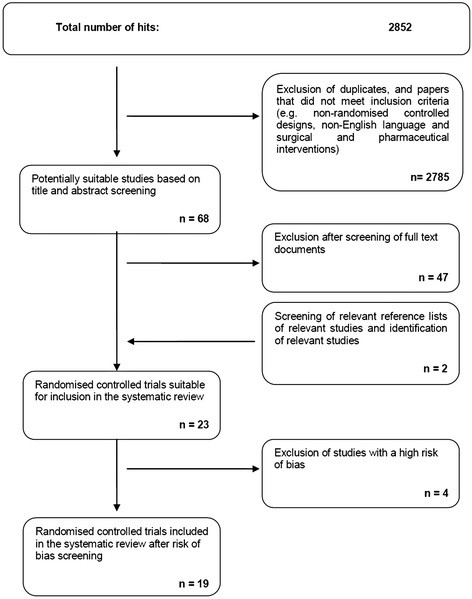
A comprehensive strategy was used to search 11 electronic databases from inception to September 2011. Search terms included Achilles, tendinopathy, pain, physical therapies, electrotherapy and exercise (English language full-text publications, human studies). Reference lists of eligible papers were hand-searched. Randomised controlled trials (RCTs) were included if they evaluated at least one non-pharmacological, non-surgical intervention for AT using at least one outcome of pain and/or function. Two independent reviewers screened 2852 search results, identifying 23 suitable studies, and assessed methodological quality and risk of bias using a modified PEDro scale. Effect size calculation and meta-analyses were based on fixed and random effects models respectively.
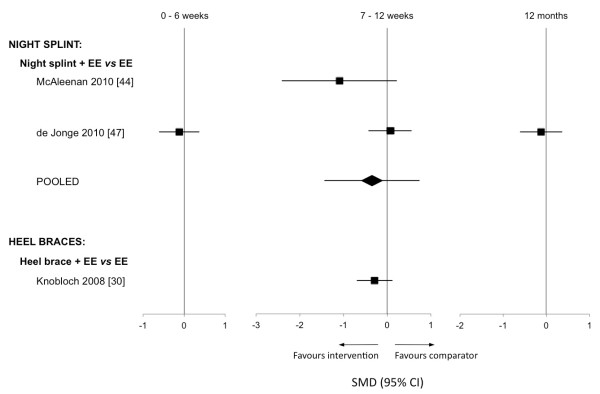
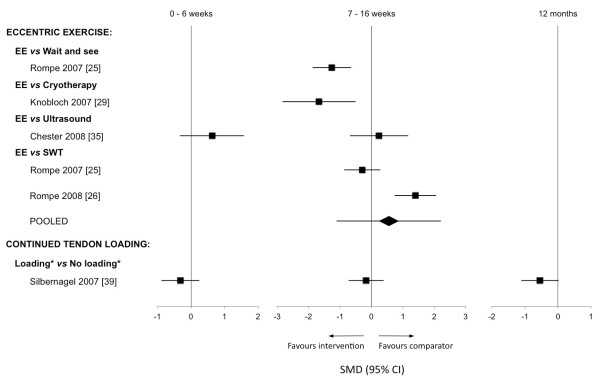
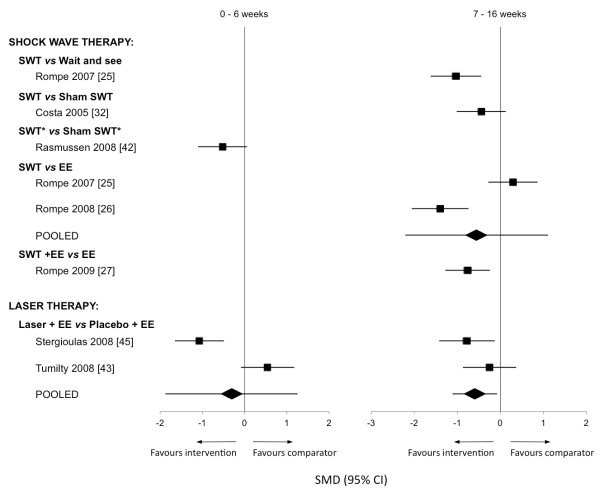
Methodological quality ranged from 2 to 12 (/14). Four studies were excluded due to high risk of bias, leaving 19 studies, the majority of which evaluated midportion AT. Effect sizes from individual RCTs support the use of eccentric exercise. Meta-analyses identified significant effects favouring the addition of laser therapy to eccentric exercise at 12 weeks (pain VAS: standardised mean difference -0.59, 95% confidence interval -1.11 to -0.07), as well as no differences in effect between eccentric exercise and shock wave therapy at 16 weeks (VISA-A:-0.55,-2.21 to 1.11). Pooled data did not support the addition of night splints to eccentric exercise at 12 weeks (VISA-A:-0.35,-1.44 to 0.74). Limited evidence from an individual RCT suggests microcurrent therapy to be an effective intervention.
Practitioners can consider eccentric exercise as an initial intervention for AT, with the addition of laser therapy as appropriate. Shock wave therapy may represent an effective alternative. High-quality RCTs following CONSORT guidelines are required to further evaluate the efficacy of physical therapies and determine optimal clinical pathways for AT.
跟腱病(AT)是一种常见疾病,会导致运动员和非运动员出现相当大的发病率。保守或物理疗法被认为是 AT 的一线治疗方法;然而,尽管研究数量不断增加,但仍然缺乏评估其疗效的高质量研究。以前的系统评价为 AT 的非手术干预提供了初步证据,但缺乏首选报告项目系统评价和荟萃分析(PRISMA)声明中概述的关键质量组成部分。本研究的目的是对 AT 管理的物理治疗进行系统评价和荟萃分析(如果可能的话)。
采用综合策略,从成立到 2011 年 9 月,搜索了 11 个电子数据库。搜索词包括跟腱、腱病、疼痛、物理疗法、电疗和运动(英文全文出版物,人类研究)。合格论文的参考文献也进行了手工搜索。如果至少有一项非药物、非手术干预措施用于 AT,并至少有一项疼痛和/或功能结果,则纳入随机对照试验(RCT)。两名独立审查员筛选了 2852 条搜索结果,确定了 23 项合适的研究,并使用改良 PEDro 量表评估了方法学质量和偏倚风险。效应大小计算和荟萃分析分别基于固定和随机效应模型。
方法学质量从 2 到 12(/14)不等。由于偏倚风险高,有 4 项研究被排除在外,只剩下 19 项研究,其中大多数评估了中段 AT。来自个体 RCT 的效应大小支持使用离心运动。荟萃分析确定了有利于在 12 周时将激光治疗与离心运动联合使用的显著效果(疼痛 VAS:标准化均数差-0.59,95%置信区间-1.11 至-0.07),以及在 16 周时离心运动与冲击波治疗之间无差异(VISA-A:-0.55,-2.21 至 1.11)。汇总数据不支持在 12 周时将夜间夹板添加到离心运动中(VISA-A:-0.35,-1.44 至 0.74)。来自单个 RCT 的有限证据表明,微电流疗法是一种有效的干预措施。
从业者可以考虑将离心运动作为 AT 的初始干预措施,并根据需要添加激光治疗。冲击波治疗可能是一种有效的替代方法。需要遵循 CONSORT 指南的高质量 RCT 来进一步评估物理疗法的疗效,并确定 AT 的最佳临床途径。