Biocenter, University of Cologne, Zülpicher Strasse 47b, Cologne, 50674, Germany.
Evodevo. 2012 Jul 2;3(1):13. doi: 10.1186/2041-9139-3-13.
Recent studies have challenged the widespread view that the pattern of embryogenesis found in Caenorhabditis elegans (clade 9) is characteristic of nematodes in general. To understand this still largely unexplored landscape of developmental events, we set out to examine more distantly related nematodes in detail for temporospatial differences in pattern formation and cell specification. Members of the genus Plectus (clade 6) seem to be suitable candidates to show variety, with certain idiosyncratic features during early development and the convenient availability of cultivatable species.
The study was conducted using 4-D lineage analysis, 3-D modeling of developing embryos and laser-induced ablation of individual blastomeres.
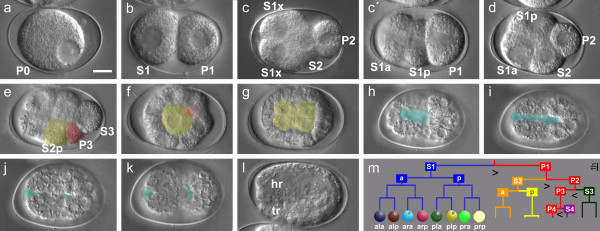
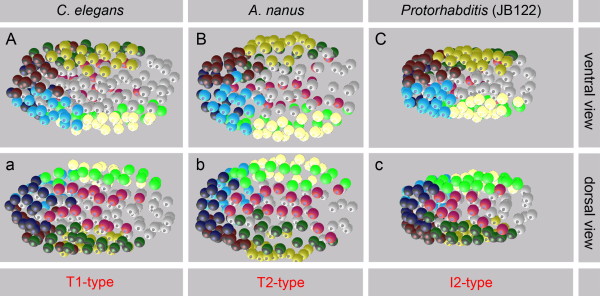
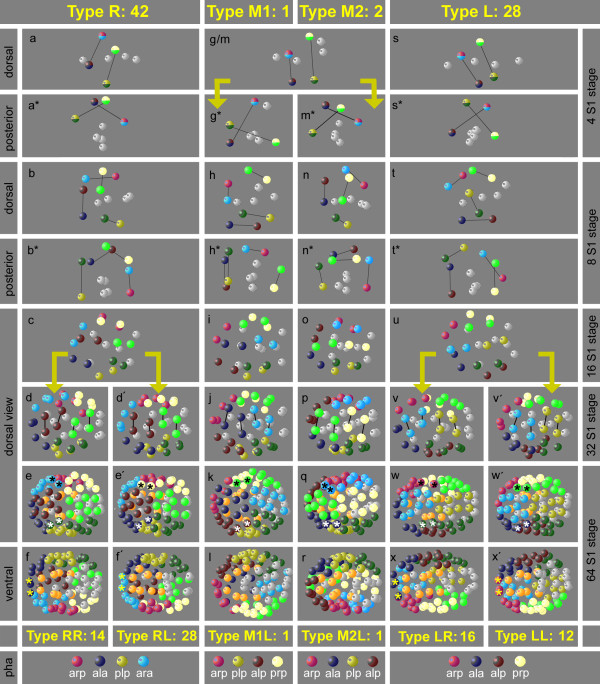
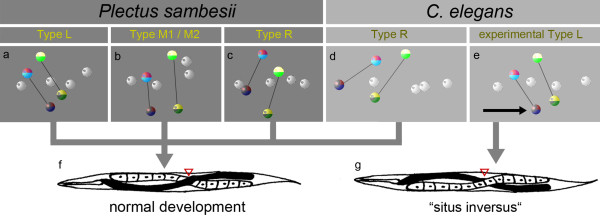
Detailed cell lineage studies of several Plectus species reveal that pattern formation and cell fate assignment differ markedly from C. elegans. Descendants of the first somatic founder cell S1 (AB) - but not the progeny of other founder cells - demonstrate extremely variable spatial arrangements illustrating that here distinct early cell-cell interactions between invariant partners, as found in C. elegans, cannot take place. Different from C. elegans, in Plectus alternative positional variations among early S1 blastomeres resulting in a 'situs inversus' pattern, nevertheless give rise to adults with normal left-right asymmetries. In addition, laser ablations of early blastomeres uncover inductions between variable cell partners.
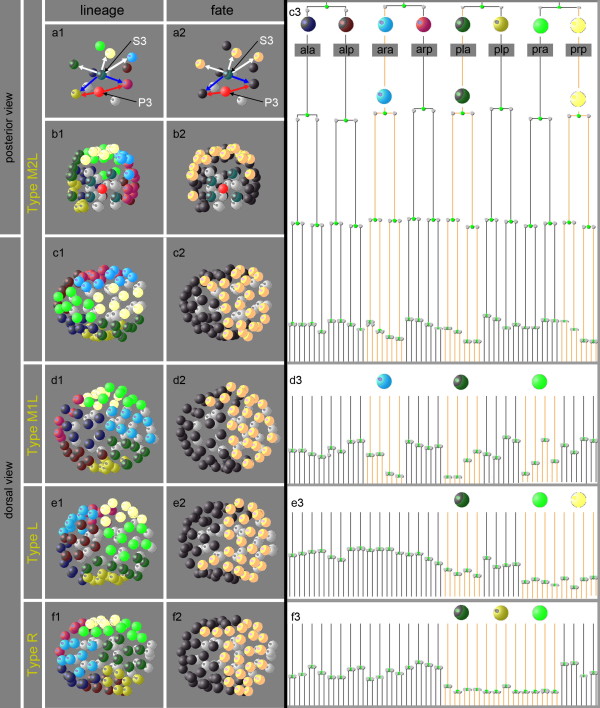
Our results suggest that embryonic cell specification in Plectus is not correlated with cell lineage but with position. With this peculiarity, Plectus appears to occupy an intermediate position between basal nematodes displaying a variable early development and the C. elegans-like invariant pattern. We suggest that indeterminate pattern formation associated with late, position-dependent fate assignment represents a plesiomorphic character among nematodes predominant in certain basal clades but lost in derived clades. Thus, the behavior of S1 cells in Plectus can be considered an evolutionary relict in a transition phase between two different developmental strategies.
最近的研究挑战了广泛存在的观点,即秀丽隐杆线虫(第 9 分支)中发现的胚胎发生模式是线虫的普遍特征。为了了解这个在很大程度上尚未探索的发育事件领域,我们着手详细研究更为遥远相关的线虫,以了解其在形态发生和细胞特化方面的时空差异。Plectus 属(第 6 分支)的成员似乎是展示多样性的合适候选者,它们在早期发育过程中具有某些特殊特征,并且可以方便地获得可培养的物种。
该研究使用了 4-D 谱系分析、发育中胚胎的 3-D 建模和单个卵裂球的激光诱导消融。
对几种 Plectus 物种的详细细胞谱系研究表明,形态发生和细胞命运分配与秀丽隐杆线虫明显不同。第一个体腔创始细胞 S1(AB)的后代 - 而不是其他创始细胞的后代 - 表现出极其可变的空间排列,表明在这里,与秀丽隐杆线虫中发现的不变伙伴之间的早期细胞 - 细胞相互作用不能发生。与秀丽隐杆线虫不同的是,在 Plectus 中,早期 S1 卵裂球之间的替代位置变化导致“反位”模式,但仍会产生具有正常左右不对称性的成虫。此外,早期卵裂球的激光消融揭示了可变细胞伙伴之间的诱导作用。
我们的结果表明,Plectus 的胚胎细胞特化与细胞谱系无关,而是与位置有关。具有这种特殊性,Plectus 似乎处于显示可变早期发育的基础线虫和类似于秀丽隐杆线虫的不变模式之间的中间位置。我们认为,与位置相关的晚期命运分配相关的不定形态发生代表了线虫中的一个祖征特征,在某些基础分支中占主导地位,但在衍生分支中丢失。因此,Plectus 中 S1 细胞的行为可以被认为是两种不同发育策略之间的过渡阶段的进化遗迹。