Department of Family Medicine and Community Health, Case Comprehensive Cancer Center, Case Western Reserve University, 10900 Euclid Ave., Cleveland, OH 44106, USA.
Breast Cancer Res Treat. 2012 Aug;134(3):1291-5. doi: 10.1007/s10549-012-2144-z. Epub 2012 Jul 3.
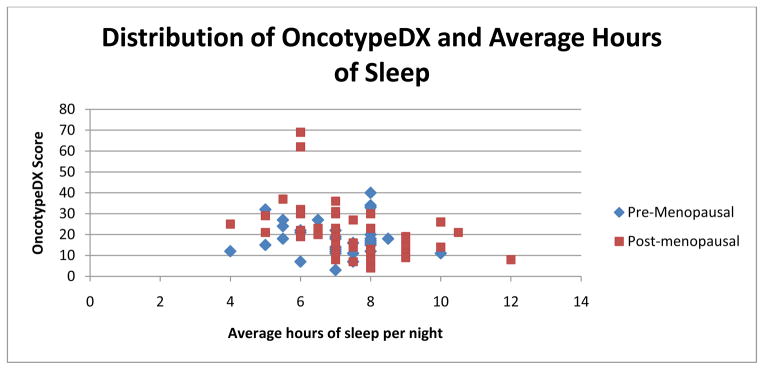
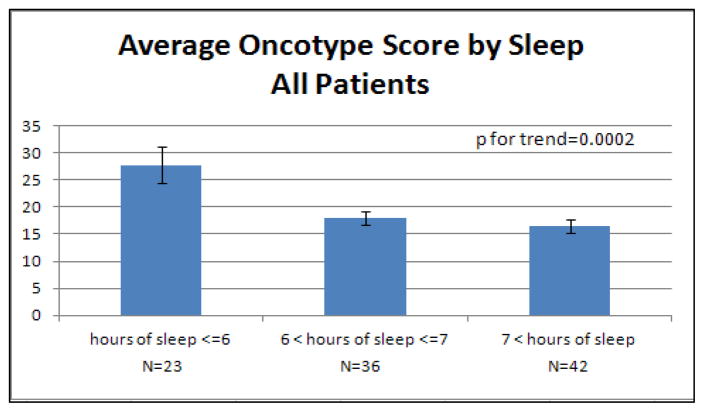
Shorter duration of sleep has been associated with risk of a number of medical conditions, including breast cancer. However, no prior study has investigated the relationship of average sleep duration before diagnosis and cancer aggressiveness. OncotypeDX is a widely utilized test to guide treatment in early stage hormone receptor positive breast cancer by predicting likelihood of recurrence. We reviewed medical records from ER+ early stage breast cancer patients participating in a case-control study for availability of OncotypeDX scores. All patients in the parent study were recruited at diagnosis and asked about average sleep duration in the 2 years before diagnosis. We analyzed data from 101 breast cancer patients with available OncotypeDX recurrence scores to test the hypothesis that shorter sleep is associated with greater likelihood of recurrence. We found that OncotypeDX recurrence scores were strongly correlated with average hours of sleep per night before breast cancer diagnosis, with fewer hours of sleep associated with a higher (worse) recurrence score (R = -0.30, p = 0.0031). This correlation was limited to post-menopausal breast cancer patients only (R = -0.41, p = 0.0011, for postmenopausal patients; R = -0.05, p = 0.80 for pre-menopausal patients). This association remains statistically significant after adjustment for age, physical activity, smoking status, and body mass index in the entire study sample (p = 0.0058) as well as in postmenopausal patients (p = 0.0021). This is the first study to suggest that women who routinely sleep fewer hours may develop more aggressive breast cancers compared with women who sleep longer hours.
睡眠时间较短与许多医疗状况的风险有关,包括乳腺癌。然而,以前没有研究调查过诊断前平均睡眠时间与癌症侵袭性之间的关系。OncotypeDX 是一种广泛用于指导早期激素受体阳性乳腺癌治疗的测试,通过预测复发的可能性来指导治疗。我们回顾了参与病例对照研究的 ER+早期乳腺癌患者的病历,以获取 OncotypeDX 评分的可用性。母研究中的所有患者均在诊断时招募,并询问诊断前 2 年的平均睡眠时间。我们分析了 101 名具有可用 OncotypeDX 复发评分的乳腺癌患者的数据,以检验睡眠时间较短与复发可能性增加相关的假设。我们发现,OncotypeDX 复发评分与乳腺癌诊断前每晚平均睡眠时间密切相关,睡眠时间越少,复发评分越高(越差)(R = -0.30,p = 0.0031)。这种相关性仅局限于绝经后乳腺癌患者(绝经后患者 R = -0.41,p = 0.0011;绝经前患者 R = -0.05,p = 0.80)。在整个研究样本中,经过年龄、体力活动、吸烟状况和体重指数调整后,这种相关性仍然具有统计学意义(p = 0.0058),在绝经后患者中,这种相关性仍然具有统计学意义(p = 0.0021)。这是第一项表明与睡眠时间较长的女性相比,常规睡眠时间较短的女性可能会发展出侵袭性更强的乳腺癌的研究。