School of Physiology and Pharmacology, Medical Sciences Building, University of Bristol, Bristol BS8 1TD, UK.
J Physiol. 2012 Oct 1;590(19):4691-705. doi: 10.1113/jphysiol.2012.238485. Epub 2012 Jul 2.
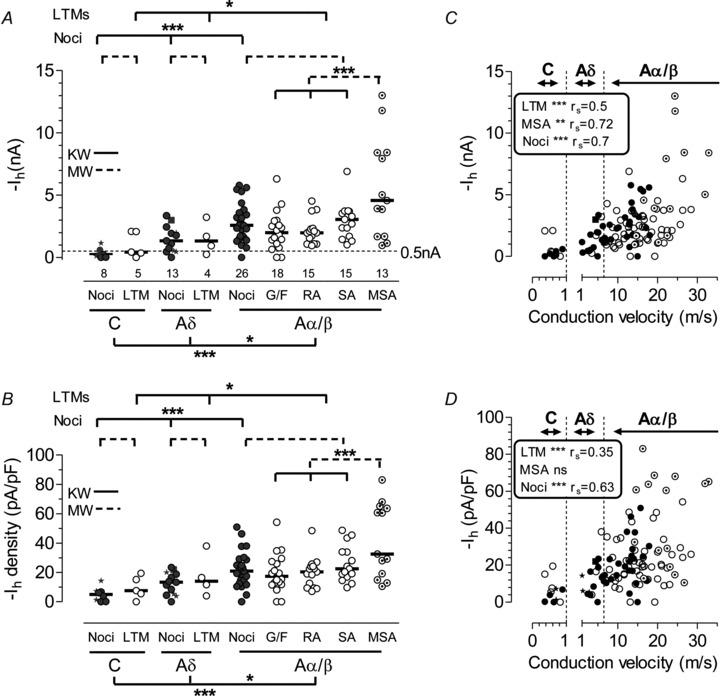
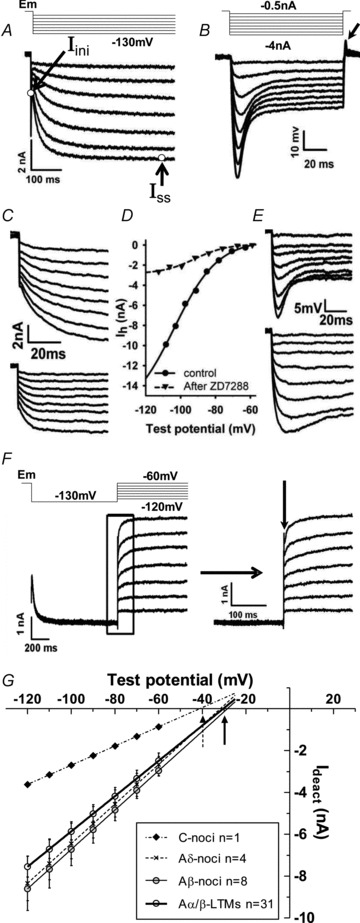
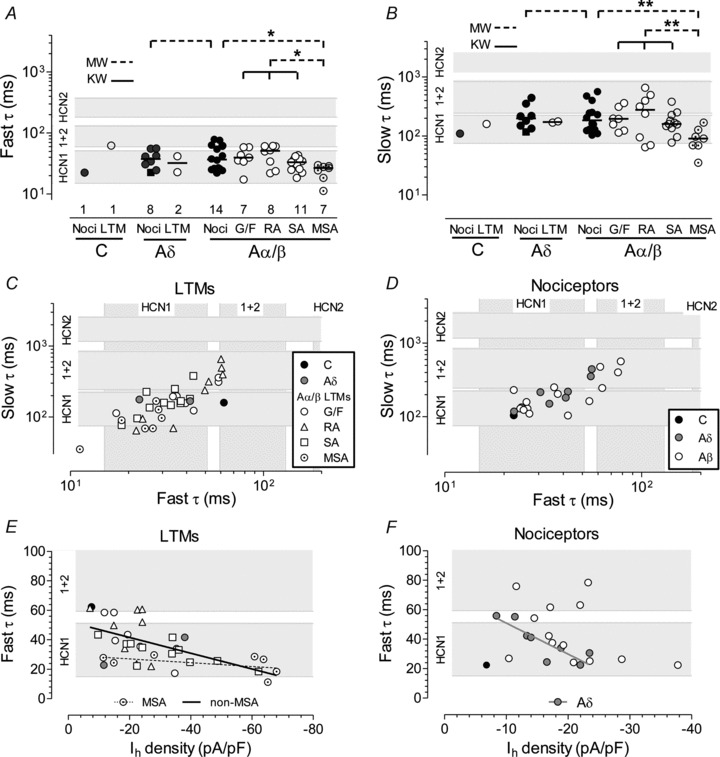
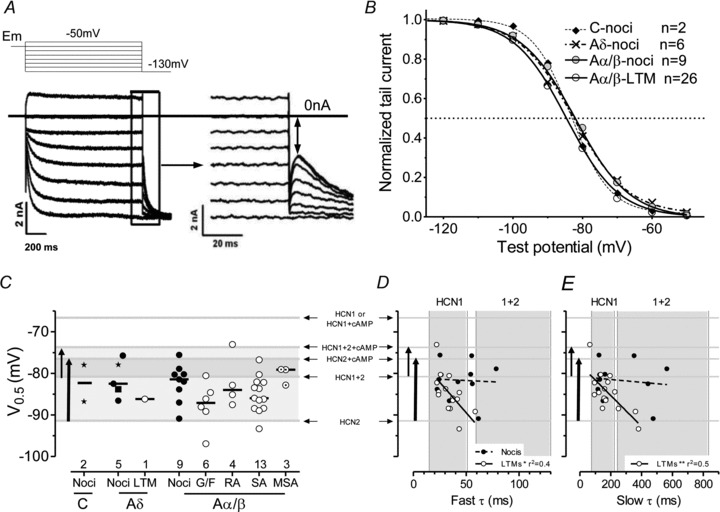
The hyperpolarization-activated current (I(h)) has been implicated in nociception/pain, but its expression levels in nociceptors remained unknown. We recorded I(h) magnitude and properties by voltage clamp from dorsal root ganglion (DRG) neurons in vivo, after classifying them as nociceptive or low-threshold-mechanoreceptors (LTMs) and as having C-, Aδ- or Aα/β-conduction velocities (CVs). For both nociceptors andLTMs, I(h) amplitude and I(h) density (at -100 mV) were significantly positively correlated with CV.Median I(h) magnitudes and I(h) density in neuronal subgroupswere respectively:muscle spindle afferents(MSAs):-4.6 nA,-33 pA pF(-1); cutaneous Aα/β LTMs: -2.2 nA, -20 pA pF(-1); Aβ-nociceptors: -2.6 nA, -21 pA pF(-1); both Aδ-LTMs and nociceptors: -1.3 nA, ∼-14 pA pF(-1); C-LTMs: -0.4 nA, -7.6 pA pF(-1); and C-nociceptors: -0.26 nA, -5 pApF(-1). I(h) activation slow time constants (slow τ values) were strongly correlated with fast τ values; both were shortest in MSAs. Most neurons had τ values consistent with HCN1-related I(h); others had τ values closer to HCN1+HCN2 channels, or HCN2 in the presence of cAMP. In contrast, median half-activation voltages (V(0.5)) of -80 to -86 mV for neuronal subgroups suggest contributions of HCN2 to I(h). τ values were unrelated to CV but were inversely correlated with I(h) and I(h) density for all non-MSA LTMs, and for Aδ-nociceptors. From activation curves ∼2-7% of I(h)would be activated at normal membrane potentials. The high I(h) may be important for excitability of A-nociceptors (responsible for sharp/pricking-type pain) and Aα/β-LTMs (tactile sensations and proprioception). Underlying HCN expression in these subgroups therefore needs to be determined. Altered high I(h) may be important for excitability of A-nociceptors (responsible for sharp/pricking-type pain) and Aα/β-LTMs (tactile sensations and proprioception). Underlying HCN expression in these subgroups therefore needs to be determined. Altered Ih expression and/or properties (e.g. in chronic/pathological pain states) may influence both nociceptor and LTM excitability.expression and/or properties (e.g. in chronic/pathological pain states) may influence both nociceptor and LTM excitability.
超极化激活电流 (I(h)) 已被牵涉到伤害感受/疼痛中,但在伤害感受器中其表达水平仍不清楚。我们通过在体记录背根神经节 (DRG) 神经元的电压钳来记录 I(h) 的幅度和特性,这些神经元被分类为伤害感受器或低阈值机械感受器 (LTM),并具有 C-、Aδ-或 Aα/β-传导速度 (CV)。对于伤害感受器和 LTM 来说,I(h) 幅度和 I(h) 密度(在 -100 mV 时)与 CV 呈显著正相关。神经元亚群的中位数 I(h) 幅度和 I(h) 密度分别为:肌梭传入纤维 (MSAs):-4.6 nA,-33 pA pF(-1);皮肤 Aα/β LTMs:-2.2 nA,-20 pA pF(-1);Aβ-伤害感受器:-2.6 nA,-21 pA pF(-1);Aδ-LTMs 和伤害感受器:-1.3 nA,约-14 pA pF(-1);C-LTMs:-0.4 nA,-7.6 pA pF(-1);C-伤害感受器:-0.26 nA,-5 pApF(-1)。I(h) 激活慢时间常数(慢 τ 值)与快 τ 值强烈相关;MSAs 中的 τ 值最短。大多数神经元的 τ 值与 HCN1 相关的 I(h) 一致;其他神经元的 τ 值更接近 HCN1+HCN2 通道,或在 cAMP 存在下的 HCN2。相比之下,神经元亚群的中位数半激活电压 (V(0.5)) 为-80 至-86 mV,表明 HCN2 对 I(h) 的贡献。τ 值与 CV 无关,但与所有非 MSA LTMs 和 Aδ-伤害感受器的 I(h) 和 I(h) 密度呈负相关。在激活曲线上,约 2-7%的 I(h) 在正常膜电位下会被激活。高 I(h) 可能对 A 伤害感受器(负责锐痛/刺痛型疼痛)和 Aα/β-LTMs(触觉和本体感觉)的兴奋性很重要。因此,需要确定这些亚群中 HCN 的表达情况。改变的高 I(h) 可能对 A 伤害感受器(负责锐痛/刺痛型疼痛)和 Aα/β-LTMs(触觉和本体感觉)的兴奋性很重要。因此,需要确定这些亚群中 HCN 的表达情况。改变的 Ih 表达和/或特性(例如在慢性/病理性疼痛状态下)可能会影响伤害感受器和 LTM 的兴奋性。