Department of Epidemiology, University of Michigan, Ann Arbor, Michigan, United States of America.
PLoS Comput Biol. 2012;8(6):e1002552. doi: 10.1371/journal.pcbi.1002552. Epub 2012 Jun 28.
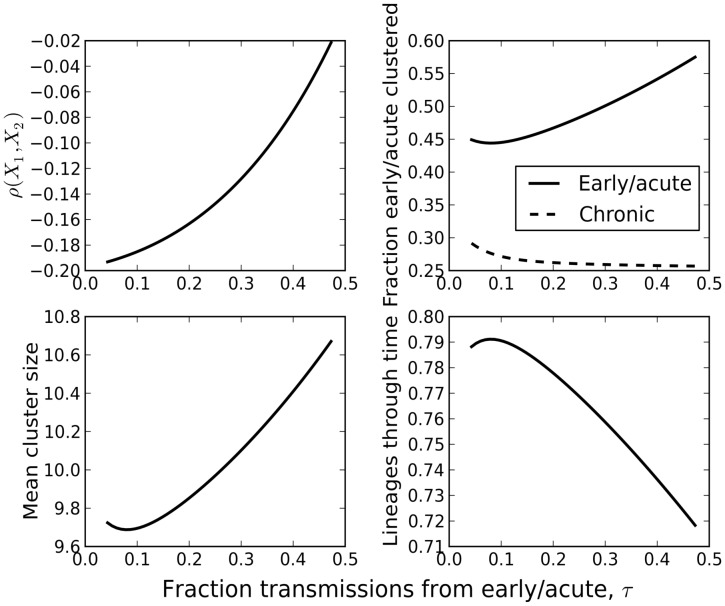
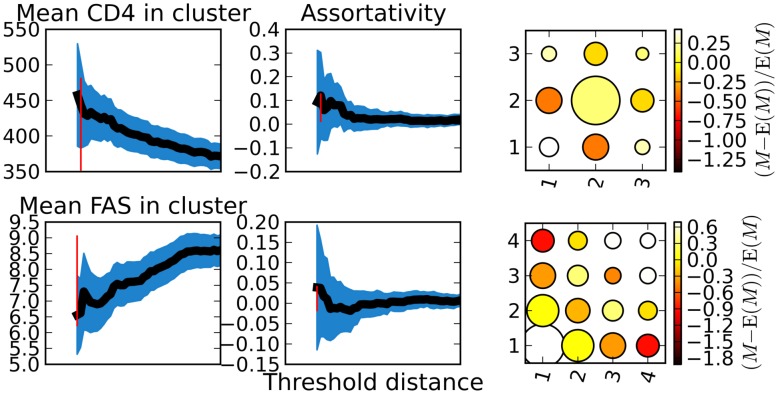
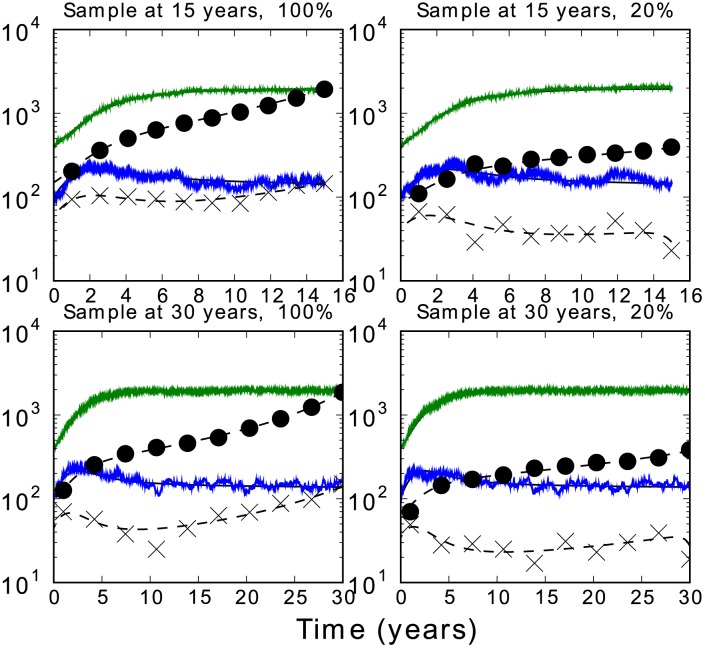
Phylogenies of highly genetically variable viruses such as HIV-1 are potentially informative of epidemiological dynamics. Several studies have demonstrated the presence of clusters of highly related HIV-1 sequences, particularly among recently HIV-infected individuals, which have been used to argue for a high transmission rate during acute infection. Using a large set of HIV-1 subtype B pol sequences collected from men who have sex with men, we demonstrate that virus from recent infections tend to be phylogenetically clustered at a greater rate than virus from patients with chronic infection ('excess clustering') and also tend to cluster with other recent HIV infections rather than chronic, established infections ('excess co-clustering'), consistent with previous reports. To determine the role that a higher infectivity during acute infection may play in excess clustering and co-clustering, we developed a simple model of HIV infection that incorporates an early period of intensified transmission, and explicitly considers the dynamics of phylogenetic clusters alongside the dynamics of acute and chronic infected cases. We explored the potential for clustering statistics to be used for inference of acute stage transmission rates and found that no single statistic explains very much variance in parameters controlling acute stage transmission rates. We demonstrate that high transmission rates during the acute stage is not the main cause of excess clustering of virus from patients with early/acute infection compared to chronic infection, which may simply reflect the shorter time since transmission in acute infection. Higher transmission during acute infection can result in excess co-clustering of sequences, while the extent of clustering observed is most sensitive to the fraction of infections sampled.
高度遗传变异的病毒(如 HIV-1)的系统发生关系可能有助于了解流行病学动态。多项研究表明,存在高度相关的 HIV-1 序列簇,尤其是在近期感染 HIV 的个体中,这支持了在急性感染期间高传播率的说法。利用从男男性行为者中收集的大量 HIV-1 亚型 B pol 序列,我们证明,近期感染的病毒在系统发生上聚类的速度比慢性感染患者的病毒更快(“过度聚类”),并且倾向于与其他近期 HIV 感染而不是慢性、已建立的感染聚类(“过度共同聚类”),这与之前的报告一致。为了确定急性感染期间更高的传染性在过度聚类和共同聚类中可能起的作用,我们开发了一种 HIV 感染的简单模型,该模型包含一个强化传播的早期阶段,并明确考虑了系统发生聚类的动态以及急性和慢性感染病例的动态。我们探讨了聚类统计数据用于推断急性阶段传播率的潜力,发现没有一个单一的统计数据可以解释控制急性阶段传播率的参数的很大差异。我们证明,与慢性感染相比,急性感染患者的病毒过度聚类并不是急性阶段高传播率的主要原因,这可能只是反映了急性感染中传播的时间较短。急性感染期间更高的传播率可能导致序列的过度共同聚类,而观察到的聚类程度对抽样感染的比例最敏感。