Brenchat Alex, Rocasalbas Maria, Zamanillo Daniel, Hamon Michel, Vela José Miguel, Romero Luz
Department of Pharmacology, Drug Discovery and Preclinical Development, ESTEVE, Avenida Mare de Déu de Montserrat 221, 08041 Barcelona, Spain.
Adv Pharmacol Sci. 2012;2012:312041. doi: 10.1155/2012/312041. Epub 2012 Jun 19.
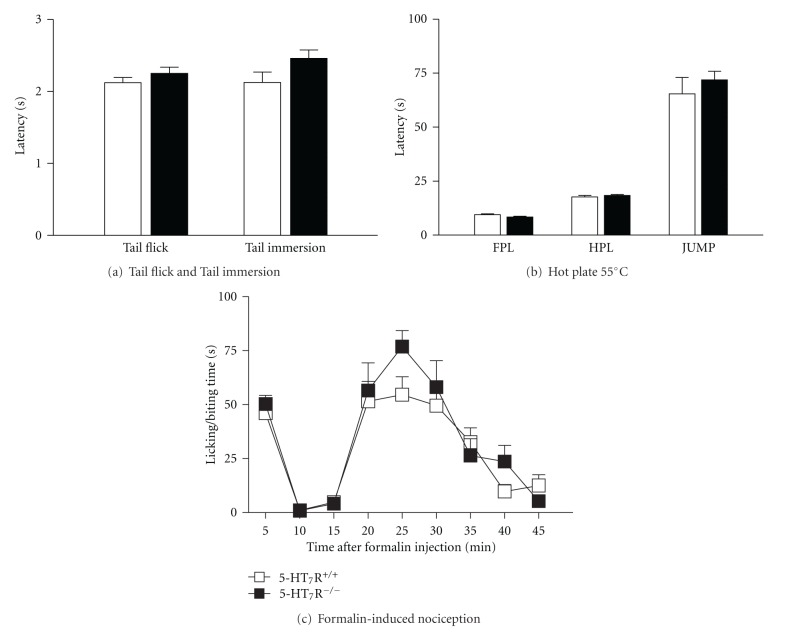
No study has ever examined the effect of 5-HT(7) receptor agonists on nociception by using 5-HT(7) receptor knockout mice. Basal sensitivity to noxious heat stimuli and formalin-induced nociception in both phase I and II of the formalin test did not differ in 5-HT(7) receptor knockout mice and paired wild-type controls. Similarly, there was no significant difference in basal body temperature between both genotypes. Subcutaneous administration of 5-HT(7) receptor agonists AS-19 (10 mg/kg), E-57431 (10 mg/kg), and E-55888 (20 mg/kg) significantly reduced formalin-induced licking/biting behavior during the phase II of the test in wild-type but not in 5-HT(7) receptor knockout mice. At these active analgesic doses, none of the three 5-HT(7) receptor agonists modified the basal body temperature neither in wild-type nor in 5-HT(7) receptor knockout mice. However, a significant decrease in body temperature was observed at a higher dose (20 mg/kg) of AS-19 and E-57431 in both genotypes. Our data strongly suggest that the 5-HT(7) receptor agonists AS-19, E-57431, and E-55888 produce antinociception in the formalin test by activating 5-HT(7) receptors. These results also strengthen the idea that the 5-HT(7) receptor plays a role in thermoregulation, but by acting in concert with other receptors.
尚无研究通过使用5-HT(7)受体基因敲除小鼠来检测5-HT(7)受体激动剂对伤害感受的影响。在福尔马林试验的第一阶段和第二阶段,5-HT(7)受体基因敲除小鼠和配对的野生型对照小鼠对有害热刺激的基础敏感性以及福尔马林诱导的伤害感受并无差异。同样,两种基因型小鼠的基础体温也无显著差异。皮下注射5-HT(7)受体激动剂AS-19(10毫克/千克)、E-57431(10毫克/千克)和E-55888(20毫克/千克)可显著降低野生型小鼠在试验第二阶段福尔马林诱导的舔舐/咬啮行为,但对5-HT(7)受体基因敲除小鼠则无此作用。在这些产生有效镇痛作用的剂量下,三种5-HT(7)受体激动剂均未改变野生型小鼠和5-HT(7)受体基因敲除小鼠的基础体温。然而,在两种基因型小鼠中,较高剂量(20毫克/千克)的AS-19和E-57431均观察到体温显著下降。我们的数据有力地表明,5-HT(7)受体激动剂AS-19、E-57431和E-55888在福尔马林试验中通过激活5-HT(7)受体产生抗伤害感受作用。这些结果也强化了5-HT(7)受体在体温调节中发挥作用,但需与其他受体协同作用的观点。