Department of Pharmacology and Cancer Biology, Duke University Medical Center, Durham, North Carolina, United States of America.
PLoS One. 2012;7(6):e38085. doi: 10.1371/journal.pone.0038085. Epub 2012 Jun 27.
Scythe/BAT3 is a member of the BAG protein family whose role in apoptosis has been extensively studied. However, since the developmental defects observed in Bat3-null mouse embryos cannot be explained solely by defects in apoptosis, we investigated whether BAT3 is also involved in cell-cycle progression.
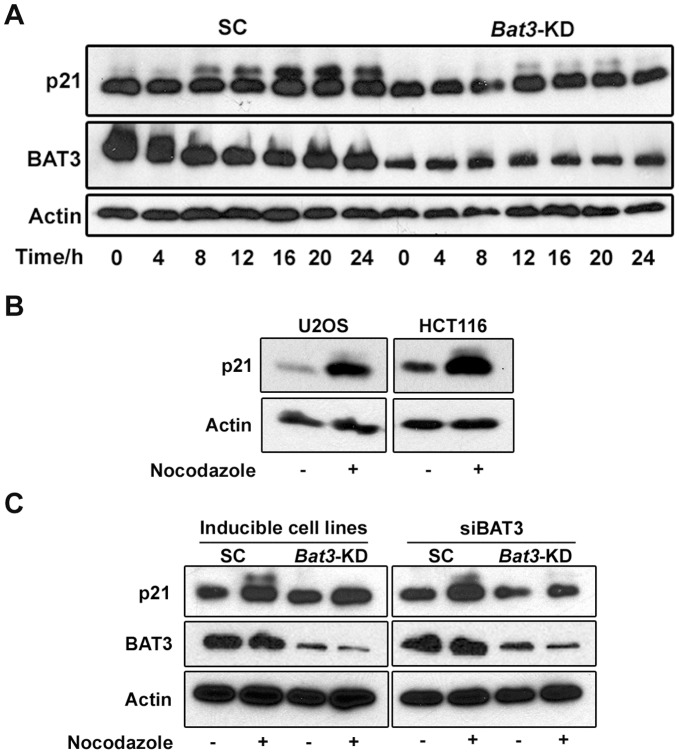
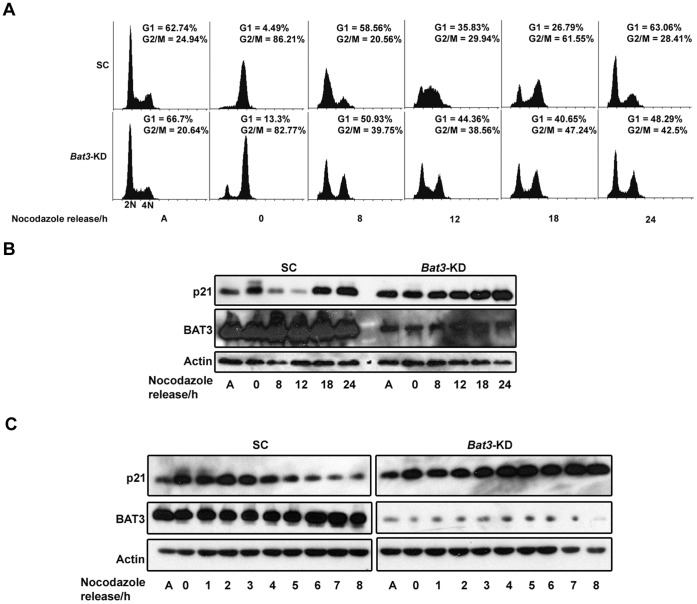
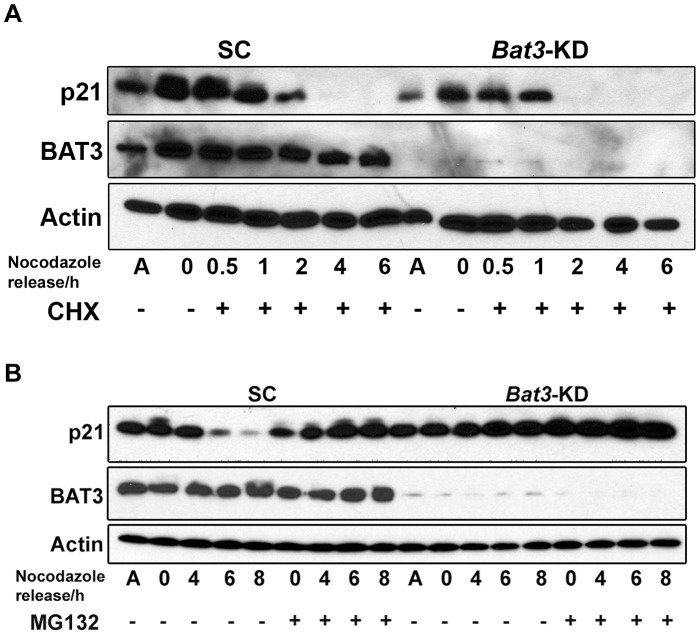
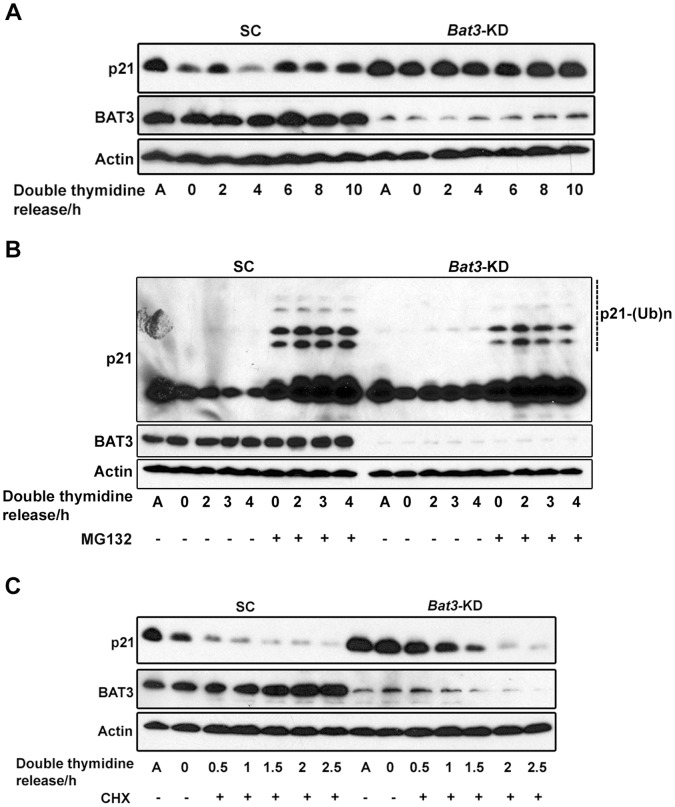
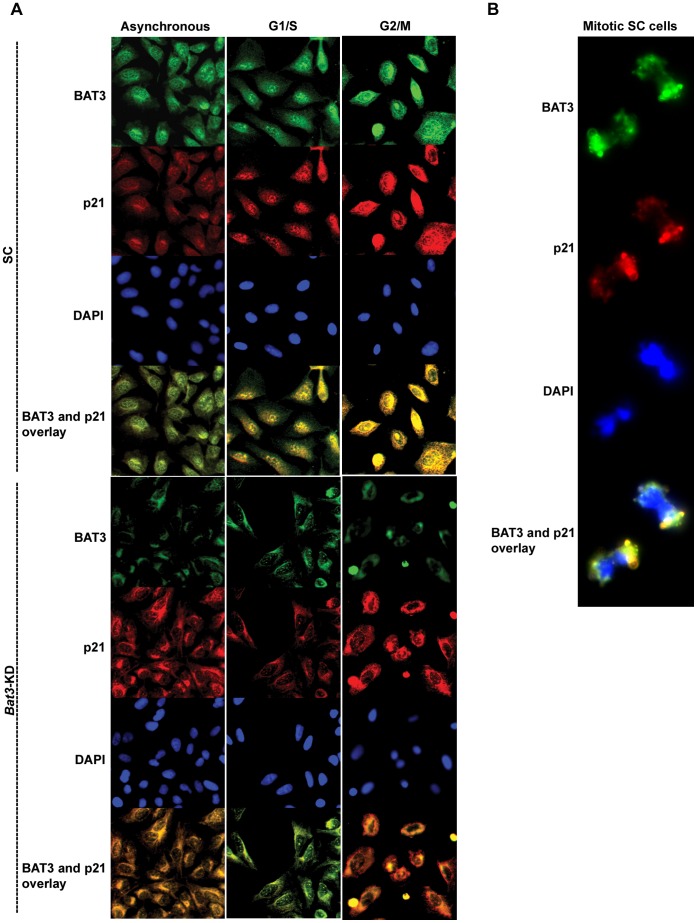
METHODS/PRINCIPAL FINDINGS: Using a stable-inducible Bat3-knockdown cellular system, we demonstrated that reduced BAT3 protein level causes a delay in both G1/S transition and G2/M progression. Concurrent with these changes in cell-cycle progression, we observed a reduction in the turnover and phosphorylation of the CDK inhibitor p21, which is best known as an inhibitor of DNA replication; however, phosphorylated p21 has also been shown to promote G2/M progression. Our findings indicate that in Bat3-knockdown cells, p21 continues to be synthesized during cell-cycle phases that do not normally require p21, resulting in p21 protein accumulation and a subsequent delay in cell-cycle progression. Finally, we showed that BAT3 co-localizes with p21 during the cell cycle and is required for the translocation of p21 from the cytoplasm to the nucleus during the G1/S transition and G2/M progression.
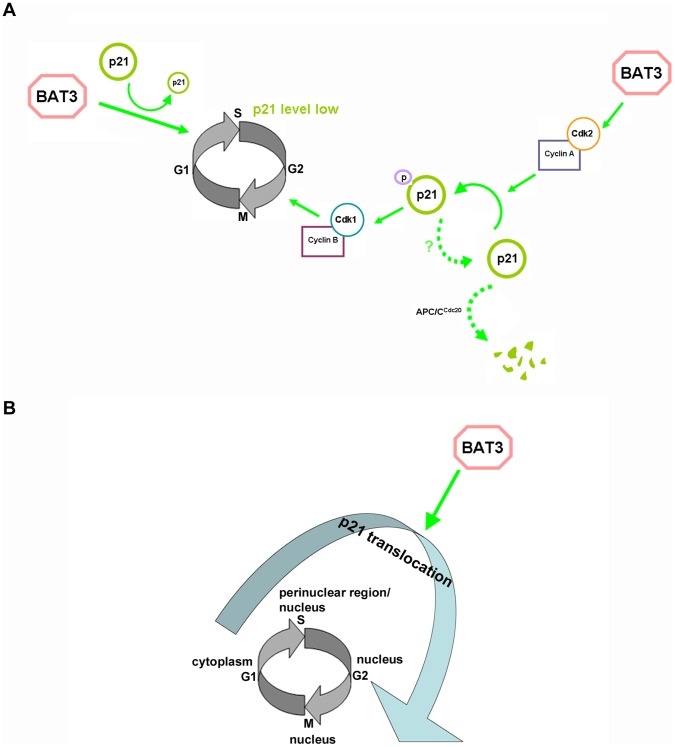
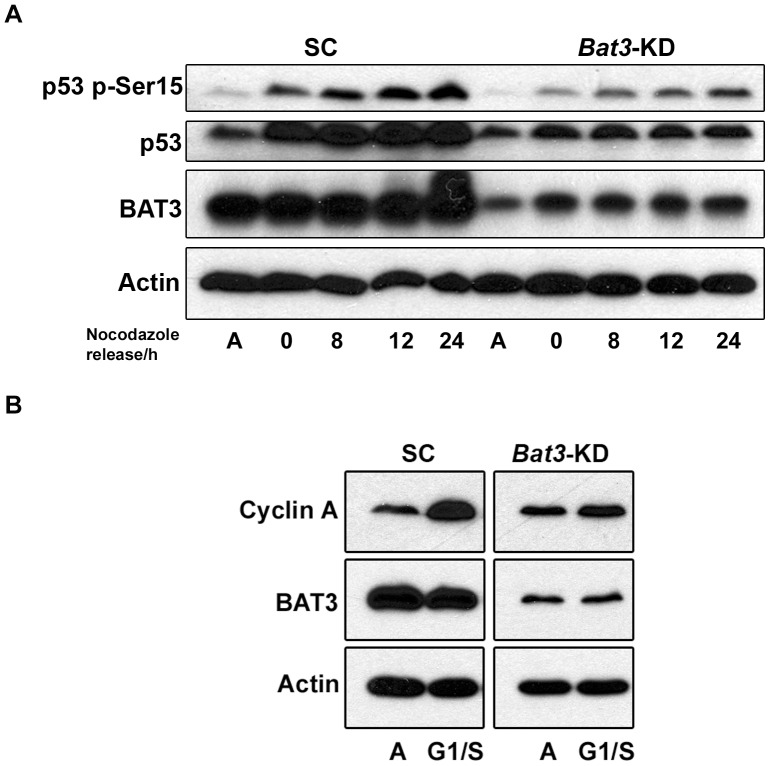
Our study reveals a novel, non-apoptotic role for BAT3 in cell-cycle regulation. By maintaining a low p21 protein level during the G1/S transition, BAT3 counteracts the inhibitory effect of p21 on DNA replication and thus enables the cells to progress from G1 to S phase. Conversely, during G2/M progression, BAT3 facilitates p21 phosphorylation by cyclin A/Cdk2, an event required for G2/M progression. BAT3 modulates these pro- and anti-proliferative roles of p21 at least in part by regulating cyclin A abundance, as well as p21 translocation between the cytoplasm and the nucleus to ensure that it functions in the appropriate intracellular compartment during each phase of the cell cycle.
Scythe/BAT3 是 BAG 蛋白家族的成员,其在细胞凋亡中的作用已得到广泛研究。然而,由于 Bat3 基因敲除小鼠胚胎中观察到的发育缺陷不能仅用凋亡缺陷来解释,我们研究了 BAT3 是否也参与细胞周期进程。
方法/主要发现:使用稳定诱导的 Bat3 敲低细胞系,我们证明 BAT3 蛋白水平降低会导致 G1/S 期转换和 G2/M 期进展延迟。与细胞周期进程的这些变化同时发生,我们观察到 CDK 抑制剂 p21 的周转率和磷酸化减少,p21 是众所周知的 DNA 复制抑制剂;然而,磷酸化的 p21 也被证明能促进 G2/M 期进展。我们的研究结果表明,在 Bat3 敲低的细胞中,p21 在通常不需要 p21 的细胞周期阶段继续合成,导致 p21 蛋白积累,随后细胞周期进程延迟。最后,我们表明,BAT3 在细胞周期中与 p21 共定位,并且在 G1/S 期转换和 G2/M 期进展过程中 p21 从细胞质向核内易位需要 BAT3。
我们的研究揭示了 BAT3 在细胞周期调控中的一个新的非凋亡作用。通过在 G1/S 期转换过程中维持低水平的 p21 蛋白,BAT3 抵消了 p21 对 DNA 复制的抑制作用,从而使细胞能够从 G1 期进入 S 期。相反,在 G2/M 期进展过程中,BAT3 通过 cyclin A/Cdk2 促进 p21 的磷酸化,这是 G2/M 期进展所必需的。BAT3 通过调节 cyclin A 丰度以及 p21 在细胞质和核之间的易位来调节 p21 的这些促有丝分裂和抗有丝分裂作用,以确保它在细胞周期的每个阶段在适当的细胞内隔室中发挥作用。