Shahrabi Farahani Mahboube, Mohsenzadegan Monireh, Taeb Jaleh, Farajollahi Mohammad M
Department of Medical Biotechnology, Faculty of Allied Medical Sciences, Iran University of Medical Sciences, Tehran, Iran.
Department of Medical Laboratory Science, Faculty of Allied Medical Sciences, Iran University of Medical Sciences, Tehran, Iran.
Med J Islam Repub Iran. 2019 Mar 12;33:16. doi: 10.34171/mjiri.33.16. eCollection 2019.
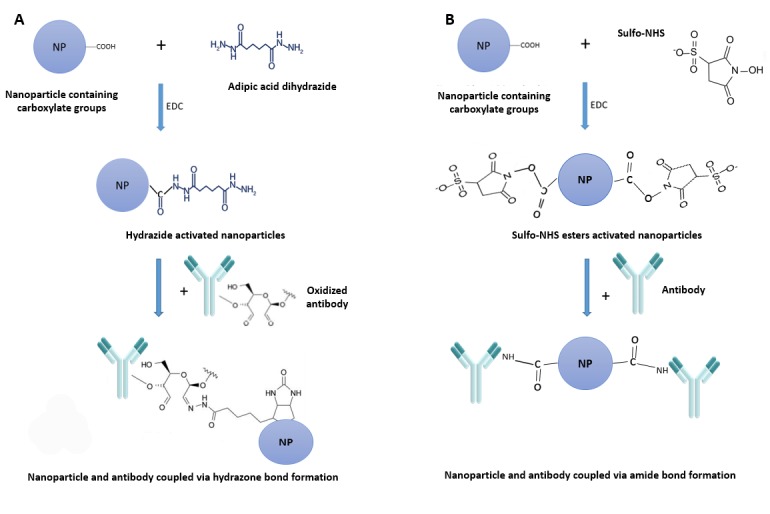
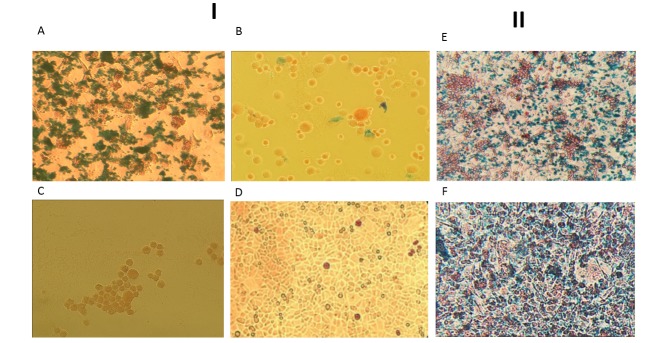
The main property of a successful conjugation of antibodies to nanoparticles is keeping the potency of antibody for binding the antigen, and an oriented conjugation can do that. Under such ground, this study was carried out to explore the efficiency of two conjugation methods in binding iron nanoparticles to an antibody produced against PSCA (prostate stem cell antigen) using in vitro labeling of PC3 cells. In this experimental study, we conjugated dextran-superparamagnetic iron oxide nanoparticles (dexSPIONs) to anti-PSCA antibody by two different methods, including targeting carbohydrate moieties in FC domain and the free amine group of amino acid side chains. Ultimately, Iron staining was done by anti-PSCA antibody-dexSPIONs in PC3 cells to detect antibody binding to the cells. A strong blue dye was induced by iron staining in conjugated dexSPIONs on the membrane of PC3 cells by the former method than the second one. Moreover, cells treated with 20 nm diameters of dexSPIONs showed higher resolution of blue color than those treated with 100 nm nanoparticles. This oriented conjugation method promoted the efficiency of targeting tumor antigens, and the presence of iron particles might enhance MRI image intensity in vivo by targeting PSCA-overexpressing cells in future studies.
抗体与纳米颗粒成功偶联的主要特性是保持抗体结合抗原的能力,而定向偶联能够做到这一点。基于此,本研究通过对PC3细胞进行体外标记,探讨了两种偶联方法将铁纳米颗粒与抗前列腺干细胞抗原(PSCA)抗体结合的效率。在本实验研究中,我们通过两种不同方法将葡聚糖-超顺磁性氧化铁纳米颗粒(dexSPIONs)与抗PSCA抗体偶联,这两种方法分别是靶向Fc结构域中的碳水化合物部分以及氨基酸侧链的游离胺基。最终,通过抗PSCA抗体-dexSPIONs对PC3细胞进行铁染色,以检测抗体与细胞的结合情况。与后一种方法相比,前一种方法在PC3细胞膜上偶联的dexSPIONs铁染色诱导出更强的蓝色染料。此外,用直径20nm的dexSPIONs处理的细胞比用100nm纳米颗粒处理的细胞显示出更高的蓝色分辨率。这种定向偶联方法提高了靶向肿瘤抗原的效率,并且在未来的研究中,铁颗粒的存在可能通过靶向PSCA过表达细胞增强体内MRI图像强度。