Centre for the Study of the Social and Environmental Determinants of Nutrition, Population Health, Health Systems and Innovation, Human Sciences Research Council, Private Bag X9182, Cape Town, 8000, South Africa.
BMC Public Health. 2012 Jul 4;12:503. doi: 10.1186/1471-2458-12-503.
Due to a paucity of data regarding the availability and efficacy of equipment, health promotion methods and materials currently used by health professionals for the management of patients with non-communicable diseases (NCDs) at primary health care (PHC) facilities in Cape Town, an audit was undertaken.
A multi-centre cross-sectional study was undertaken to interview patients (n = 580) with NCDs at 30 PHC facilities. A questionnaire was used to obtain information on preferences for health promotion methods for lifestyle modification. Individual semi-structured interviews were conducted with selected health professionals (n = 14) and captured using a digital recorder. Data were transferred to the Atlas ti software programme and analysed using a thematic content analysis approach.
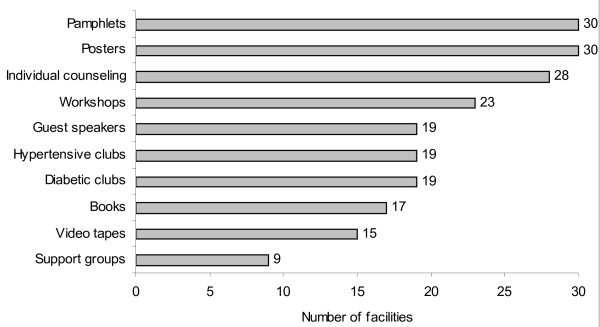
Blood pressure measurement (97.6%) was the most common diagnostic test used, followed by weight measurement (88.3%), urine (85.7%) and blood glucose testing (80.9%). Individual lifestyle modification counselling was the preferred health education method of choice for the majority of patients. Of the 64% of patients that selected chronic clubs/support groups as a method of choice, only a third rated this as their first choice. Pamphlets, posters and workshops/group counselling sessions were the least preferred methods with only 9%, 13% and 11% of patients choosing these as their first choice, respectively. In an individual counselling setting 44.7% of patients reported that they would prefer to be counselled by a doctor, followed by a nurse (16.9%), health educator (8.8%) and nutrition advisor (4.8%). Health professionals identified numerous barriers to education and counselling. These can be summarised as a lack of resources, including time, space and equipment; staff-related barriers such as staff shortage and staff turnover; and patient-related barriers such as patient load and patient non-compliance.
The majority of patients attending PHC facilities want to receive lifestyle modification education. There is not however, one specific method that can be regarded as the gold standard. Patients' preferences regarding health education methods differ, and they are more likely to be susceptible to methods that do not involve much reading. Health education materials such as posters, pamphlets and booklets should be used to supplement information received during counselling or support group sessions.
由于缺乏有关医疗设备、健康促进方法和材料的可用性和有效性的数据,因此对开普敦初级保健(PHC)设施中卫生专业人员用于管理非传染性疾病(NCD)患者的方法进行了审核。
进行了一项多中心横断面研究,以采访 30 个 PHC 设施中 580 名 NCD 患者。使用问卷获取有关生活方式改变的健康促进方法偏好的信息。对选定的卫生专业人员(n=14)进行了个体半结构化访谈,并使用数字记录器进行了记录。将数据转移到 Atlas ti 软件程序中,并使用主题内容分析方法进行分析。
血压测量(97.6%)是最常用的诊断测试,其次是体重测量(88.3%)、尿液检查(85.7%)和血糖测试(80.9%)。大多数患者首选个体生活方式改变咨询作为主要的健康教育方法。在选择慢性俱乐部/支持小组作为首选方法的 64%患者中,只有三分之一将其评为首选。小册子、海报和工作坊/小组咨询是最不受欢迎的方法,只有 9%、13%和 11%的患者将其作为首选。在个体咨询环境中,44.7%的患者报告说他们更愿意接受医生的咨询,其次是护士(16.9%)、健康教育者(8.8%)和营养师(4.8%)。卫生专业人员确定了教育和咨询的许多障碍。这些可以概括为缺乏资源,包括时间、空间和设备;人员相关障碍,例如人员短缺和人员流动;以及患者相关障碍,例如患者负荷和患者不遵守规定。
大多数在 PHC 设施就诊的患者希望接受生活方式改变教育。但是,没有一种特定的方法可以被视为黄金标准。患者对健康教育方法的偏好存在差异,他们更容易接受不需要大量阅读的方法。应使用海报、小册子和传单等健康教育材料来补充咨询或支持小组会议期间收到的信息。