Department of Entomology, The University of Arizona, Tucson, Arizona, United States of America.
PLoS One. 2012;7(6):e39862. doi: 10.1371/journal.pone.0039862. Epub 2012 Jun 29.
Many polyphagous pests sequentially use crops and uncultivated habitats in landscapes dominated by annual crops. As these habitats may contribute in increasing or decreasing pest density in fields of a specific crop, understanding the scale and temporal variability of source and sink effects is critical for managing landscapes to enhance pest control.
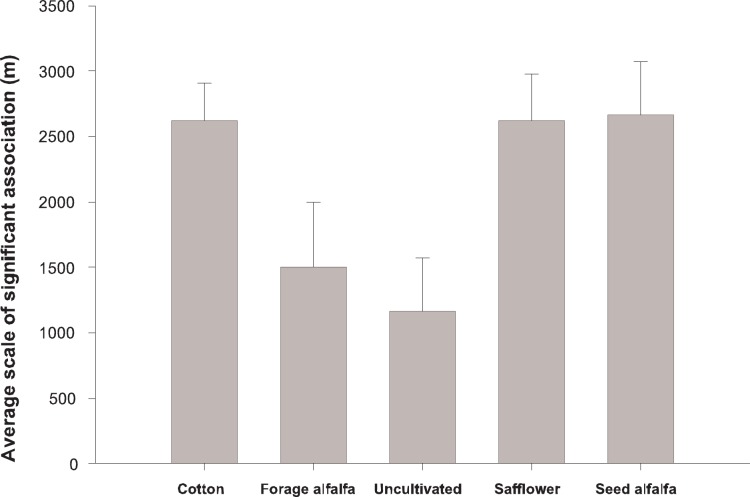
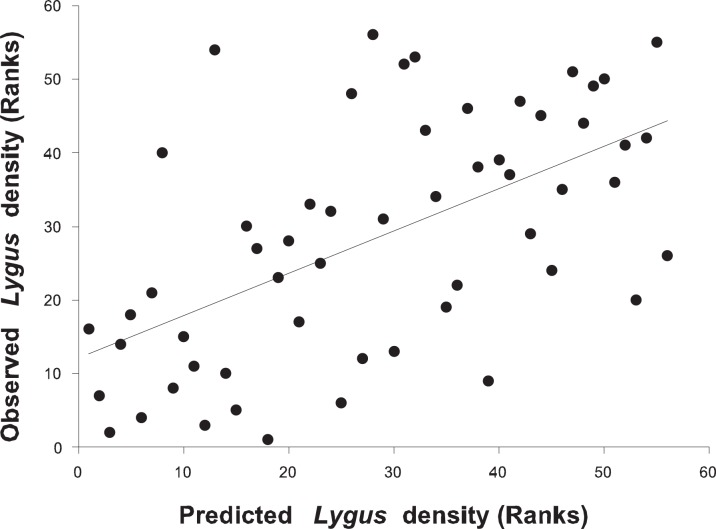
METHODOLOGY/PRINCIPAL FINDINGS: We evaluated how local and landscape characteristics affect population density of the western tarnished plant bug, Lygus hesperus (Knight), in cotton fields of the San Joaquin Valley in California. During two periods covering the main window of cotton vulnerability to Lygus attack over three years, we examined the associations between abundance of six common Lygus crops, uncultivated habitats and Lygus population density in these cotton fields. We also investigated impacts of insecticide applications in cotton fields and cotton flowering date. Consistent associations observed across periods and years involved abundances of cotton and uncultivated habitats that were negatively associated with Lygus density, and abundance of seed alfalfa and cotton flowering date that were positively associated with Lygus density. Safflower and forage alfalfa had variable effects, possibly reflecting among-year variation in crop management practices, and tomato, sugar beet and insecticide applications were rarely associated with Lygus density. Using data from the first two years, a multiple regression model including the four consistent factors successfully predicted Lygus density across cotton fields in the last year of the study.
CONCLUSIONS/SIGNIFICANCE: Our results show that the approach developed here is appropriate to characterize and test the source and sink effects of various habitats on pest dynamics and improve the design of landscape-level pest management strategies.
在以一年生作物为主的景观中,许多多食性害虫会先后利用作物和未开垦的生境。由于这些生境可能会增加或减少特定作物田中的害虫密度,因此了解源汇效应的规模和时间可变性对于管理景观以增强害虫防治至关重要。
方法/主要发现:我们评估了局部和景观特征如何影响加利福尼亚州圣华金谷棉花田中的西部污点叶蝉(Lygus hesperus(Knight))的种群密度。在三年中覆盖棉花对 Lygus 攻击易感性的主要窗口期的两个时期内,我们研究了六个常见 Lygus 作物、未开垦生境与这些棉花田中 Lygus 种群密度之间的丰度之间的关系。我们还调查了棉花田中的杀虫剂应用和棉花开花日期的影响。在两个时期和几年中观察到的一致关联涉及棉花和未开垦生境的丰度与 Lygus 密度呈负相关,以及种子紫花苜蓿和棉花开花日期的丰度与 Lygus 密度呈正相关。红花和饲料紫花苜蓿的影响不同,可能反映了作物管理实践的年际变化,而番茄、糖甜菜和杀虫剂应用很少与 Lygus 密度相关。使用前两年的数据,一个包含四个一致因素的多元回归模型成功地预测了研究最后一年棉花田中 Lygus 的密度。
结论/意义:我们的结果表明,这里开发的方法适用于表征和测试各种生境对害虫动态的源汇效应,并改进景观水平害虫管理策略的设计。