Meisner Matthew H, Rosenheim Jay A
Department of Evolution and Ecology, University of California Davis, Davis, California, United States of America ; Department of Statistics, University of California Davis, Davis, California, United States of America.
Department of Entomology and Nematology, University of California Davis, Davis, California, United States of America.
PLoS One. 2014 Jan 17;9(1):e85710. doi: 10.1371/journal.pone.0085710. eCollection 2014.
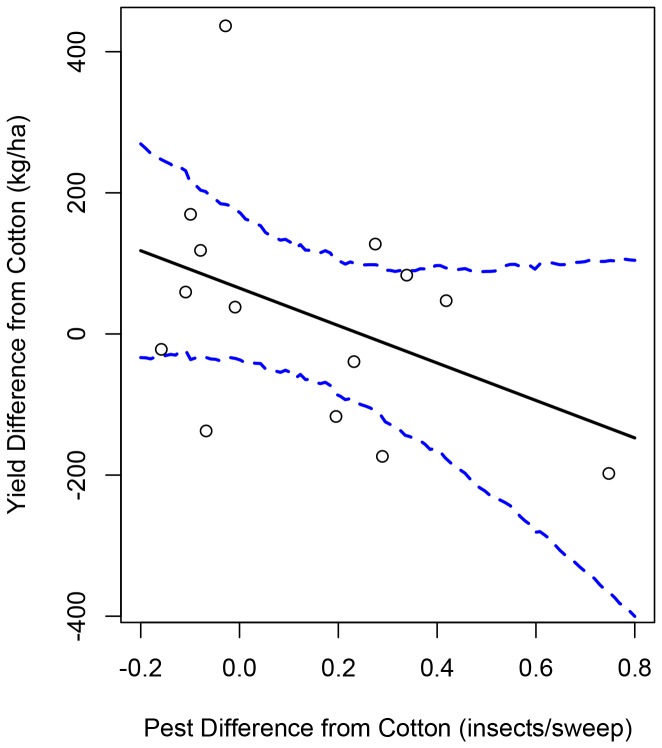
Crop rotation has been practiced for centuries in an effort to improve agricultural yield. However, the directions, magnitudes, and mechanisms of the yield effects of various crop rotations remain poorly understood in many systems. In order to better understand how crop rotation influences cotton yield, we used hierarchical Bayesian models to analyze a large ecoinformatics database consisting of records of commercial cotton crops grown in California's San Joaquin Valley. We identified several crops that, when grown in a field the year before a cotton crop, were associated with increased or decreased cotton yield. Furthermore, there was a negative association between the effect of the prior year's crop on June densities of the pest Lygus hesperus and the effect of the prior year's crop on cotton yield. This suggested that some crops may enhance L. hesperus densities in the surrounding agricultural landscape, because residual L. hesperus populations from the previous year cannot continuously inhabit a focal field and attack a subsequent cotton crop. In addition, we found that cotton yield declined approximately 2.4% for each additional year in which cotton was grown consecutively in a field prior to the focal cotton crop. Because L. hesperus is quite mobile, the effects of crop rotation on L. hesperus would likely not be revealed by small plot experimentation. These results provide an example of how ecoinformatics datasets, which capture the true spatial scale of commercial agriculture, can be used to enhance agricultural productivity.
几个世纪以来,人们一直在实行轮作,以提高农业产量。然而,在许多系统中,各种轮作对产量影响的方向、幅度和机制仍知之甚少。为了更好地了解轮作如何影响棉花产量,我们使用分层贝叶斯模型分析了一个大型生态信息学数据库,该数据库包含加利福尼亚州圣华金谷种植的商业棉花作物记录。我们确定了几种作物,当它们在棉花作物前一年种植在一块田地时,与棉花产量的增加或减少有关。此外,前一年作物对害虫牧草盲蝽6月密度的影响与前一年作物对棉花产量的影响之间存在负相关。这表明,一些作物可能会提高周围农业景观中牧草盲蝽的密度,因为前一年残留的牧草盲蝽种群不能持续栖息在一块田地并攻击后续的棉花作物。此外,我们发现,在种植目标棉花作物之前,一块田地连续种植棉花的年份每增加一年,棉花产量就会下降约2.4%。由于牧草盲蝽具有很强的移动性,小规模试验可能无法揭示轮作对牧草盲蝽的影响。这些结果提供了一个例子,说明如何利用捕捉商业农业真实空间尺度的生态信息学数据集来提高农业生产力。