LBPA, UMR8113 du CNRS, Ecole Normale Supérieure de Cachan, Cedex, Cachan, France.
PLoS One. 2012;7(7):e40223. doi: 10.1371/journal.pone.0040223. Epub 2012 Jul 2.
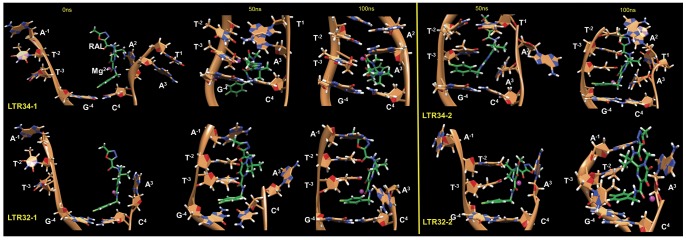
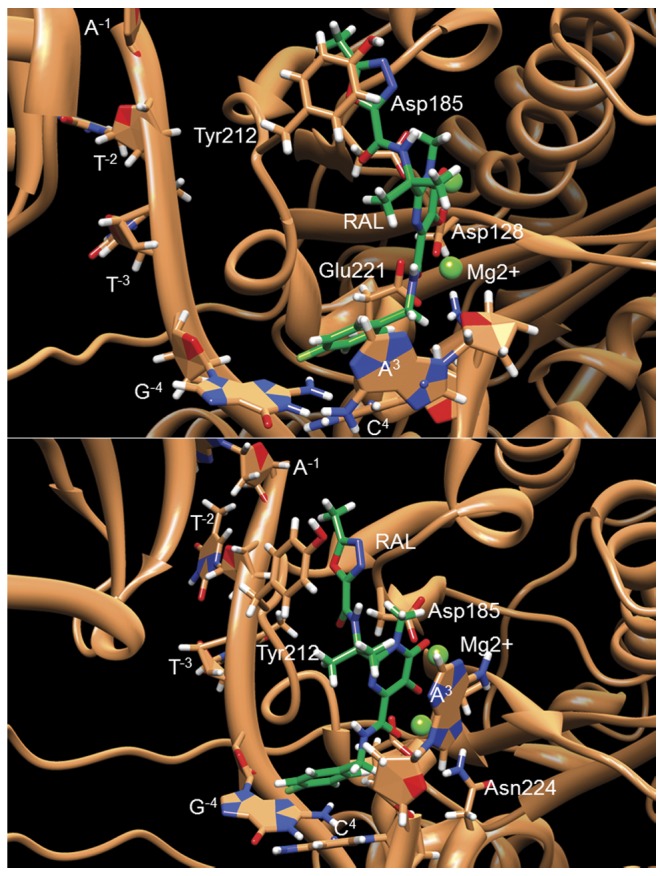
Integration of HIV DNA into host chromosome requires a 3'-processing (3'-P) and a strand transfer (ST) reactions catalyzed by virus integrase (IN). Raltegravir (RAL), commonly used in AIDS therapy, belongs to the family of IN ST inhibitors (INSTIs) acting on IN-viral DNA complexes (intasomes). However, studies show that RAL fails to bind IN alone, but nothing has been reported on the behaviour of RAL toward free viral DNA. Here, we assessed whether free viral DNA could be a primary target for RAL, assuming that the DNA molecule is a receptor for a huge number of pharmacological agents. Optical spectroscopy, molecular dynamics and free energy calculations, showed that RAL is a tight binder of both processed and unprocessed LTR (long terminal repeat) ends. Complex formation involved mainly van der Waals forces and was enthalpy driven. Dissociation constants (Kds) revealed that RAL affinity for unbound LTRs was stronger than for bound LTRs. Moreover, Kd value for binding of RAL to LTRs and IC50 value (half concentration for inhibition) were in same range, suggesting that RAL binding to DNA and ST inhibition are correlated events. Accommodation of RAL into terminal base-pairs of unprocessed LTR is facilitated by an extensive end fraying that lowers the RAL binding energy barrier. The RAL binding entails a weak damping of fraying and correlatively of 3'-P inhibition. Noteworthy, present calculated RAL structures bound to free viral DNA resemble those found in RAL-intasome crystals, especially concerning the contacts between the fluorobenzyl group and the conserved 5'C(4)pA(3)3' step. We propose that RAL inhibits IN, in binding first unprocessed DNA. Similarly to anticancer drug poisons acting on topoisomerases, its interaction with DNA does not alter the cut, but blocks the subsequent joining reaction. We also speculate that INSTIs having viral DNA rather IN as main target could induce less resistance.
HIV DNA 整合到宿主染色体需要病毒整合酶(IN)催化的 3'-加工(3'-P)和链转移(ST)反应。拉替拉韦(RAL)常用于艾滋病治疗,属于 IN ST 抑制剂(INSTIs)家族,作用于 IN-病毒 DNA 复合物(intasomes)。然而,研究表明 RAL 不能单独与 IN 结合,但尚未有关于 RAL 对游离病毒 DNA 行为的报道。在这里,我们评估了游离病毒 DNA 是否可能成为 RAL 的主要靶标,假设 DNA 分子是大量药理试剂的受体。光学光谱、分子动力学和自由能计算表明,RAL 是加工和未加工 LTR(长末端重复)末端的紧密结合物。复合物形成主要涉及范德华力,且是焓驱动的。离解常数(Kd)表明,RAL 对未结合 LTR 的亲和力强于对结合 LTR 的亲和力。此外,RAL 与 LTR 结合的 Kd 值和 IC50 值(抑制的半浓度)处于同一范围内,表明 RAL 与 DNA 的结合和 ST 抑制是相关事件。RAL 进入未加工 LTR 末端碱基对的容纳通过广泛的末端磨损来促进,这降低了 RAL 结合的能量障碍。RAL 结合导致未磨损的弱阻尼和相应的 3'-P 抑制。值得注意的是,目前计算出的 RAL 结合游离病毒 DNA 的结构与 RAL-intasome 晶体中发现的结构相似,特别是涉及氟苄基基团和保守的 5'C(4)pA(3)3' 步之间的接触。我们提出 RAL 通过首先结合未加工的 DNA 来抑制 IN。与作用于拓扑异构酶的抗癌药物类似,其与 DNA 的相互作用不会改变切割,但会阻止随后的连接反应。我们还推测,以病毒 DNA 而不是 IN 为主要靶标的 INSTIs 可能会引起较少的耐药性。