Department of Internal Medicine, Colorado Permanente Medical Group, Institute for Health Research, Kaiser Permanente, Denver, CO, USA.
BMC Med Inform Decis Mak. 2012 Jul 8;12:65. doi: 10.1186/1472-6947-12-65.
Patients have typically received health care through face-to-face encounters. However, expansion of electronic communication and electronic health records (EHRs) provide alternative means for patient and physicians to interact. Electronic consultations may complement regular healthcare by providing "better, faster, cheaper" processes for diagnosing, treating, and monitoring health conditions. Virtual consultation between physicians may provide a method of streamlining care, potentially saving patients the time and expense of added visits. The purpose of this study was to compare physician usage and patient satisfaction with virtual consultations (VCs) with traditional consultations (TCs) facilitated within an EHR.
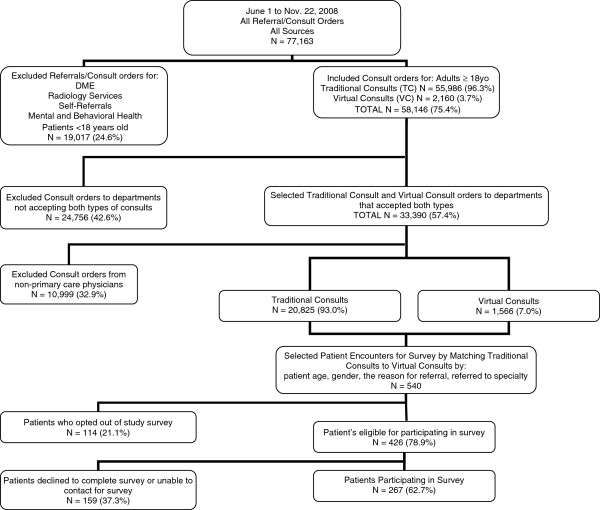
We conducted an observational case-control survey study within Kaiser Permanente, Colorado. A sample of patients who had VCs requested by physicians (N = 270) were matched with patients who had TCs requested by physicians (N = 270), by patient age, gender, reason for the consult, and specialty department. These patients (VC and TC), were invited to participate in a satisfaction survey. In addition, 205 primary care physicians who submitted a VC or TC were surveyed.
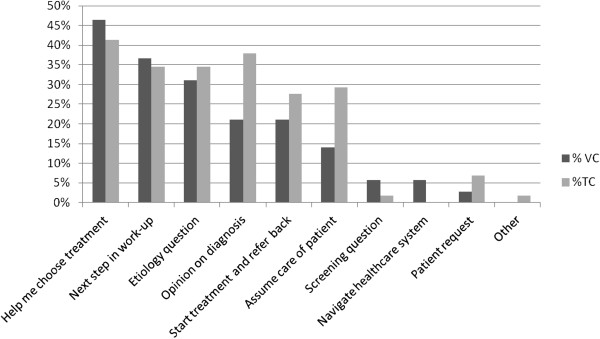
During the study period, 58,146 VC or TC were requested (TC = 96.3%). Patients who completed a satisfaction survey (267 out of 540 patients, 49.4% response rate) indicated they were satisfied with their care, irrespective of the kind of consult (mean 10-point Likert score of 8.5). 88 of 205 primary care physicians surveyed (42.9%) returned at least one survey; VC and TC survey response rates and consulted departments were comparable (p = 0.13). More TCs than VCs requested transfer of patient care (p = 0.03), assistance with diagnosis (p = 0.04) or initiating treatment (p =0.04). Within 3 weeks of the consultation request, 72.1% of respondents reported receiving information from VCs, compared with 33.9% of the TCs (p < 0.001). Utility of information provided by consultants and satisfaction with consultations did not differ between VCs and TCs.
Referring physicians received information from consultants more quickly from VCs compared with TCs, but the value and application of information from both types of consultations were similar. VCs may decrease the need for face-to-face specialty encounters without a decrease in the patient's perception of care.
患者通常通过面对面的方式获得医疗服务。然而,电子通信和电子健康记录(EHR)的扩展为患者和医生提供了互动的替代方式。电子咨询可以通过提供“更好、更快、更便宜”的诊断、治疗和监测健康状况的流程来补充常规医疗保健。医生之间的虚拟咨询可能提供一种简化护理的方法,有可能为患者节省额外就诊的时间和费用。本研究的目的是比较电子病历(EHR)中医生使用虚拟咨询(VC)和传统咨询(TC)的情况,并评估患者的满意度。
我们在 Kaiser Permanente, Colorado 进行了一项观察性病例对照调查研究。对 270 名由医生请求的 VC 患者(VC 组)和 270 名由医生请求的 TC 患者(TC 组)进行了匹配,匹配的因素包括患者年龄、性别、咨询原因和专科部门。邀请这些患者(VC 和 TC)参加满意度调查。此外,还对 205 名提交 VC 或 TC 的初级保健医生进行了调查。
在研究期间,共请求了 58146 次 VC 或 TC(TC 占 96.3%)。完成满意度调查的患者(540 名患者中的 267 名,49.4%的应答率)表示对他们的护理满意,不论咨询类型如何(10 分制 Likert 评分平均为 8.5 分)。在 205 名接受调查的初级保健医生中,有 88 名(42.9%)至少回复了一份调查;VC 和 TC 调查的回复率和咨询科室相似(p = 0.13)。与 VC 相比,TC 更多地请求转移患者护理(p = 0.03)、协助诊断(p = 0.04)或开始治疗(p = 0.04)。在咨询请求后的 3 周内,72.1%的受访者报告从 VC 中收到了信息,而从 TC 中收到信息的比例为 33.9%(p < 0.001)。顾问提供的信息的实用性和咨询的满意度在 VC 和 TC 之间没有差异。
与 TC 相比,转诊医生从 VC 中更快地收到了顾问的信息,但两种咨询类型的信息的价值和应用相似。VC 可能会减少对面对面专科就诊的需求,而不会降低患者对护理的感知。