Asia-Pacific Centre for Animal Health, Faculty of Veterinary Science, The University of Melbourne, Parkville, VIC, Australia.
BMC Microbiol. 2012 Jul 8;12:138. doi: 10.1186/1471-2180-12-138.
Mycoplasma gallisepticum is a major poultry pathogen and causes severe economic loss to the poultry industry. In mycoplasmas lipoproteins are abundant on the membrane surface and play a critical role in interactions with the host, but tools for exploring their molecular biology are limited.
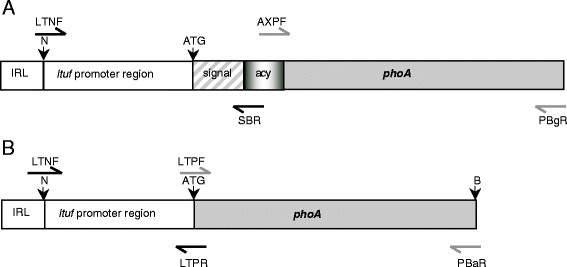
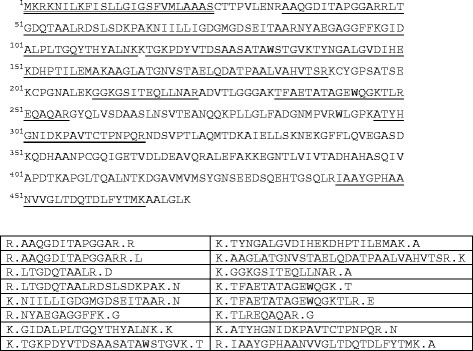
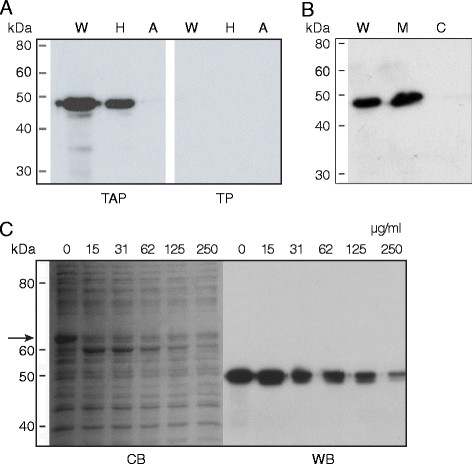
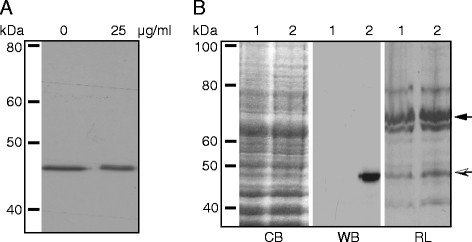
In this study we examined whether the alkaline phosphatase gene (phoA ) from Escherichia coli could be used as a reporter in mycoplasmas. The promoter region from the gene for elongation factor Tu (ltuf) and the signal and acylation sequences from the vlhA 1.1 gene, both from Mycoplasma gallisepticum , together with the coding region of phoA , were assembled in the transposon-containing plasmid pISM2062.2 (pTAP) to enable expression of alkaline phosphatase (AP) as a recombinant lipoprotein. The transposon was used to transform M. gallisepticum strain S6. As a control, a plasmid containing a similar construct, but lacking the signal and acylation sequences, was also produced (pTP) and also introduced into M. gallisepticum . Using a colorimetric substrate for detection of alkaline phosphatase activity, it was possible to detect transformed M. gallisepticum . The level of transcription of phoA in organisms transformed with pTP was lower than in those transformed with pTAP, and alkaline phosphatase was not detected by immunoblotting or enzymatic assays in pTP transformants, eventhough alkaline phosphatase expression could be readily detected by both assays in pTAP transformants. Alkaline phosphatase was shown to be located in the hydrophobic fraction of transformed mycoplasmas following Triton X-114 partitioning and in the membrane fraction after differential fractionation. Trypsin proteolysis confirmed its surface exposure. The inclusion of the VlhA lipoprotein signal sequence in pTAP enabled translocation of PhoA and acylation of the amino terminal cysteine moiety, as confirmed by the effect of treatment with globomycin and radiolabelling studies with [14C]palmitate. PhoA could be identified by mass-spectrometry after separation by two-dimensional electrophoresis.
This is the first study to express PhoA as a lipoprotein in mycoplasmas. The pTAP plasmid will facilitate investigations of lipoproteins and protein translocation across the cell membrane in mycoplasmas, and the ease of detection of these transformants makes this vector system suitable for the simultaneous screening and detection of cloned genes expressed as membrane proteins in mycoplasmas.
鸡毒支原体是一种主要的家禽病原体,给家禽业造成严重的经济损失。在支原体中,脂蛋白在膜表面大量存在,在与宿主的相互作用中起着至关重要的作用,但用于探索其分子生物学的工具却很有限。
本研究考察了大肠杆菌碱性磷酸酶基因(phoA)是否可作为支原体中的报告基因。来自禽支原体的延伸因子 Tu(ltuf)基因启动子区域和 vlhA1.1 基因的信号和酰化序列,以及 phoA 的编码区,被组装到含有转座子的质粒 pISM2062.2(pTAP)中,使碱性磷酸酶(AP)作为重组脂蛋白表达。该转座子被用于转化鸡毒支原体 S6 株。作为对照,还产生了一个含有类似构建体但缺乏信号和酰化序列的质粒(pTP),并将其引入鸡毒支原体中。使用碱性磷酸酶活性的比色底物,可以检测到转化的鸡毒支原体。在转化体中,pTP 中的 phoA 转录水平低于 pTAP 中的转录水平,且在 pTP 转化体中,免疫印迹或酶活性测定均未检测到碱性磷酸酶,但在 pTAP 转化体中,这两种测定方法均可容易地检测到碱性磷酸酶的表达。通过 Triton X-114 分配和差速分级分离,碱性磷酸酶显示位于转化支原体的疏水区和膜区。胰蛋白酶水解证实了其表面暴露。pTAP 中包含 VlhA 脂蛋白信号序列,可使 PhoA 易位和氨基末端半胱氨酸残基酰化,用博来霉素处理和用[14C]棕榈酸进行放射性标记研究证实了这一点。通过二维电泳分离后,通过质谱可鉴定出 PhoA。
这是首次在支原体中表达 PhoA 作为脂蛋白。pTAP 质粒将促进对支原体中脂蛋白和跨细胞膜蛋白易位的研究,并且这些转化体易于检测,使该载体系统适合于同时筛选和检测作为膜蛋白在支原体中表达的克隆基因。