Tao Xiaodong, Crest Justin, Kotadia Shaila, Azucena Oscar, Chen Diana C, Sullivan William, Kubby Joel
W.M. Keck Center for Adaptive Optical Microscopy, Jack Baskin School of Engineering, University of California, Santa Cruz, California 95064, USA.
Opt Express. 2012 Jul 2;20(14):15969-82. doi: 10.1364/OE.20.015969.
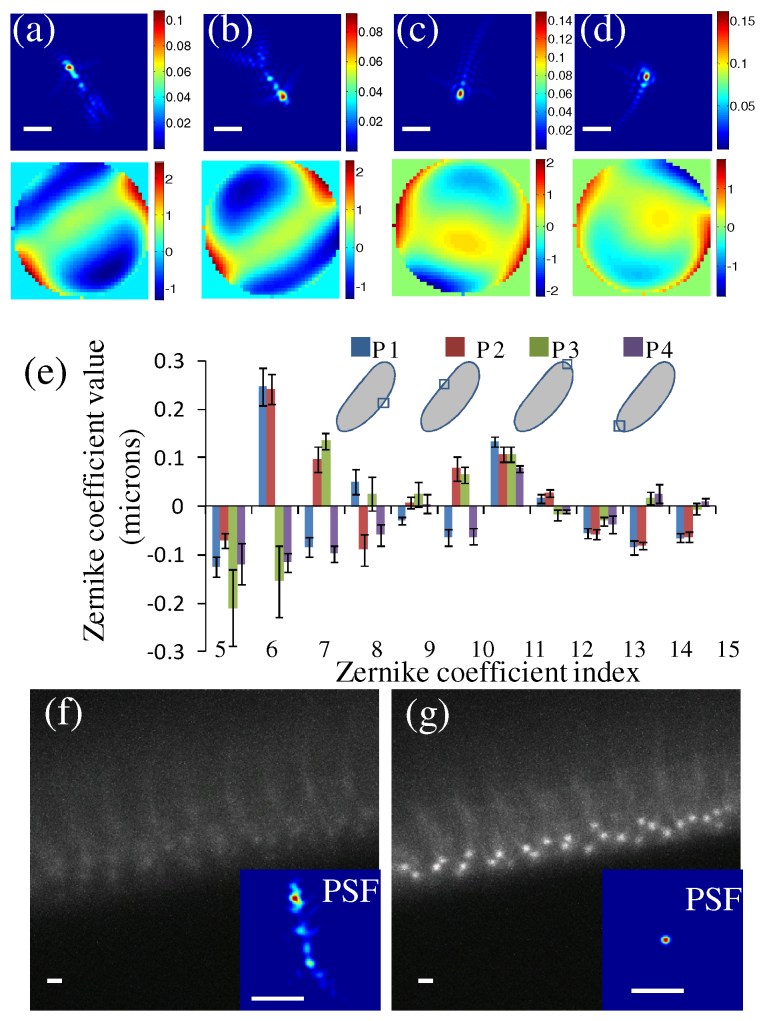
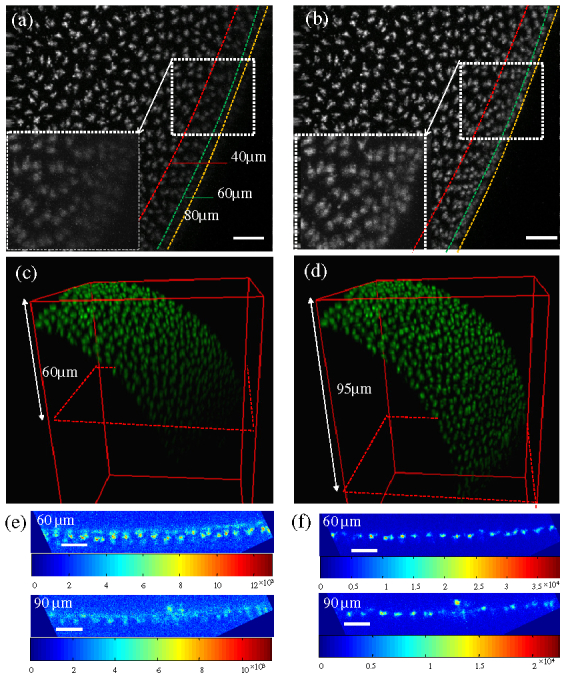
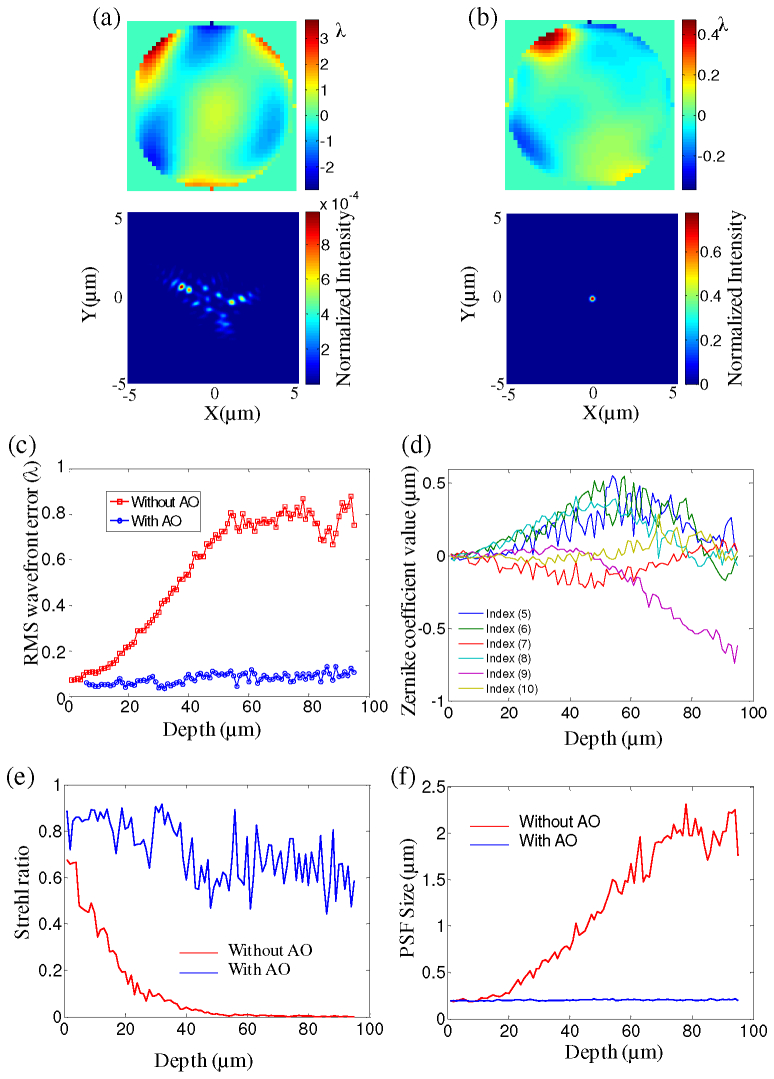
Spatially and temporally dependent optical aberrations induced by the inhomogeneous refractive index of live samples limit the resolution of live dynamic imaging. We introduce an adaptive optical microscope with a direct wavefront sensing method using a Shack-Hartmann wavefront sensor and fluorescent protein guide-stars for live imaging. The results of imaging Drosophila embryos demonstrate its ability to correct aberrations and achieve near diffraction limited images of medial sections of large Drosophila embryos. GFP-polo labeled centrosomes can be observed clearly after correction but cannot be observed before correction. Four dimensional time lapse images are achieved with the correction of dynamic aberrations. These studies also demonstrate that the GFP-tagged centrosome proteins, Polo and Cnn, serve as excellent biological guide-stars for adaptive optics based microscopy.
活样本不均匀折射率所引起的空间和时间相关光学像差限制了活细胞动态成像的分辨率。我们介绍一种自适应光学显微镜,它采用夏克-哈特曼波前传感器和荧光蛋白导星的直接波前传感方法进行活细胞成像。对果蝇胚胎成像的结果表明,该显微镜能够校正像差,并获得大型果蝇胚胎中间部分接近衍射极限的图像。校正后可以清晰观察到绿色荧光蛋白标记的中心体,校正前则无法观察到。通过校正动态像差获得了四维延时图像。这些研究还表明,绿色荧光蛋白标记的中心体蛋白Polo和Cnn是基于自适应光学的显微镜的优良生物导星。