Department of Biostatistics, University of Washington, Seattle, Washington, USA.
Nat Genet. 2012 Jul 8;44(8):886-9. doi: 10.1038/ng.2344.
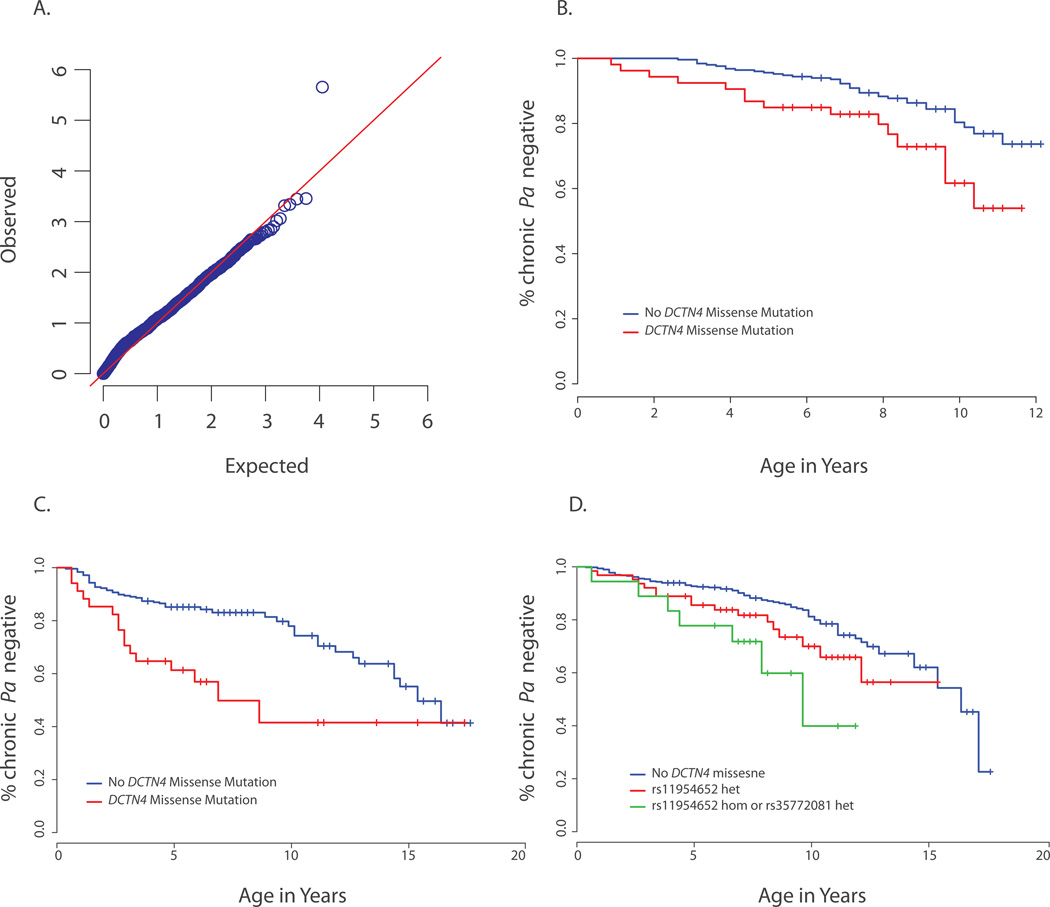
Exome sequencing has become a powerful and effective strategy for the discovery of genes underlying Mendelian disorders. However, use of exome sequencing to identify variants associated with complex traits has been more challenging, partly because the sample sizes needed for adequate power may be very large. One strategy to increase efficiency is to sequence individuals who are at both ends of a phenotype distribution (those with extreme phenotypes). Because the frequency of alleles that contribute to the trait are enriched in one or both phenotype extremes, a modest sample size can potentially be used to identify novel candidate genes and/or alleles. As part of the National Heart, Lung, and Blood Institute (NHLBI) Exome Sequencing Project (ESP), we used an extreme phenotype study design to discover that variants in DCTN4, encoding a dynactin protein, are associated with time to first P. aeruginosa airway infection, chronic P. aeruginosa infection and mucoid P. aeruginosa in individuals with cystic fibrosis.
外显子组测序已经成为发现孟德尔疾病相关基因的强大而有效的策略。然而,使用外显子组测序来识别与复杂特征相关的变体更具挑战性,部分原因是为了获得足够的功效,所需的样本量可能非常大。一种提高效率的策略是对表型分布两端的个体进行测序(具有极端表型的个体)。因为对特征有贡献的等位基因的频率在一个或两个表型极端中富集,因此可以使用适度的样本量来鉴定新的候选基因和/或等位基因。作为国家心脏、肺和血液研究所 (NHLBI) 外显子组测序项目 (ESP) 的一部分,我们使用极端表型研究设计发现,编码动力蛋白 dynactin 的 DCTN4 中的变体与囊性纤维化个体中铜绿假单胞菌气道感染的首次发生时间、慢性铜绿假单胞菌感染和粘液性铜绿假单胞菌有关。