Biostatistics Division, Dalla Lana School of Public Health, University of Toronto, Toronto, ON, Canada.
Program in Genetics and Genome Biology, The Hospital for Sick Children, Toronto, ON, Canada.
Eur Respir J. 2024 Nov 7;64(5). doi: 10.1183/13993003.00062-2024. Print 2024 Nov.
is a common pathogen that contributes to progressive lung disease in cystic fibrosis (CF). Genetic factors other than CF-causing (CF transmembrane conductance regulator) variations contribute ∼85% of the variation in chronic infection age in CF according to twin studies, but the susceptibility loci remain unknown. Our objective is to advance understanding of the genetic basis of host susceptibility to infection.
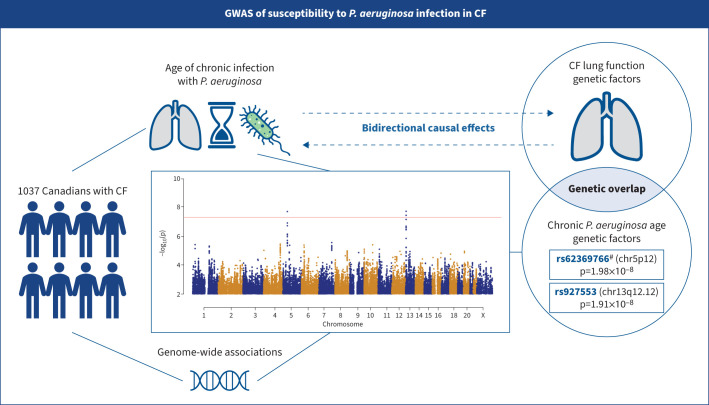
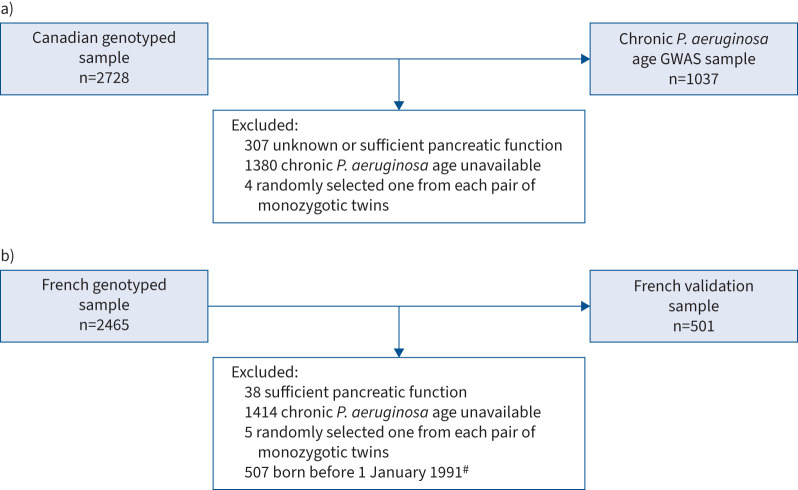
We conducted a genome-wide association study of chronic infection age in 1037 Canadians with CF. We subsequently assessed the genetic correlation between chronic infection age and lung function through polygenic risk score (PRS) analysis and inferred their causal relationship through bidirectional Mendelian randomisation analysis.
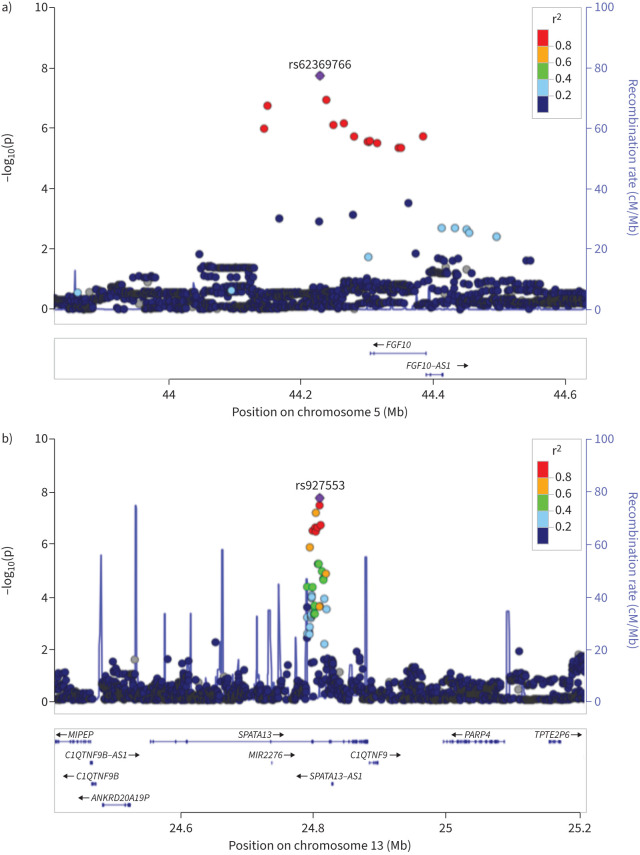
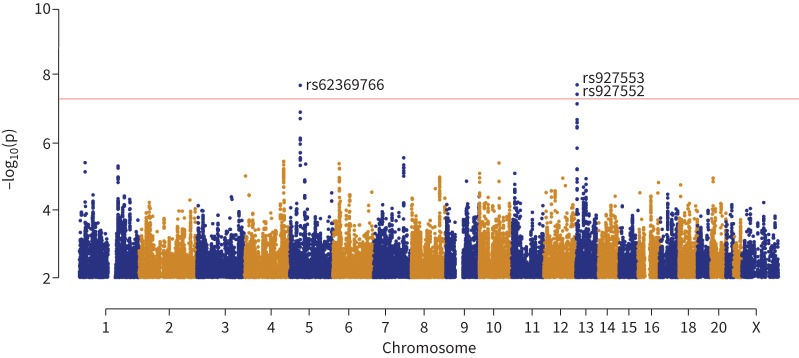
Two novel genome-wide significant loci with lead single nucleotide polymorphisms (SNPs) rs62369766 (chr5p12; p=1.98×10) and rs927553 (chr13q12.12; p=1.91×10) were associated with chronic infection age. The rs62369766 locus was validated using an independent French cohort (n=501). Furthermore, the PRS constructed from CF lung function-associated SNPs was significantly associated with chronic infection age (p=0.002). Finally, our analysis presented evidence for a causal effect of lung function on chronic infection age (β=0.782 years, p=4.24×10). In the reverse direction, we observed a moderate effect (β=0.002, p=0.012).
We identified two novel loci that are associated with chronic infection age in individuals with CF. Additionally, we provided evidence of common genetic contributors and a potential causal relationship between infection susceptibility and lung function in CF. Therapeutics targeting these genetic factors may delay the onset of chronic infections, which account for significant remaining morbidity in CF.
铜绿假单胞菌是囊性纤维化(CF)导致肺部进行性疾病的常见病原体。根据双胞胎研究,除了导致 CF 的 CF 跨膜电导调节因子(CF transmembrane conductance regulator)变异外,遗传因素约占 CF 慢性感染年龄变异的 85%,但易感基因座仍不清楚。我们的目标是深入了解宿主对铜绿假单胞菌感染易感性的遗传基础。
我们对 1037 名加拿大 CF 患者的慢性感染年龄进行了全基因组关联研究。随后,我们通过多基因风险评分(PRS)分析评估了慢性感染年龄与肺功能之间的遗传相关性,并通过双向孟德尔随机化分析推断了它们的因果关系。
两个新的全基因组显著位点,其 lead 单核苷酸多态性(SNP)分别为 rs62369766(chr5p12;p=1.98×10)和 rs927553(chr13q12.12;p=1.91×10),与慢性感染年龄相关。rs62369766 位点在一个独立的法国队列(n=501)中得到了验证。此外,由 CF 肺功能相关 SNP 构建的 PRS 与慢性感染年龄显著相关(p=0.002)。最后,我们的分析提供了肺功能对慢性感染年龄存在因果影响的证据(β=0.782 岁,p=4.24×10)。在相反的方向上,我们观察到中等效应(β=0.002,p=0.012)。
我们在 CF 个体中发现了两个与慢性感染年龄相关的新位点。此外,我们提供了感染易感性和 CF 肺功能之间存在共同遗传因素和潜在因果关系的证据。针对这些遗传因素的治疗方法可能会延迟慢性感染的发生,这在 CF 中仍存在显著的剩余发病率。