• 文献检索
  • 文档翻译
  • 深度研究
  • 学术资讯
  • Suppr Zotero 插件Zotero 插件
  • 邀请有礼
  • 套餐&价格
  • 历史记录
应用&插件
Suppr Zotero 插件Zotero 插件浏览器插件Mac 客户端Windows 客户端微信小程序
定价
高级版会员购买积分包购买API积分包
服务
文献检索文档翻译深度研究API 文档MCP 服务
关于我们
关于 Suppr公司介绍联系我们用户协议隐私条款
关注我们

Suppr 超能文献

核心技术专利:CN118964589B侵权必究
粤ICP备2023148730 号-1Suppr @ 2026

文献检索

告别复杂PubMed语法,用中文像聊天一样搜索,搜遍4000万医学文献。AI智能推荐,让科研检索更轻松。

立即免费搜索

文件翻译

保留排版,准确专业,支持PDF/Word/PPT等文件格式,支持 12+语言互译。

免费翻译文档

深度研究

AI帮你快速写综述,25分钟生成高质量综述,智能提取关键信息,辅助科研写作。

立即免费体验

澳大利亚布里斯班的冷热温度暴露与救护车出勤情况:一项时间序列研究。

Exposure to hot and cold temperatures and ambulance attendances in Brisbane, Australia: a time-series study.

作者信息

Turner Lyle R, Connell Des, Tong Shilu

机构信息

School of Public Health and Social Work, Institute of Health and Biomedical Innovation, Queensland University of Technology, Brisbane, Australia.

出版信息

BMJ Open. 2012 Jul 7;2(4). doi: 10.1136/bmjopen-2012-001074. Print 2012.

DOI:10.1136/bmjopen-2012-001074
PMID:22773538
原文链接:https://pmc.ncbi.nlm.nih.gov/articles/PMC3400068/
Abstract

OBJECTIVES

To investigate the effect of hot and cold temperatures on ambulance attendances.

DESIGN

An ecological time-series study.

SETTING AND PARTICIPANTS

The study was conducted in Brisbane, Australia. The authors collected information on 783 935 daily ambulance attendances, along with data of associated meteorological variables and air pollutants, for the period of 2000-2007.

OUTCOME MEASURES

The total number of ambulance attendances was examined, along with those related to cardiovascular, respiratory and other non-traumatic conditions. Generalised additive models were used to assess the relationship between daily mean temperature and the number of ambulance attendances.

RESULTS

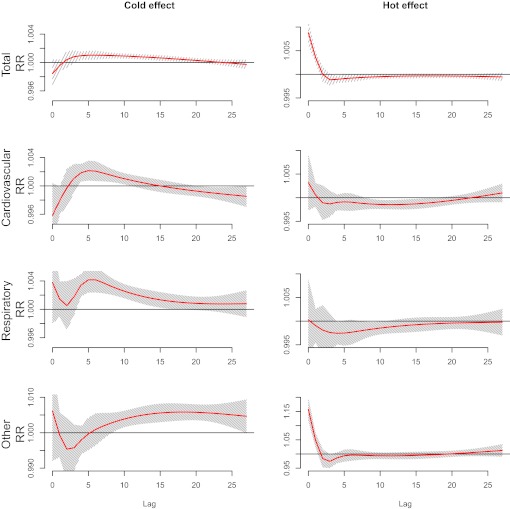
There were statistically significant relationships between mean temperature and ambulance attendances for all categories. Acute heat effects were found with a 1.17% (95% CI 0.86% to 1.48%) increase in total attendances for 1°C increase above threshold (0-1 days lag). Cold effects were delayed and longer lasting with a 1.30% (0.87% to 1.73%) increase in total attendances for a 1°C decrease below the threshold (2-15 days lag). Harvesting was observed following initial acute periods of heat effects but not for cold effects.

CONCLUSIONS

This study shows that both hot and cold temperatures led to increases in ambulance attendances for different medical conditions. Our findings support the notion that ambulance attendance records are a valid and timely source of data for use in the development of local weather/health early warning systems.

摘要

目的

研究高温和低温对救护车出勤情况的影响。

设计

一项生态时间序列研究。

背景与参与者

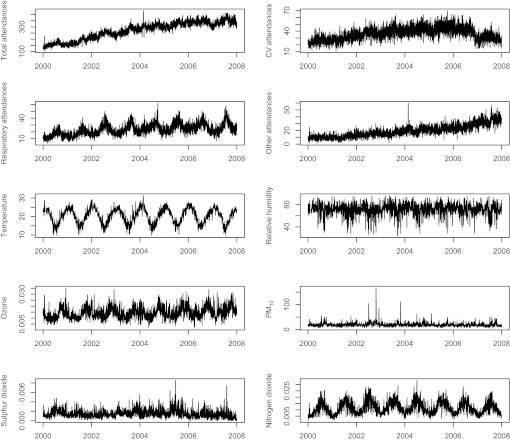
该研究在澳大利亚布里斯班进行。作者收集了2000年至2007年期间783935次每日救护车出勤的信息,以及相关气象变量和空气污染物的数据。

观察指标

检查救护车出勤总数,以及与心血管、呼吸和其他非创伤性疾病相关的出勤数。采用广义相加模型评估日平均温度与救护车出勤数之间的关系。

结果

所有类别中,平均温度与救护车出勤数之间均存在统计学显著关系。发现急性热效应,温度高于阈值每升高1°C(滞后0 - 1天),出勤总数增加1.17%(95%CI 0.86%至1.48%)。冷效应出现延迟且持续时间更长,温度低于阈值每降低1°C(滞后2 - 15天),出勤总数增加1.30%(0.87%至1.73%)。在热效应的初始急性期后观察到收获效应,但冷效应未见此现象。

结论

本研究表明,高温和低温都会导致不同医疗状况下救护车出勤数增加。我们的研究结果支持以下观点,即救护车出勤记录是用于开发当地天气/健康早期预警系统的有效且及时的数据来源。
https://cdn.ncbi.nlm.nih.gov/pmc/blobs/35ef/3400068/29a0c79a5481/bmjopen-2012-001074fig2.jpg
https://cdn.ncbi.nlm.nih.gov/pmc/blobs/35ef/3400068/b78ba35937da/bmjopen-2012-001074fig1.jpg
https://cdn.ncbi.nlm.nih.gov/pmc/blobs/35ef/3400068/29a0c79a5481/bmjopen-2012-001074fig2.jpg
https://cdn.ncbi.nlm.nih.gov/pmc/blobs/35ef/3400068/b78ba35937da/bmjopen-2012-001074fig1.jpg
https://cdn.ncbi.nlm.nih.gov/pmc/blobs/35ef/3400068/29a0c79a5481/bmjopen-2012-001074fig2.jpg

相似文献

1
Exposure to hot and cold temperatures and ambulance attendances in Brisbane, Australia: a time-series study.澳大利亚布里斯班的冷热温度暴露与救护车出勤情况:一项时间序列研究。
BMJ Open. 2012 Jul 7;2(4). doi: 10.1136/bmjopen-2012-001074. Print 2012.
2
The effect of heat waves on ambulance attendances in Brisbane, Australia.热浪对澳大利亚布里斯班救护车出勤的影响。
Prehosp Disaster Med. 2013 Oct;28(5):482-7. doi: 10.1017/S1049023X13008789. Epub 2013 Aug 28.
3
Impact of exposure to mine fire emitted PM on ambulance attendances: A time series analysis from the Hazelwood Health Study.煤矿火排放 PM 暴露对救护车出勤的影响:来自 Hazelwood 健康研究的时间序列分析。
Environ Res. 2021 May;196:110402. doi: 10.1016/j.envres.2020.110402. Epub 2020 Oct 31.
4
The effects of meteorological variables on ambulance attendance for cardiovascular diseases in Rasht, Iran.气象变量对伊朗拉什特心血管疾病救护车出勤的影响。
J Therm Biol. 2019 Jul;83:150-156. doi: 10.1016/j.jtherbio.2019.05.002. Epub 2019 May 9.
5
Hourly associations between ambient temperature and emergency ambulance calls in one central Chinese city: Call for an immediate emergency plan.中国某一中心城市环境温度与急救车呼叫的每小时关联:呼吁立即制定紧急计划。
Sci Total Environ. 2020 Apr 1;711:135046. doi: 10.1016/j.scitotenv.2019.135046. Epub 2019 Nov 3.
6
Part 2. Association of daily mortality with ambient air pollution, and effect modification by extremely high temperature in Wuhan, China.第二部分. 中国武汉每日死亡率与环境空气污染的关联以及极高温度的效应修正
Res Rep Health Eff Inst. 2010 Nov(154):91-217.
7
Emergency ambulance dispatches and apparent temperature: a time series analysis in Emilia-Romagna, Italy.紧急救护车派遣与明显温度:意大利艾米利亚-罗马涅地区的时间序列分析。
Environ Res. 2011 Nov;111(8):1192-200. doi: 10.1016/j.envres.2011.07.005. Epub 2011 Aug 3.
8
Impact of extreme temperatures on ambulance dispatches in London, UK.极端温度对英国伦敦救护车派遣的影响。
Environ Res. 2020 Mar;182:109100. doi: 10.1016/j.envres.2019.109100. Epub 2020 Jan 3.
9
Hourly associations between heat and ambulance calls.高温与救护车呼叫之间的每小时关联。
Environ Pollut. 2017 Jan;220(Pt B):1424-1428. doi: 10.1016/j.envpol.2016.10.091. Epub 2016 Nov 5.
10
Extremely cold and hot temperatures increase the risk of diabetes mortality in metropolitan areas of two Chinese cities.极寒和极热天气增加中国两座城市市区糖尿病死亡率风险。
Environ Res. 2014 Oct;134:91-7. doi: 10.1016/j.envres.2014.06.022. Epub 2014 Aug 1.

引用本文的文献

1
Ambulance Attendance in the State of Queensland, Australia: Exploring the Impacts of Heatwaves Using a Retrospective Population-Based Study.澳大利亚昆士兰州的救护车出勤情况:通过一项基于人群的回顾性研究探索热浪的影响。
Prehosp Disaster Med. 2025 Jun;40(3):147-155. doi: 10.1017/S1049023X25101192. Epub 2025 Jun 25.
2
Short-term effect of temperature on cause-specific, sex-specific, and age-specific ambulance dispatches in Czechia: a nationwide time-series analysis.温度对捷克特定病因、性别和年龄的救护车派遣的短期影响:一项全国性时间序列分析。
Int J Epidemiol. 2025 Apr 12;54(3). doi: 10.1093/ije/dyaf051.
3
Impact of extreme heat on health in Australia: a scoping review.

本文引用的文献

1
High temperature effects on out-patient visits and hospital admissions in Chiang Mai, Thailand.高温对泰国清迈门诊就诊和住院的影响。
Sci Total Environ. 2011 Nov 15;409(24):5260-7. doi: 10.1016/j.scitotenv.2011.09.005. Epub 2011 Oct 4.
2
The impact of temperature on mortality in Tianjin, China: a case-crossover design with a distributed lag nonlinear model.温度对中国天津死亡率的影响:病例交叉设计与分布滞后非线性模型。
Environ Health Perspect. 2011 Dec;119(12):1719-25. doi: 10.1289/ehp.1103598. Epub 2011 Aug 9.
3
Ambient temperature and morbidity: a review of epidemiological evidence.
极端高温对澳大利亚健康的影响:一项范围综述
BMC Public Health. 2025 Feb 7;25(1):522. doi: 10.1186/s12889-025-21677-9.
4
Effect of Temperature on Emergency Ambulance Call-Outs for Cardiovascular Causes: A Scoping Review.温度对心血管疾病紧急救护车出诊的影响:一项范围综述
Environ Health (Wash). 2023 Jun 26;1(1):6-14. doi: 10.1021/envhealth.3c00003. eCollection 2023 Jul 21.
5
Cardiovascular morbidity risk attributable to thermal stress: analysis of emergency ambulance dispatch data from Shenzhen, China.归因于热应激的心血管发病风险:来自中国深圳的紧急救护车派遣数据的分析。
BMC Public Health. 2024 Oct 17;24(1):2861. doi: 10.1186/s12889-024-20144-1.
6
A nationwide time-series analysis for short-term effects of ambient temperature on violent crime in South Korea.全国时间序列分析表明,环境温度对韩国暴力犯罪的短期影响。
Sci Rep. 2024 Feb 8;14(1):3210. doi: 10.1038/s41598-024-53547-6.
7
Evaluating long-term and high spatiotemporal resolution of wet-bulb globe temperature through land-use based machine learning model.通过基于土地利用的机器学习模型评估湿球黑球温度的长期和高时空分辨率。
J Expo Sci Environ Epidemiol. 2024 Nov;34(6):941-951. doi: 10.1038/s41370-023-00630-1. Epub 2023 Dec 16.
8
Heat, heatwaves, and ambulance service use: a systematic review and meta-analysis of epidemiological evidence.热、热浪和救护车使用:流行病学证据的系统评价和荟萃分析。
Int J Biometeorol. 2023 Oct;67(10):1523-1542. doi: 10.1007/s00484-023-02525-0. Epub 2023 Jul 27.
9
Determining the Impact of Heatwaves on Emergency Ambulance Calls in Queensland: A Retrospective Population-Based Study.确定热浪对昆士兰州紧急救护车呼叫的影响:一项回顾性基于人群的研究。
Int J Environ Res Public Health. 2023 Mar 10;20(6):4875. doi: 10.3390/ijerph20064875.
10
Hospitalization Costs of Respiratory Diseases Attributable to Temperature in Australia and Projections for Future Costs in the 2030s and 2050s under Climate Change.气候变化下澳大利亚因气温导致的呼吸疾病住院费用以及未来 2030 年代和 2050 年代的预计费用。
Int J Environ Res Public Health. 2022 Aug 6;19(15):9706. doi: 10.3390/ijerph19159706.
环境温度与发病:流行病学证据综述。
Environ Health Perspect. 2012 Jan;120(1):19-28. doi: 10.1289/ehp.1003198. Epub 2011 Aug 8.
4
Emergency ambulance dispatches and apparent temperature: a time series analysis in Emilia-Romagna, Italy.紧急救护车派遣与明显温度:意大利艾米利亚-罗马涅地区的时间序列分析。
Environ Res. 2011 Nov;111(8):1192-200. doi: 10.1016/j.envres.2011.07.005. Epub 2011 Aug 3.
5
Impact of two recent extreme heat episodes on morbidity and mortality in Adelaide, South Australia: a case-series analysis.近期两次极端高温事件对南澳大利亚州阿德莱德发病率和死亡率的影响:病例系列分析。
Environ Health. 2011 May 19;10:42. doi: 10.1186/1476-069X-10-42.
6
Assessing the relationship between global warming and mortality: lag effects of temperature fluctuations by age and mortality categories.评估全球变暖与死亡率之间的关系:按年龄和死亡率类别划分的温度波动滞后效应。
Environ Pollut. 2011 Jul;159(7):1789-93. doi: 10.1016/j.envpol.2011.03.039. Epub 2011 Apr 21.
7
The relationship between temperature and ambulance response calls for heat-related illness in Toronto, Ontario, 2005.2005 年安大略省多伦多市与热相关疾病相关的温度与救护车反应次数之间的关系。
J Epidemiol Community Health. 2011 Sep;65(9):829-31. doi: 10.1136/jech.2009.101485. Epub 2010 Nov 21.
8
The effects of temperature and use of air conditioning on hospitalizations.温度和空调使用对住院的影响。
Am J Epidemiol. 2010 Nov 1;172(9):1053-61. doi: 10.1093/aje/kwq231. Epub 2010 Sep 9.
9
The seasonality of acute coronary syndrome and its relations with climatic parameters.急性冠状动脉综合征的季节性及其与气候参数的关系。
Am J Emerg Med. 2011 Sep;29(7):768-74. doi: 10.1016/j.ajem.2010.02.027. Epub 2010 May 1.
10
Distributed lag non-linear models.分布滞后非线性模型。
Stat Med. 2010 Sep 20;29(21):2224-34. doi: 10.1002/sim.3940.