Division of Endocrinology and Metabolism, Faculty of Medicine, HRH Princess Maha Chakri Sirindhorn Medical Center, Srinakharinwirot University, Nakornnayok, Thailand.
Diabetes Care. 2012 Nov;35(11):2121-7. doi: 10.2337/dc12-0116. Epub 2012 Jul 6.
To assess the efficacy of curcumin in delaying development of type 2 diabetes mellitus (T2DM) in the prediabetic population.
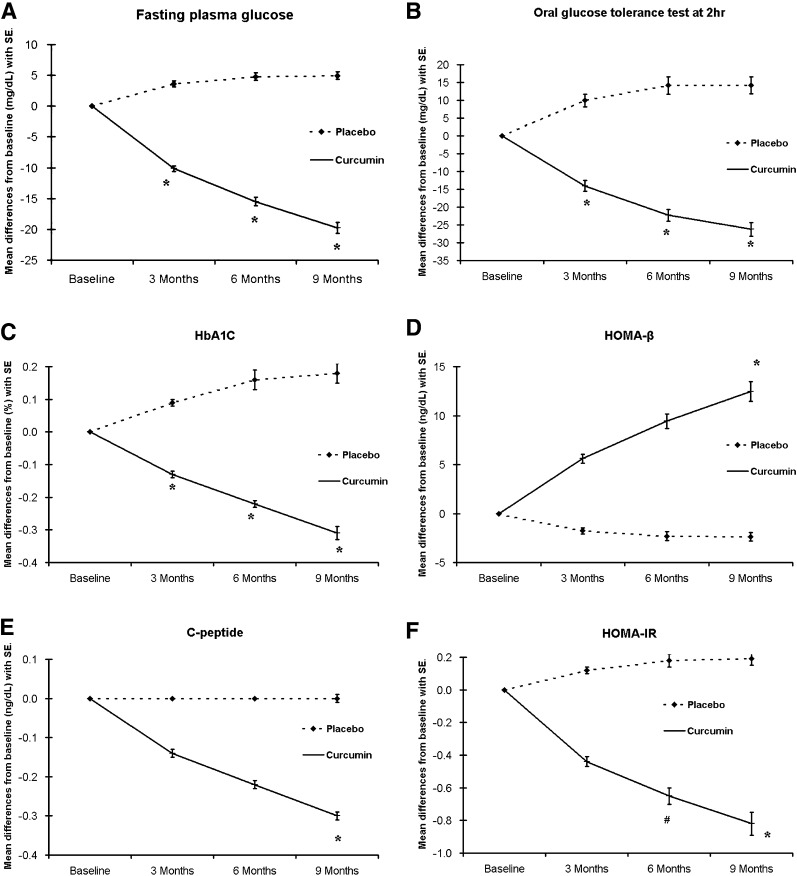
This randomized, double-blinded, placebo- controlled trial included subjects (n = 240) with criteria of prediabetes. All subjects were randomly assigned to receive either curcumin or placebo capsules for 9 months. To assess the T2DM progression after curcumin treatments and to determine the number of subjects progressing to T2DM, changes in β-cell functions (homeostasis model assessment [HOMA]-β, C-peptide, and proinsulin/insulin), insulin resistance (HOMA-IR), anti-inflammatory cytokine (adiponectin), and other parameters were monitored at the baseline and at 3-, 6-, and 9-month visits during the course of intervention.
After 9 months of treatment, 16.4% of subjects in the placebo group were diagnosed with T2DM, whereas none were diagnosed with T2DM in the curcumin-treated group. In addition, the curcumin-treated group showed a better overall function of β-cells, with higher HOMA-β (61.58 vs. 48.72; P < 0.01) and lower C-peptide (1.7 vs. 2.17; P < 0.05). The curcumin-treated group showed a lower level of HOMA-IR (3.22 vs. 4.04; P < 0.001) and higher adiponectin (22.46 vs. 18.45; P < 0.05) when compared with the placebo group.
A 9-month curcumin intervention in a prediabetic population significantly lowered the number of prediabetic individuals who eventually developed T2DM. In addition, the curcumin treatment appeared to improve overall function of β-cells, with very minor adverse effects. Therefore, this study demonstrated that the curcumin intervention in a prediabetic population may be beneficial.
评估姜黄素在延缓糖尿病前期人群 2 型糖尿病(T2DM)发展方面的疗效。
这项随机、双盲、安慰剂对照试验纳入了符合糖尿病前期标准的受试者(n=240)。所有受试者均随机分配接受姜黄素或安慰剂胶囊治疗 9 个月。为评估姜黄素治疗后 T2DM 的进展情况,并确定进展为 T2DM 的受试者人数,在干预过程中,于基线和 3、6、9 个月时监测β细胞功能(稳态模型评估[HOMA]-β、C 肽和胰岛素原/胰岛素)、胰岛素抵抗(HOMA-IR)、抗炎细胞因子(脂联素)和其他参数的变化。
治疗 9 个月后,安慰剂组有 16.4%的受试者被诊断为 T2DM,而姜黄素治疗组无一例被诊断为 T2DM。此外,姜黄素治疗组β细胞的整体功能更好,HOMA-β更高(61.58比 48.72;P<0.01),C 肽更低(1.7 比 2.17;P<0.05)。与安慰剂组相比,姜黄素治疗组的 HOMA-IR 水平更低(3.22 比 4.04;P<0.001),脂联素水平更高(22.46 比 18.45;P<0.05)。
在糖尿病前期人群中进行为期 9 个月的姜黄素干预可显著降低最终发展为 T2DM 的糖尿病前期人数。此外,姜黄素治疗似乎改善了β细胞的整体功能,且不良反应极小。因此,本研究表明,在糖尿病前期人群中进行姜黄素干预可能有益。