Postgraduate Programme in Epidemiology, Federal University of Pelotas, Pelotas, RS, Brazil.
BMC Public Health. 2012 Jul 9;12:511. doi: 10.1186/1471-2458-12-511.
Socioeconomic inequalities in child nutrition may change rapidly over time, particularly in populations undergoing the nutrition transition. Yet, the few available studies are repeated cross-sectional surveys. By studying three prospective birth cohorts in the same city over a period of more than two decades, we describe secular trends in overweight and stunting at different ages, according to socioeconomic position.
Population-based birth cohort studies were launched in the city of Pelotas (Brazil) in 1982, 1993 and 2004, with follow-up visits at twelve, 24 and 48 months. Children were weighed and measured at every visit. Z-scores of length/height-for-age and body mass index-for-age were calculated using the WHO Child Growth Standards. The slope and relative indices of inequality, based on family income quintiles, were estimated for each follow-up visit.
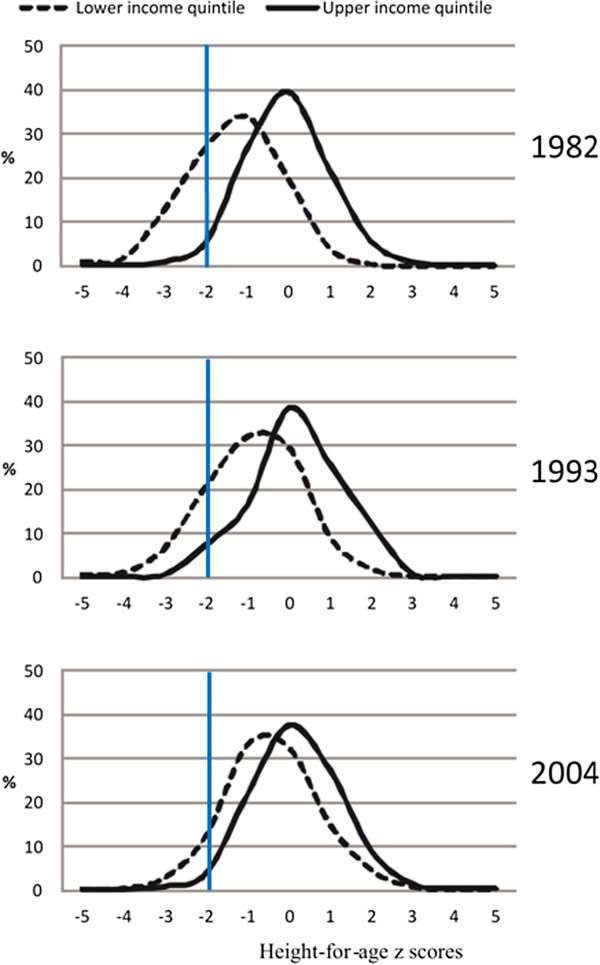
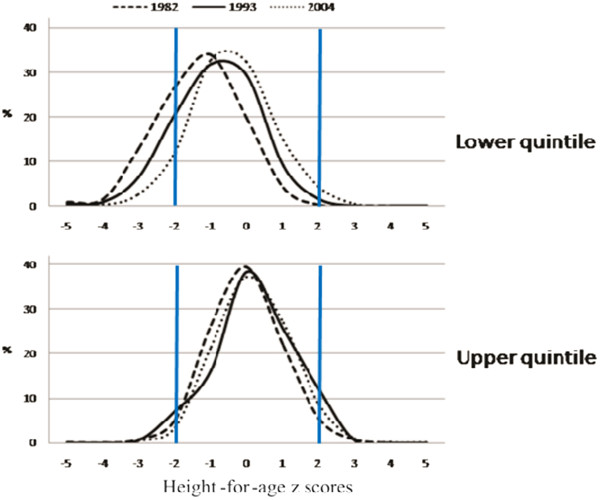
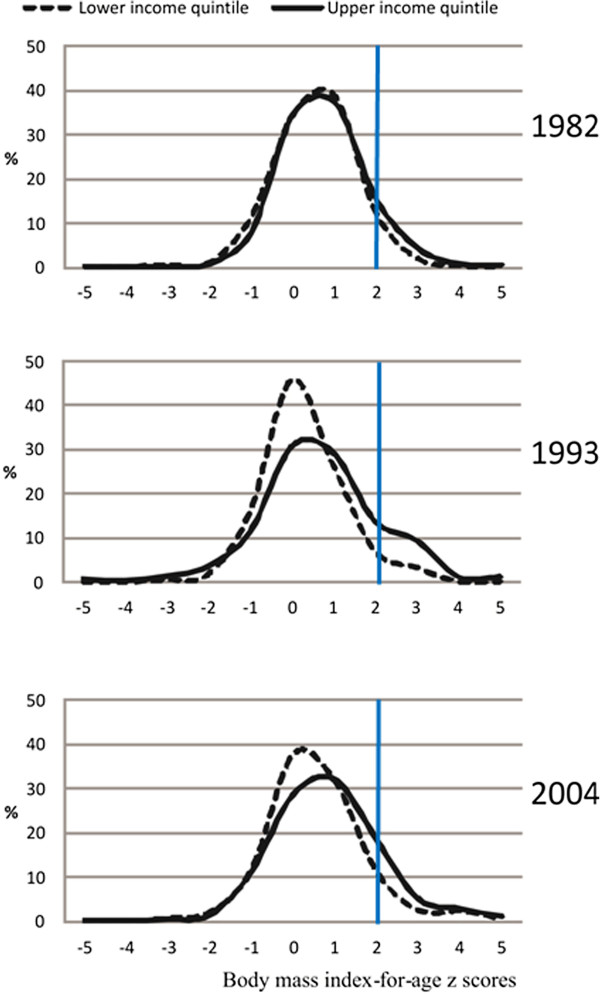
Between the 1982 and 2004 cohorts, stunting among four-year-olds declined (from 10.9% to 3.6%), while overweight increased (from 7.6% to 12.3%). In every visit, stunting prevalence was inversely related to income. Both absolute and relative inequalities declined over time; among four-year-olds stunting dropped from 26.0% in the 1982 cohort to 6.7% in the 2004 cohort in the poorest group, while in the richest group stunting prevalence dropped from 2.7% in 1982 to 1.1% in the 2004 cohort study. The secular trend towards increased overweight was evident for four-year-olds, in almost all socioeconomic groups, but not among one and two-year-olds. Among four-year old children, overweight prevalence increased in all income quintiles, by 130% in the middle-income group, 64% in the poorest and 41% in the richest group.
The decline in stunting is remarkable, but the increase in overweight among four-year olds - particularly among the poorest and the middle-income groups- requires concerted efforts to prevent the long term consequences of child overweight.
社会经济不平等可能会在儿童营养方面迅速变化,特别是在经历营养转型的人群中。然而,现有的少数研究都是重复的横断面调查。通过在同一个城市研究三个前瞻性的出生队列,我们描述了根据社会经济地位,不同年龄的超重和发育迟缓的长期趋势。
1982 年、1993 年和 2004 年在巴西佩洛塔斯市开展了基于人群的出生队列研究,随访时间为 12 个月、24 个月和 48 个月。每次就诊时都会对儿童进行称重和测量。使用世卫组织儿童生长标准计算身长/身高年龄和体重指数/年龄的 Z 分数。根据家庭收入五分位数计算每个随访就诊时的斜率和不平等相对指数。
在 1982 年至 2004 年的队列中,四岁儿童的发育迟缓率下降(从 10.9%降至 3.6%),而超重率增加(从 7.6%增至 12.3%)。在每次就诊时,发育迟缓的患病率与收入呈反比。绝对和相对不平等都随时间下降;在四岁儿童中,最贫困组的发育迟缓率从 1982 年队列的 26.0%降至 2004 年队列的 6.7%,而最富裕组的发育迟缓率从 1982 年的 2.7%降至 2004 年队列的 1.1%。在几乎所有社会经济群体中,四岁儿童的超重率都呈上升趋势,但在一岁和两岁儿童中没有这种趋势。在四岁儿童中,所有收入五分位数的超重率都有所增加,中等收入组增加了 130%,最贫困组增加了 64%,最富裕组增加了 41%。
发育迟缓的下降是显著的,但四岁儿童的超重率上升,尤其是最贫困和中等收入组,需要共同努力,以防止儿童超重的长期后果。