Fossdal Carl Gunnar, Yaqoob Nadeem, Krokene Paal, Kvaalen Harald, Solheim Halvor, Yakovlev Igor A
Norwegian Forest and Landscape Institute, Høgskoleveien 8, As, NO-1431, Norway.
BMC Plant Biol. 2012 Jul 9;12:105. doi: 10.1186/1471-2229-12-105.
NB-LRR resistance proteins are involved in recognizing pathogens and other exogenous stressors in plants. Resistance proteins are the first step in induced defence responses and a better understanding of their regulation is important to understand the mechanisms of plant defence. Much of the post-transcriptional regulation in plants is controlled by microRNAs (miRNA). We examined the expression of five Norway spruce miRNA that may regulate NB-LRR related transcripts in secondary phloem (bark) of resistant Norway spruce after wounding and inoculation with the necrotrophic blue stain fungus Ceratocystis polonica.
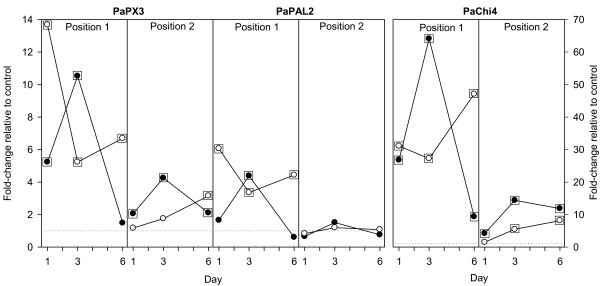
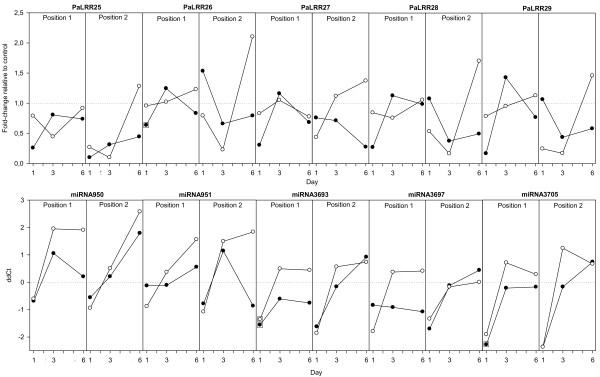
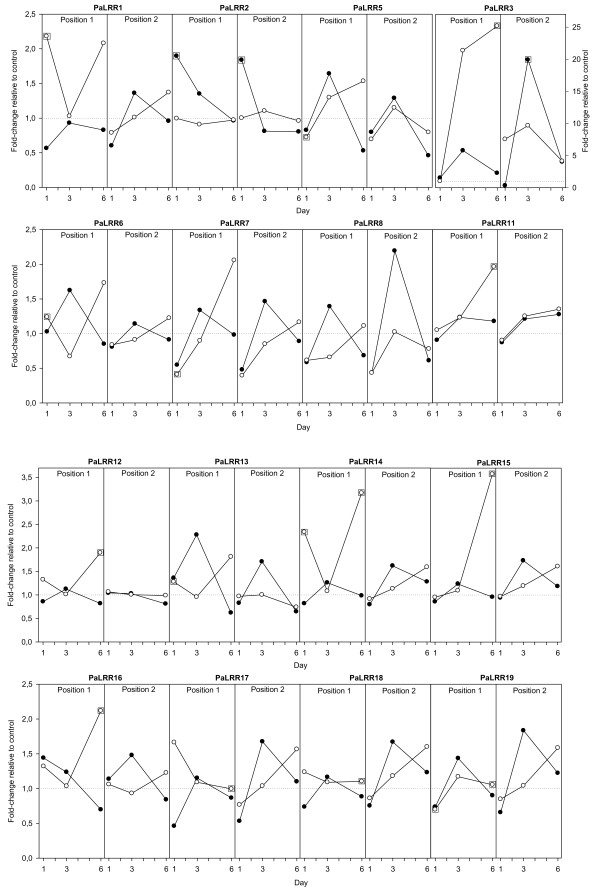
The plants of this clone recovered from both the pathogen inoculations and wounding alone. We found local and systemic induction of the resistance marker genes PaChi4, PaPAL and PaPX3 indicative of an effective induced host defence response. There were minor local and systemic changes in the expression of five miRNAs and 21 NB-LRRs between healthy and treated plants. Only five putative NB-LRRs (PaLRR1, PaLRR3, PaLRR14, PaLRR15 and PaLRR16) showed significant increases greater than two-fold as a local response to C. polonica. Of all NB-LRRs only PaLRR3, the most highly differentially regulated NB-LRR, showed a significant increase also due to wounding. The five miRNAs showed indications of an initial local and systemic down-regulation at day 1, followed by a later increase up to and beyond the constitutive levels at day 6. However, the initial down-regulation was significant only for miR3693 and miR3705.
Overall, local and systemic expression changes were evident only for the established resistance marker genes and PaLRR3. The minor expression changes observed both for the followed miRNAs and their predicted NB-LRR targets suggest that the expression of most NB-LRR genes are maintained close to their constitutive levels in stressed and healthy Norway spruce plants.
NB-LRR抗性蛋白参与植物中病原体及其他外源应激源的识别。抗性蛋白是诱导防御反应的第一步,更好地理解其调控对于了解植物防御机制至关重要。植物中的许多转录后调控由微小RNA(miRNA)控制。我们检测了5种挪威云杉miRNA的表达,这些miRNA可能在抗性挪威云杉受伤并接种坏死营养型蓝变真菌波兰长喙壳菌后调控次生韧皮部(树皮)中与NB-LRR相关的转录本。
该克隆的植株从病原体接种和单独受伤中均恢复过来。我们发现抗性标记基因PaChi4、PaPAL和PaPX3的局部和系统诱导,表明宿主诱导防御反应有效。在健康植株和处理后的植株之间,5种miRNA和21种NB-LRR的表达存在轻微的局部和系统变化。仅5种假定的NB-LRR(PaLRR1、PaLRR3、PaLRR14、PaLRR15和PaLRR16)作为对波兰长喙壳菌的局部反应显示出大于两倍的显著增加。在所有NB-LRR中,只有差异调控程度最高的PaLRR3也因受伤而显著增加。这5种miRNA在第1天显示出初始局部和系统下调的迹象,随后在第6天增加至并超过组成型水平。然而,初始下调仅对miR3693和miR3705显著。
总体而言,仅已确立的抗性标记基因和PaLRR3存在明显的局部和系统表达变化。所检测的miRNA及其预测的NB-LRR靶标的轻微表达变化表明,在受胁迫和健康的挪威云杉植株中,大多数NB-LRR基因的表达维持在接近其组成型水平。