Centre of Excellence in Clinical Virology, Department of Pediatrics, Faculty of Medicine, Chulalongkorn University, Bangkok, Thailand.
Hum Vaccin Immunother. 2012 Jul;8(7):896-904. doi: 10.4161/hv.19989. Epub 2012 Jul 1.
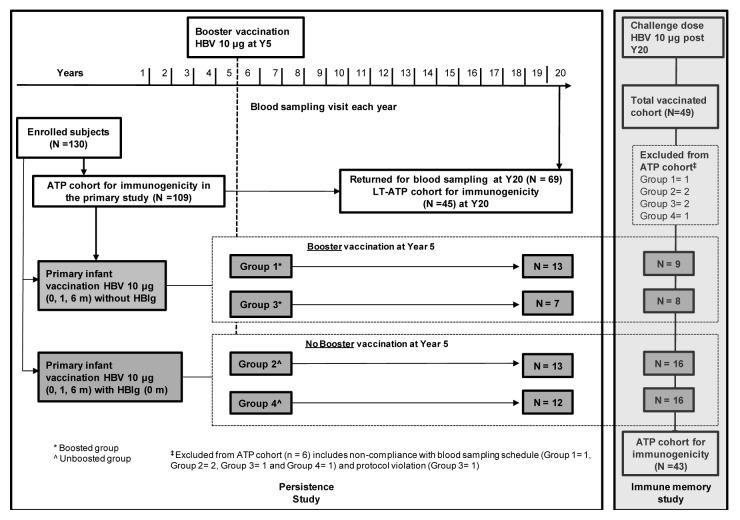
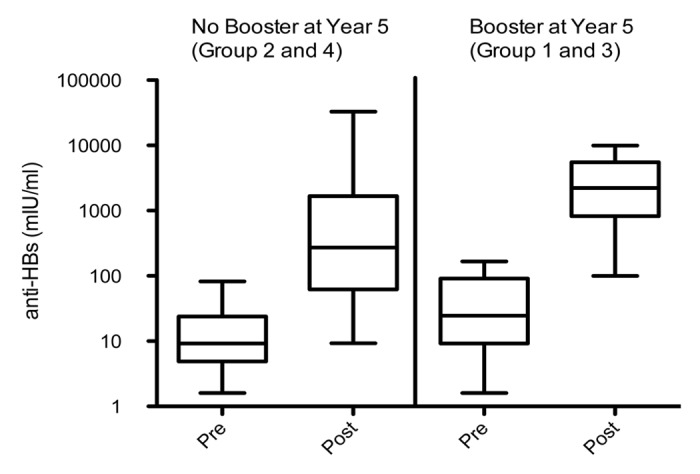
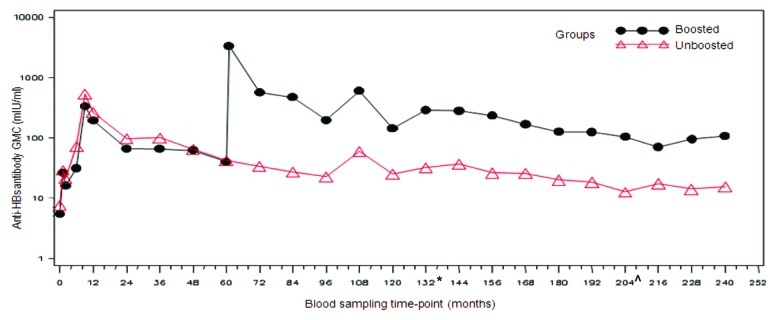
This study assessed antibody persistence and immune memory to hepatitis B vaccine 20 y after priming with a recombinant hepatitis B virus (HBV) vaccine during infancy. Infants were vaccinated according to a 0, 1, 6 mo schedule with or without simultaneous administration of hepatitis B immunoglobulin (HBIg). Half of the subjects enrolled received an interim booster dose at year 5 (boosted) group, whereas the other half of the subjects enrolled did not (unboosted group). Antibody persistence was assessed until year 20. Immune memory was assessed by administration of a final HBV vaccine challenge dose at year 20 in a second study. At year 20, anti-HBs antibody concentration ≥ 10 mIU/ml rates and GMCs were higher among subjects in the boosted group (84.2% [16/19]; 95%CI: 60.4-96.6) when compared with those in the unboosted group [44.0% (11/25)]; 95% CI: 24.4-65.1). After the HBV vaccine challenge dose at year 20, anti-HBs anamnestic response for subjects in the unboosted and boosted groups was observed in 93.1% (95% CI: 77.2-99.2) and 100% (95% CI: 76.8-100) of subjects, respectively. The mean anti-HBs antibody concentration (GMC) was 562.0 mIU/ml (292.5-1079.7 mIU/ml) post administration of the challenge dose; this is a 28.5 fold increase from the pre- to post-challenge dose administration at year 20. This study demonstrates persistence of anti-HBs antibodies and presence of immune memory following hepatitis B vaccination for up to at least 20 y in Thailand. Immune memory was demonstrated for virtually all subjects, regardless whether they received they had received the additional HBV dose or not. The challenge dose at year 20 was well tolerated and a robust response was demonstrated. ClinicalTrials.gov Identifier: NCT00240526, NCT00774995.
本研究评估了婴儿时期接受重组乙型肝炎病毒(HBV)疫苗初免后 20 年时乙型肝炎疫苗的抗体持久性和免疫记忆。婴儿按照 0、1、6 个月的时间表接种疫苗,同时可单独给予乙型肝炎免疫球蛋白(HBIg)。入组的一半受试者在第 5 年接受了一次临时加强剂量(加强组),而另一半受试者未接受加强剂量(未加强组)。直至第 20 年评估抗体持久性。在第 20 年的第二项研究中,通过给予最终的 HBV 疫苗挑战剂量来评估免疫记忆。第 20 年时,加强组受试者的抗-HBs 抗体浓度≥10mIU/ml 的比例和几何平均浓度(GMC)更高[84.2%(16/19);95%CI:60.4-96.6],而非加强组的受试者更低[44.0%(11/25);95%CI:24.4-65.1]。在第 20 年接受 HBV 疫苗挑战剂量后,未加强组和加强组受试者均观察到抗-HBs 回忆应答,分别为 93.1%(95%CI:77.2-99.2)和 100%(95%CI:76.8-100)。接种挑战剂量后,抗-HBs 抗体浓度(GMC)均值为 562.0mIU/ml(292.5-1079.7mIU/ml),与第 20 年接种前相比,这是接种后剂量的 28.5 倍增加。本研究表明,在泰国,乙型肝炎疫苗接种后长达 20 年以上,抗-HBs 抗体持续存在且具有免疫记忆。无论是否接受了额外的 HBV 剂量,几乎所有受试者都具有免疫记忆。第 20 年的挑战剂量具有良好的耐受性,并显示出了强大的应答。临床试验注册编号:NCT00240526,NCT00774995。