Section of Molecular Cell and Developmental Biology, Institute for Cellular and Molecular Biology, University of Texas, Austin, TX 78712, USA.
J Cell Biol. 2012 Jul 9;198(1):37-45. doi: 10.1083/jcb.201204072.
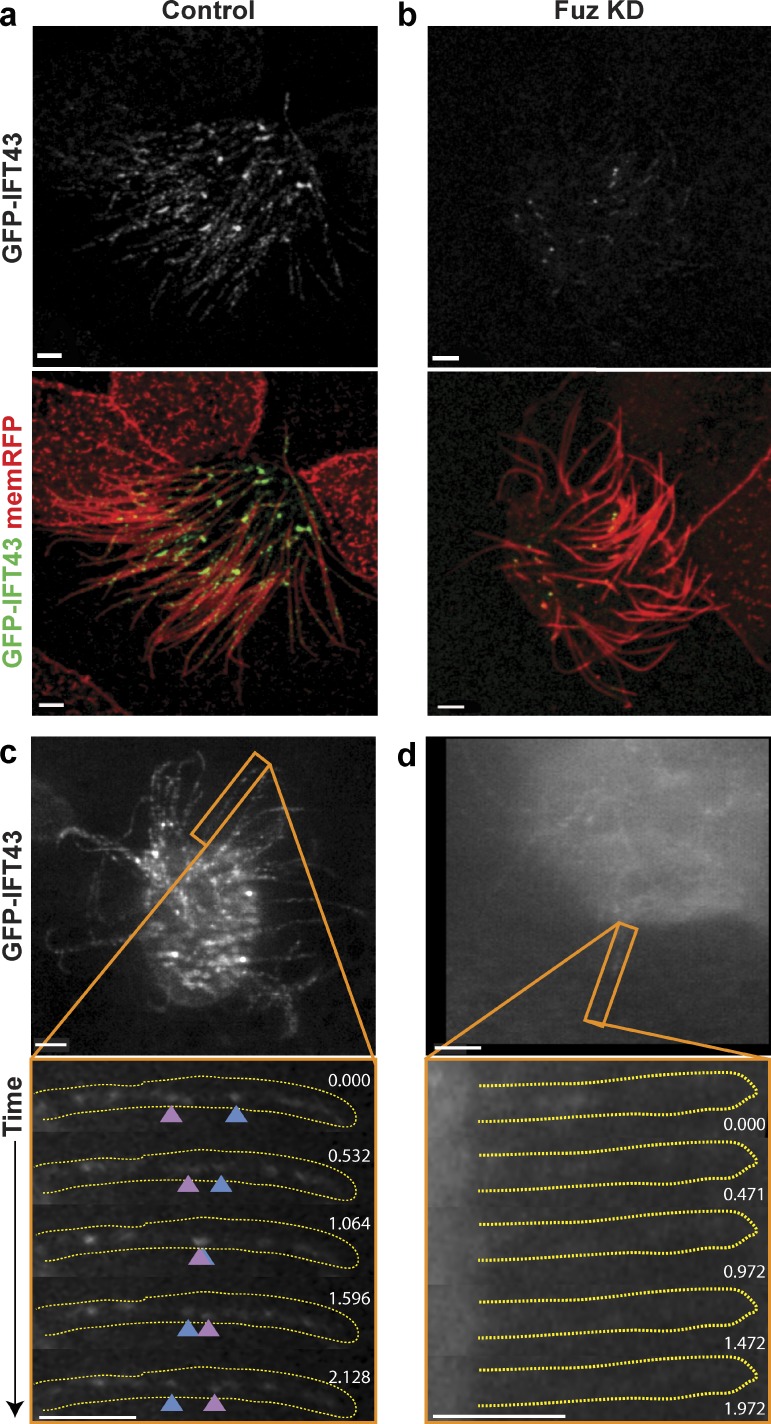
Cilia play key roles in development and homeostasis, and defects in cilia structure or function lead to an array of human diseases. Ciliogenesis is accomplished by the intraflagellar transport (IFT) system, a set of proteins governing bidirectional transport of cargoes within ciliary axonemes. In this paper, we present a novel platform for in vivo analysis of vertebrate IFT dynamics. Using this platform, we show that the planar cell polarity (PCP) effector Fuz was required for normal IFT dynamics in vertebrate cilia, the first evidence directly linking PCP to the core machinery of ciliogenesis. Further, we show that Fuz played a specific role in trafficking of retrograde, but not anterograde, IFT proteins. These data place Fuz in the small group of known IFT effectors outside the core machinery and, additionally, identify Fuz as a novel cytoplasmic effector that differentiates between the retrograde and anterograde IFT complexes.
纤毛在发育和稳态中发挥着关键作用,纤毛结构或功能的缺陷会导致一系列人类疾病。纤毛发生是通过内鞭毛运输(IFT)系统完成的,该系统是一组控制纤毛轴丝内货物双向运输的蛋白质。在本文中,我们提出了一种用于体内分析脊椎动物 IFT 动力学的新平台。使用该平台,我们表明平面细胞极性(PCP)效应因子 Fuz 对于脊椎动物纤毛中正常的 IFT 动力学是必需的,这是直接将 PCP 与纤毛发生的核心机制联系起来的第一个证据。此外,我们还表明 Fuz 在逆行 IFT 蛋白的运输中发挥特定作用,但在顺行 IFT 蛋白的运输中不起作用。这些数据将 Fuz 置于已知的核心机制之外的少数 IFT 效应因子之列,此外,还将 Fuz 确定为一种新的细胞质效应因子,可区分逆行和顺行 IFT 复合物。