Lin Xin, Zhang Huan, Cui Yudong, Lin Senjie
State Key Laboratory of Marine Environmental Science, Xiamen University Xiamen, Fujian, China.
Front Microbiol. 2012 Jul 2;3:235. doi: 10.3389/fmicb.2012.00235. eCollection 2012.
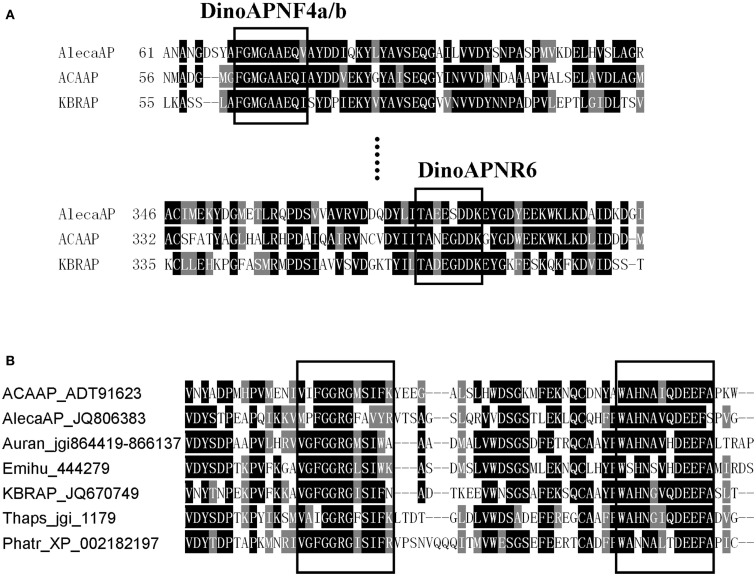
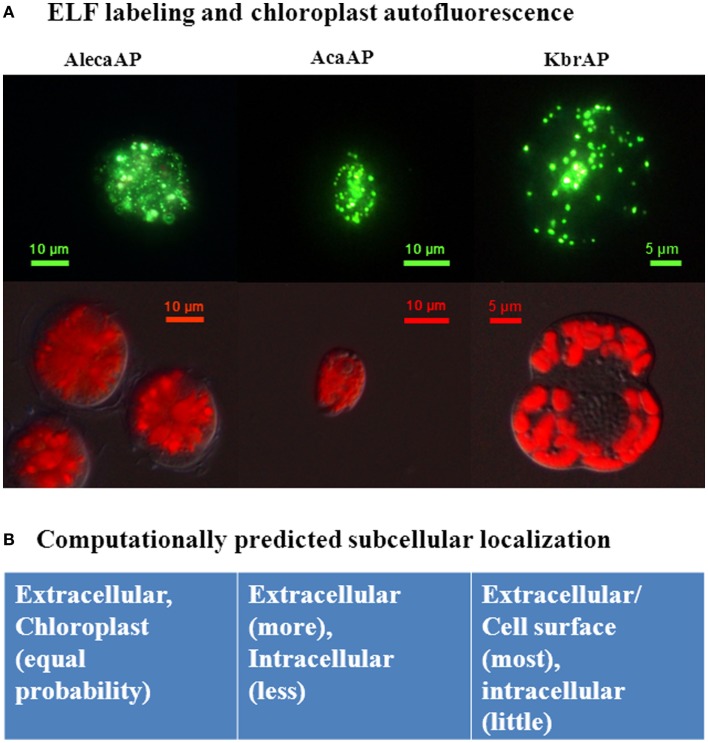
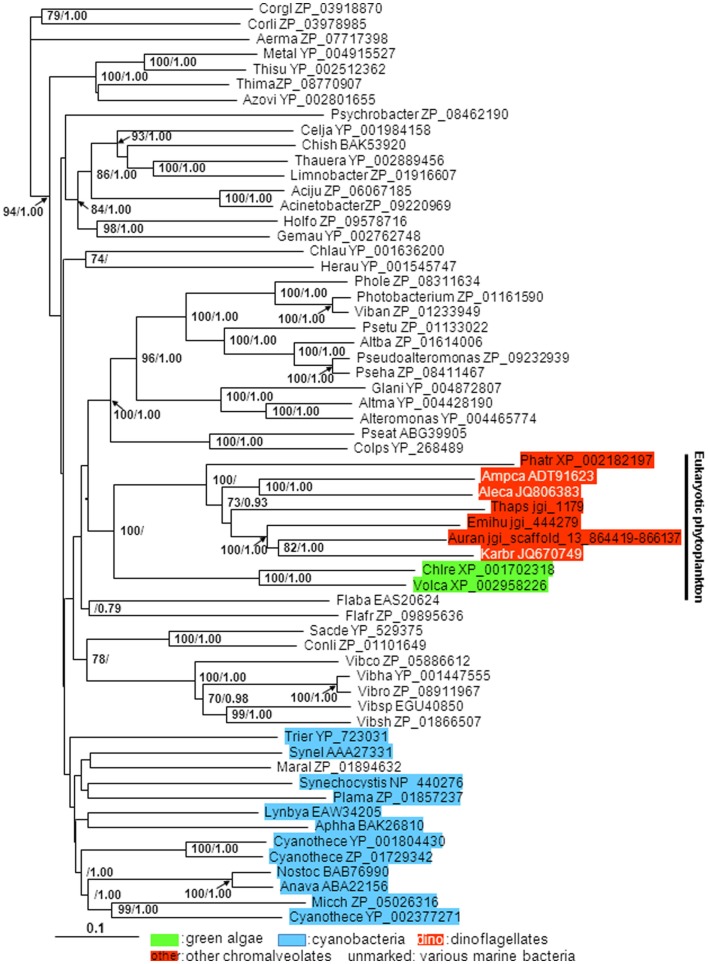
Alkaline phosphatase (AP) is a key enzyme for phytoplankton to utilize dissolved organic phosphorus (DOP) when dissolved inorganic phosphorus is limited. While three major types of AP and their correspondingly diverse subcellular localization have been recognized in bacteria, little is known about AP in eukaryotic phytoplankton such as dinoflagellates. Here, we isolated a full-length AP cDNA from a latest-diverging dinoflagellate genus Alexandrium, and conducted comparative analyses with homologs from a relatively basal (Amphidinium carterae) and late-diverging (Karenia brevis) lineage of dinoflagellates as well as other eukaryotic algae. New data and previous studies indicate that AP is common in dinoflagellates and most other major eukaryotic groups of phytoplankton. AP sequences are more variable than many other genes studied in dinoflagellates, and are divergent among different eukaryotic phytoplankton lineages. Sequence comparison to the other characterized APs suggests that dinoflagellates and some other eukaryotic phytoplankton possess the putative AP as phoA type, but some other eukaryotic phytoplankton seem to have other types. Phylogenetic analyses based on AP amino acid sequences indicated that the "red-type" eukaryotic lineages formed a monophyletic group, suggesting a common origin of their APs. As different amino acid sequences have been found to predictably determine different spatial distribution in the cells, which may facilitate access to different pools of DOP, existing computational models were adopted to predict the subcellular localizations of putative AP in the three dinoflagellates and other eukaryotic phytoplankton. Results showed different subcellular localizations of APs in different dinoflagellates and other lineages. The linkage between AP sequence divergence, subcellular localization, and ecological niche differentiation requires rigorous experimental verification, and this study now provides a framework for such a future effort.
碱性磷酸酶(AP)是浮游植物在溶解无机磷有限时利用溶解有机磷(DOP)的关键酶。虽然在细菌中已识别出三种主要类型的AP及其相应多样的亚细胞定位,但对于诸如甲藻等真核浮游植物中的AP却知之甚少。在此,我们从一个分化较晚的甲藻属亚历山大藻中分离出一条全长AP cDNA,并与来自甲藻相对基部(卡氏扁甲藻)和分化较晚(短裸甲藻)谱系以及其他真核藻类的同源物进行了比较分析。新数据和先前的研究表明,AP在甲藻和大多数其他主要的真核浮游植物类群中很常见。AP序列比在甲藻中研究的许多其他基因更具变异性,并且在不同的真核浮游植物谱系中存在差异。与其他已表征的AP进行序列比较表明,甲藻和一些其他真核浮游植物拥有推测为phoA类型的AP,但其他一些真核浮游植物似乎具有其他类型。基于AP氨基酸序列的系统发育分析表明,“红色型”真核谱系形成一个单系类群,表明它们的AP有共同起源。由于已发现不同的氨基酸序列可预测地决定细胞中的不同空间分布,这可能有助于获取不同的DOP库,因此采用现有的计算模型来预测三种甲藻和其他真核浮游植物中推测AP的亚细胞定位。结果显示不同甲藻和其他谱系中AP的亚细胞定位不同。AP序列差异、亚细胞定位和生态位分化之间的联系需要严格的实验验证,而本研究现在为未来的此类工作提供了一个框架。