Institute of Geriatric Cardiology, Chinese PLA General Hospital, Beijing 100853, China.
J Geriatr Cardiol. 2011 Mar;8(1):31-4. doi: 10.3724/SP.J.1263.2011.00031.
The present study investigated the prognostic value of medical comorbidities at admission for 30-day in-hospital mortality in patients with acute myocardial infarction (AMI).
A total of 5161 patients with AMI were admitted in Chinese PLA General Hospital between January 1, 1993 and December 31, 2007. Medical comorbidities including hypertension, diabetes mellitus, previous myocardial infarction, valvular heart disease, chronic obstructive pulmonary disease (COPD), renal insufficiency, previous stroke, atrial fibrillation and anemia, were identified at admission. The patients were divided into 4 groups based on the number of medical comorbidities at admission (0, 1, 2, and ≥ 3). Cox regression analysis was used to calculate relative risk (RR) and 95% confidence intervals (CI), with adjustment for age, sex, heart failure and percutaneous coronary intervention (PCI).
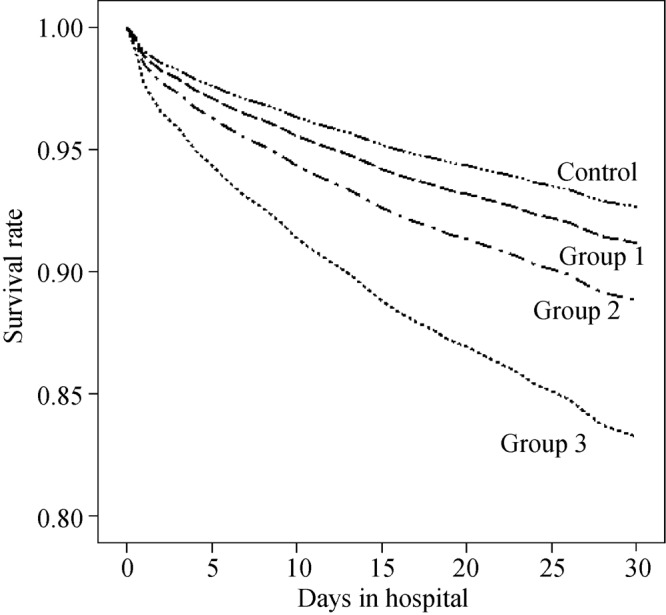
The mean age of the studied population was 63.9 ± 13.6 years, and 80.1% of the patients were male. In 74.6% of the patients at least one comorbidity were identified. Hypertension (50.7%), diabetes mellitus (24.0%) and previous myocardial infarction (12%) were the leading common comorbidities at admission. The 30-day in-hospital mortality in patients with 0, 1, 2, and ≥ 3 comorbidities at admission (7.2%) was 4.9%, 7.2%, 11.1%, and 20.3%, respectively. The presence of 2 or more comorbidities was associated with higher 30-day in-hospital mortality compared with patients without comorbidity (RR: 1.41, 95% CI: 1.13-1.77, P = 0.003, and RR: 1.95, 95% CI: 1.59-2.39, P = 0.000, respectively).
Medical comorbidities were frequently found in patients with AMI. AMI patients with more comorbidities had a higher 30-day in-hospital mortality might be predictive of early poor outcome in patients with AMI.
本研究旨在探讨入院时合并症对急性心肌梗死(AMI)患者 30 天院内死亡率的预后价值。
回顾性分析 1993 年 1 月 1 日至 2007 年 12 月 31 日期间在中国人民解放军总医院住院的 5161 例 AMI 患者。入院时记录的合并症包括高血压、糖尿病、既往心肌梗死、瓣膜性心脏病、慢性阻塞性肺疾病(COPD)、肾功能不全、既往卒中和心房颤动、贫血。根据入院时合并症的数量(0、1、2 和≥3 个)将患者分为 4 组。采用 Cox 回归分析计算相对危险度(RR)和 95%置信区间(CI),并调整年龄、性别、心力衰竭和经皮冠状动脉介入治疗(PCI)。
研究人群的平均年龄为 63.9±13.6 岁,80.1%为男性。74.6%的患者至少有一种合并症。入院时最常见的合并症为高血压(50.7%)、糖尿病(24.0%)和既往心肌梗死(12%)。入院时无合并症、1 种合并症、2 种合并症和≥3 种合并症的患者 30 天院内死亡率分别为 7.2%、7.2%、11.1%和 20.3%。与无合并症患者相比,存在 2 种或更多合并症的患者 30 天院内死亡率更高(RR:1.41,95%CI:1.13-1.77,P=0.003;RR:1.95,95%CI:1.59-2.39,P=0.000)。
AMI 患者常合并多种合并症。合并症较多的 AMI 患者 30 天院内死亡率较高,可能预示着 AMI 患者早期预后不良。