Public Health, Department of Social and Environmental Medicine, Graduate School of Medicine, Osaka University, Suita, Osaka, Japan.
J Epidemiol. 2012;22(4):331-9. doi: 10.2188/jea.je20110163. Epub 2012 Jun 16.
We assessed the impact of parental history of stroke on stroke mortality, as well as the effect modification between lifestyle and stroke mortality, among Japanese.
In this community-based, prospective cohort study, 22,763 men and 30,928 women aged 40 to 79 years with no history of cardiovascular disease or cancer at baseline (1988-1990) were followed through 2008. We examined the association between parental history of stroke and stroke mortality and estimated the impact of the combination of lifestyle and parental history on stroke mortality in offspring.
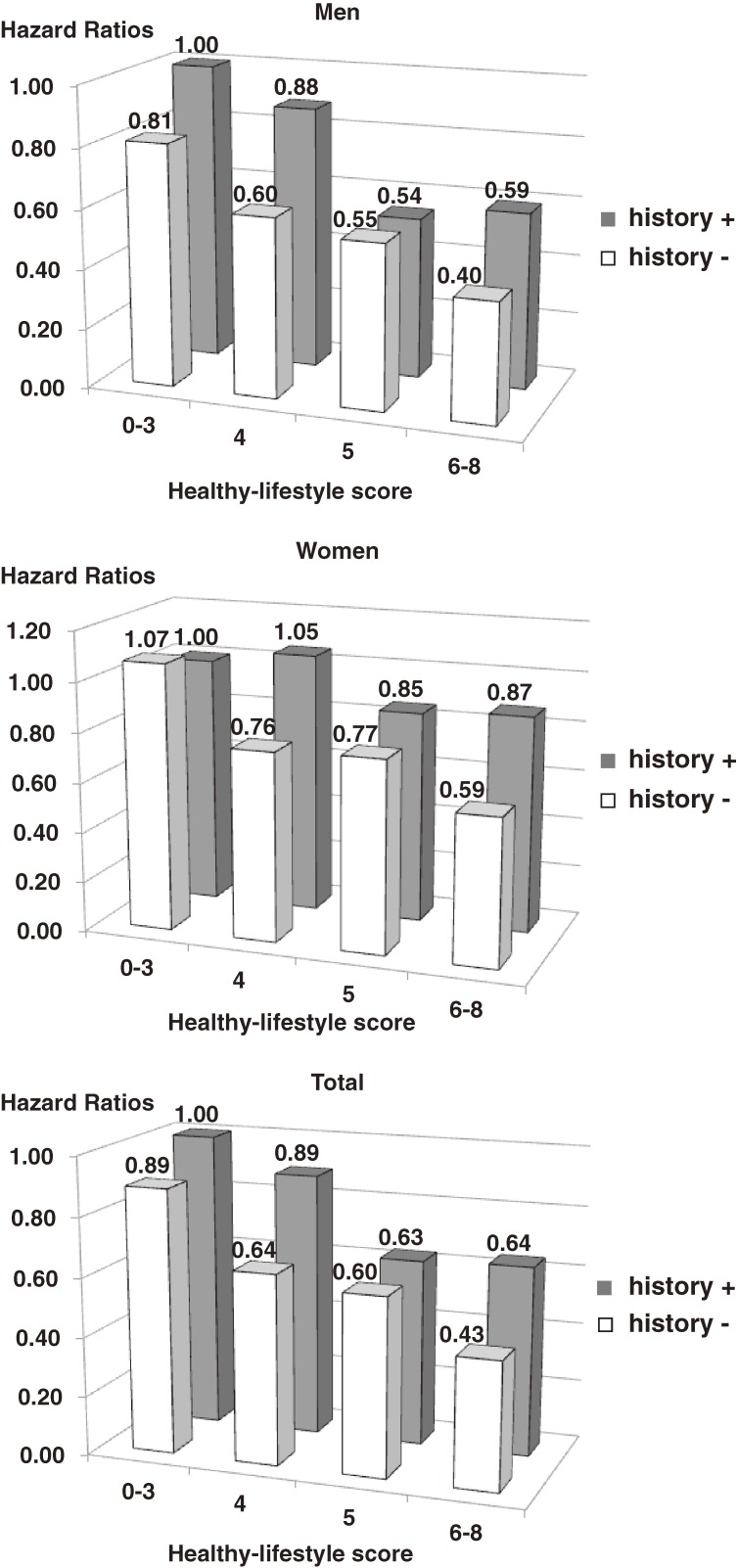
During a mean follow-up period of 15.9 years, there were 1502 stroke deaths. In both sexes, participants with a parental history of stroke had a higher risk of stroke mortality as compared with those without such a history. The respective multivariable hazard ratio (95% CI) and population attributable fraction were 1.28 (1.10-1.49) and 5.4% in men, 1.22 (1.04-1.43) and 4.3% in women, and 1.25 (1.12-1.40) and 4.8% in all participants, for offspring with a maternal and/or paternal history of stroke. There was an inverse association between healthy-lifestyle score and stroke mortality, irrespective of parental history of stroke. The overall multivariable hazard ratio for the highest (6-8) versus the lowest (0-3) score categories was 0.56 (95% CI, 0.43-0.72) for participants with a maternal and/or paternal history of stroke and 0.44 (0.36-0.53) for those without such a history.
Parental history of stroke was associated with stroke mortality in offspring. The inverse association between healthy lifestyle behaviors and stroke mortality, regardless of parental history, suggests that lifestyle modification is beneficial, even among individuals with a parental history of stroke.
我们评估了父母中风史对日本人群中风死亡率的影响,以及生活方式与中风死亡率之间的效应修饰作用。
在这项基于社区的前瞻性队列研究中,共有 22763 名男性和 30928 名女性,年龄在 40 岁至 79 岁之间,基线时无心血管疾病或癌症史(1988-1990 年),随访至 2008 年。我们研究了父母中风史与中风死亡率之间的关系,并估计了生活方式和父母中风史的组合对后代中风死亡率的影响。
在平均 15.9 年的随访期间,有 1502 例中风死亡。在男性和女性中,与无此类病史的参与者相比,有父母中风史的参与者中风死亡率更高。相应的多变量危险比(95%CI)和人群归因分数分别为男性 1.28(1.10-1.49)和 5.4%,女性 1.22(1.04-1.43)和 4.3%,所有参与者 1.25(1.12-1.40)和 4.8%,对于有母亲和/或父亲中风史的后代。无论父母的中风史如何,健康生活方式评分与中风死亡率呈负相关。对于有母亲和/或父亲中风史的参与者,最高(6-8)与最低(0-3)评分组别的总体多变量危险比为 0.56(95%CI,0.43-0.72),对于没有此类病史的参与者,该比值为 0.44(0.36-0.53)。
父母的中风史与后代的中风死亡率有关。无论父母的中风史如何,健康的生活方式行为与中风死亡率呈负相关,这表明即使在有父母中风史的个体中,生活方式的改变也是有益的。