Michishita Ryoma, Matsuda Takuro, Kawakami Shotaro, Kiyonaga Akira, Tanaka Hiroaki, Morito Natsumi, Higaki Yasuki
Department of Health Development, Institute of Industrial Ecological Sciences, University of Occupational and Environmental Health.
J Epidemiol. 2016 Jul 5;26(7):378-85. doi: 10.2188/jea.JE20150202. Epub 2016 Mar 5.
This cross-sectional study evaluated the association between unhealthy lifestyle behaviors and the prevalence of chronic kidney disease (CKD) in middle-aged and older men.
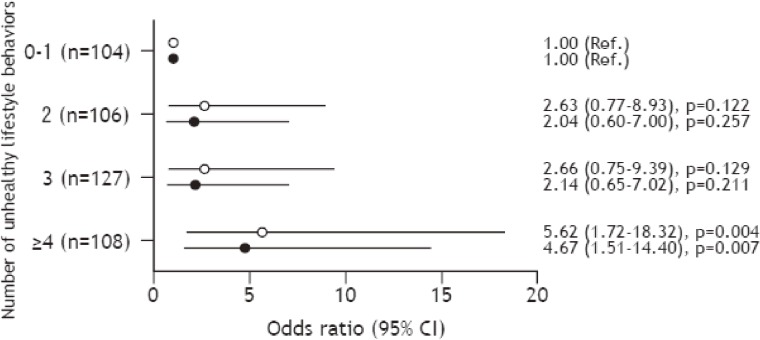
The subjects included 445 men without a history of cardiovascular disease, stroke, or dialysis treatment, who were not taking medications. Unhealthy lifestyle behaviors were evaluated using a standardized self-administered questionnaire and were defined as follows: 1) lack of habitual moderate exercise, 2) lack of daily physical activity, 3) slow walking speed, 4) fast eating speed, 5) late-night dinner, 6) bedtime snacking, and 7) skipping breakfast. The participants were divided into four categories, which were classified into quartile distributions based on the number of unhealthy lifestyle behaviors (0-1, 2, 3, and ≥4 unhealthy behaviors).
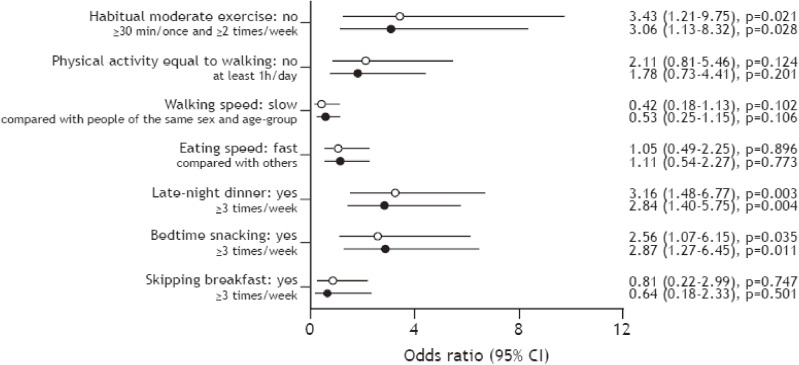
According to a multivariate analysis, the odds ratio (OR) for CKD (defined as estimated glomerular filtration rate [eGFR] <60 mL/min/1.73 m(2) and/or proteinuria) was found to be significantly higher in the ≥4 group than in the 0-1 group (OR 4.67; 95% confidence interval [CI], 1.51-14.40). Moreover, subjects' lack of habitual moderate exercise (OR 3.06; 95% CI, 1.13-8.32) and presence of late-night dinner (OR 2.84; 95% CI, 1.40-5.75) and bedtime snacking behaviors (OR 2.87; 95% CI, 1.27-6.45) were found to be significantly associated with the prevalence of CKD.
These results suggest that an accumulation of unhealthy lifestyle behaviors, especially those related to lack of habitual moderate exercise and presence of late-night dinner and bedtime snacking may be associated with the prevalence of CKD.
这项横断面研究评估了中年及老年男性不健康生活方式行为与慢性肾脏病(CKD)患病率之间的关联。
研究对象包括445名无心血管疾病、中风或透析治疗史且未服用药物的男性。使用标准化的自填问卷评估不健康生活方式行为,定义如下:1)缺乏习惯性适度运动,2)缺乏日常身体活动,3)步行速度慢,4)进食速度快,5)晚餐时间晚,6)睡前吃零食,7)不吃早餐。参与者被分为四类,根据不健康生活方式行为的数量(0 - 1、2、3和≥4种不健康行为)分为四分位数分布。
根据多变量分析,≥4种不健康行为组的CKD(定义为估计肾小球滤过率[eGFR]<60 mL/min/1.73 m²和/或蛋白尿)比值比(OR)显著高于0 - 1种不健康行为组(OR 4.67;95%置信区间[CI],1.51 - 14.40)。此外,发现受试者缺乏习惯性适度运动(OR 3.06;95% CI,1.13 - 8.32)、晚餐时间晚(OR 2.84;95% CI,1.40 - 5.75)和睡前吃零食行为(OR 2.87;95% CI,1.27 - 6.45)与CKD患病率显著相关。
这些结果表明,不健康生活方式行为的累积,尤其是那些与缺乏习惯性适度运动、晚餐时间晚和睡前吃零食相关的行为,可能与CKD患病率有关。