Department of Molecular Genetics and Microbiology, Duke University Medical Center, Durham, North Carolina, United States of America.
PLoS One. 2012;7(7):e39405. doi: 10.1371/journal.pone.0039405. Epub 2012 Jul 6.
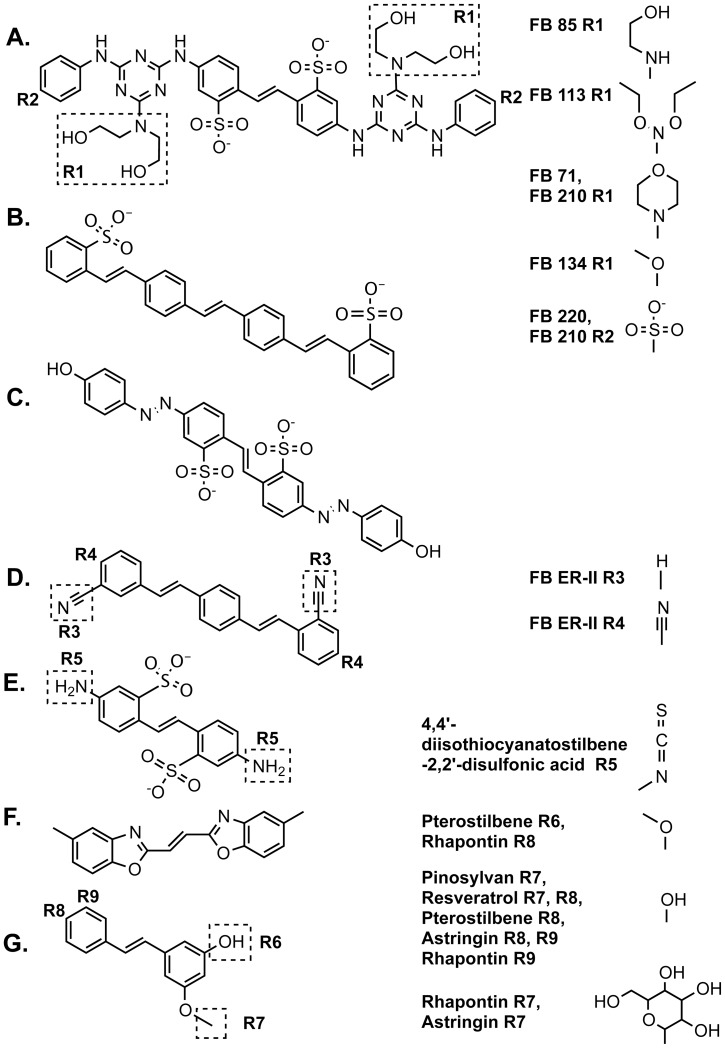
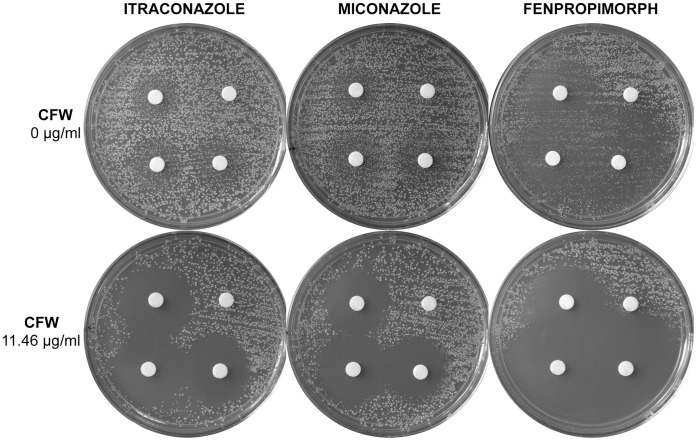
Superficial mycoses caused by dermatophyte fungi are among the most common infections worldwide, yet treatment is restricted by limited effective drugs available, drug toxicity, and emergence of drug resistance. The stilbene fluorescent brightener calcofluor white (CFW) inhibits fungi by binding chitin in the cell wall, disrupting cell wall integrity, and thus entails a different mechanism of inhibition than currently available antifungal drugs. To identify novel therapeutic options for the treatment of skin infections, we compared the sensitivity of representative strains of the dermatophyte Trichophyton rubrum and Candida albicans to CFW and a panel of fluorescent brighteners and phytoalexin compounds. We identified the structurally related stilbene fluorescent brighteners 71, 85, 113 and 134 as fungicidal to both T. rubrum and C. albicans to a similar degree as CFW, and the stilbene phytoalexins pinosylvan monomethyl ether and pterostilbene inhibited to a lesser degree, allowing us to develop a structure-activity relationship for fungal inhibition. Given the abilities of CFW to absorb UV(365 nm) and bind specifically to fungal cell walls, we tested whether CFW combined with UV(365 nm) irradiation would be synergistic to fungi and provide a novel photodynamic treatment option. However, while both treatments individually were cytocidal, UV(365 nm) irradiation reduced sensitivity to CFW, which we attribute to CFW photoinactivation. We also tested combination treatments of CFW with other fungal inhibitors and identified synergistic interactions between CFW and some ergosterol biosynthesis inhibitors in C. albicans. Therefore, our studies identify novel fungal inhibitors and drug interactions, offering promise for combination topical treatment regimes for superficial mycoses.
浅部真菌病是由真菌引起的,是全球最常见的感染之一,但由于现有有效药物有限、药物毒性和耐药性的出现,治疗受到限制。芪类荧光增白剂Calcofluor White(CFW)通过与细胞壁中的几丁质结合,破坏细胞壁完整性,从而抑制真菌,其抑制机制与现有抗真菌药物不同。为了寻找治疗皮肤感染的新治疗方法,我们比较了代表菌株的敏感性 Trichophyton rubrum 和 Candida albicans 对 CFW 和一组荧光增白剂和植物抗毒素化合物。我们确定了结构相关的芪类荧光增白剂 71、85、113 和 134 对 T. rubrum 和 C. albicans 具有杀菌作用,与 CFW 相似,而芪类植物抗毒素 pinosylvan monomethyl ether 和 pterostilbene 的抑制作用较弱,使我们能够建立真菌抑制的结构-活性关系。鉴于 CFW 吸收 UV(365nm)并特异性结合真菌细胞壁的能力,我们测试了 CFW 与 UV(365nm)照射结合是否对真菌具有协同作用,并提供一种新的光动力治疗选择。然而,虽然两种处理方法单独使用时都具有细胞毒性,但 UV(365nm)照射降低了对 CFW 的敏感性,我们将其归因于 CFW 的光失活。我们还测试了 CFW 与其他真菌抑制剂的联合治疗方法,并在 C. albicans 中确定了 CFW 与一些麦角固醇生物合成抑制剂之间的协同相互作用。因此,我们的研究确定了新型真菌抑制剂和药物相互作用,为浅部真菌病的联合局部治疗方案提供了希望。