Department of Epidemiology and Biostatistics, School of Public Health, Guiling Medical University, Guilin, China.
PLoS One. 2012;7(7):e40131. doi: 10.1371/journal.pone.0040131. Epub 2012 Jul 5.
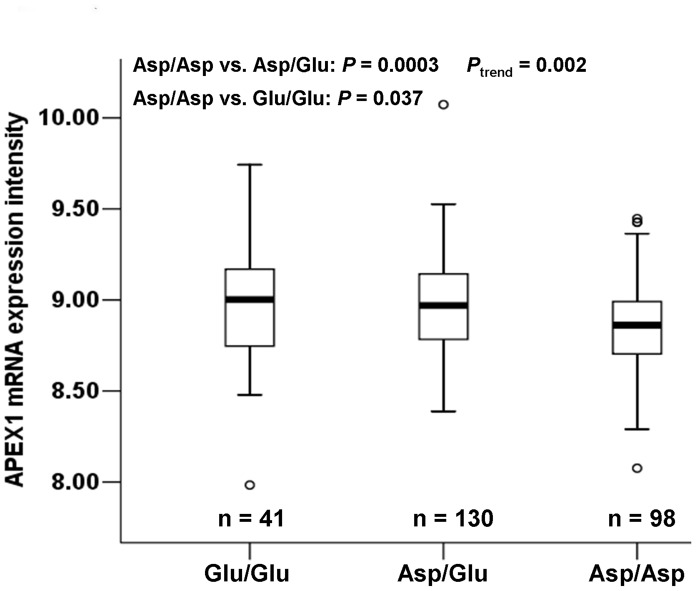
In vitro benzo[a]pyrene diol epoxide (BPDE)-induced DNA adducts in cultured peripheral lymphocytes have been shown to be a phenotypic biomarker of individual's DNA repair phenotype that is associated with cancer risk. In this study, we explored associations between genotypes of base-excision repair genes (PARP1 Val762Ala, APEX1 Asp148Glu, and XRCC1 Arg399Gln) and in vitro BPDE-induced DNA adducts in cultured peripheral blood lymphocytes in 706 cancer-free non-Hispanic white subjects. We found that levels of BPDE-induced DNA adducts were significantly higher in ever smokers than in never smokers and that individuals with the Glu variant genotypes (i.e., Asp/Glu and Glu/Glu) exhibited lower levels of BPDE-induced DNA adducts than did individuals with the common Asp/Asp homozygous genotype (median RAL levels: 32.0 for Asp/Asp, 27.0 for Asp/Glu, and 17.0 for Glu/Glu, respectively; P(trend) = 0.030). Further stratified analysis showed that compared with individuals with the common APEX1-148 homozygous Asp/Asp genotype, individuals with the APEX1-148Asp/Glu genotype or the Glu/Glu genotype had a lower risk of having higher-level adducts (adjusted OR = 0.60, 95% CI: 0.36-0.98 and adjusted OR = 0.47, 95% CI: 0.26-0.86, respectively; P(trend) = 0.012) among smokers. Such an effect was not observed in non-smokers. However, there was no significant interaction between the APEX1 Asp148Glu polymorphism and smoking exposure in this study population (P = 0.512). Additional genotype-phenotype analysis found that the APEX1-148Glu allele had significantly increased expression of APEX1 mRNA in 270 Epstein-Barr virus-transformed lymphoblastoid cell lines, which is likely associated with more active repair activity. Our findings suggest that the functional APEX1-148Glu allele is associated with reduced risk of having high levels of BPDE-induced DNA adducts mediated with high levels of mRNA expression.
体外苯并[a]芘二醇环氧化物(BPDE)诱导的培养外周血淋巴细胞中的 DNA 加合物已被证明是个体 DNA 修复表型的表型生物标志物,与癌症风险相关。在这项研究中,我们在 706 名非西班牙裔白人癌症患者中,探索了碱基切除修复基因(PARP1 Val762Ala、APE1 Asp148Glu 和 XRCC1 Arg399Gln)的基因型与体外 BPDE 诱导的培养外周血淋巴细胞中的 DNA 加合物之间的关联。我们发现,与从不吸烟者相比,曾吸烟者 BPDE 诱导的 DNA 加合物水平明显更高,而具有Glu 变异基因型(即 Asp/Glu 和 Glu/Glu)的个体的 BPDE 诱导的 DNA 加合物水平低于具有常见 Asp/Asp 纯合基因型的个体(中位数 RAL 水平:Asp/Asp 为 32.0,Asp/Glu 为 27.0,Glu/Glu 为 17.0;P(趋势)=0.030)。进一步的分层分析表明,与具有常见 APEX1-148 纯合 Asp/Asp 基因型的个体相比,具有 APEX1-148Asp/Glu 基因型或 Glu/Glu 基因型的个体发生高水平加合物的风险较低(调整后的 OR=0.60,95%CI:0.36-0.98 和调整后的 OR=0.47,95%CI:0.26-0.86;P(趋势)=0.012)在吸烟者中。在非吸烟者中未观察到这种影响。然而,在该研究人群中,APEX1 Asp148Glu 多态性与吸烟暴露之间没有显著的交互作用(P=0.512)。进一步的基因型-表型分析发现,APEX1-148Glu 等位基因在 270 个 Epstein-Barr 病毒转化的淋巴母细胞系中显著增加了 APEX1 mRNA 的表达,这可能与更活跃的修复活性有关。我们的研究结果表明,具有功能的 APEX1-148Glu 等位基因与 BPDE 诱导的 DNA 加合物水平较低相关,这与高水平的 mRNA 表达介导的高风险有关。