Department of Anesthesiology, Pharmacology and Physiology, University of Medicine and Dentistry of New Jersey, New Jersey Medical School, Newark, New Jersey, United States of America.
PLoS One. 2012;7(7):e40347. doi: 10.1371/journal.pone.0040347. Epub 2012 Jul 9.
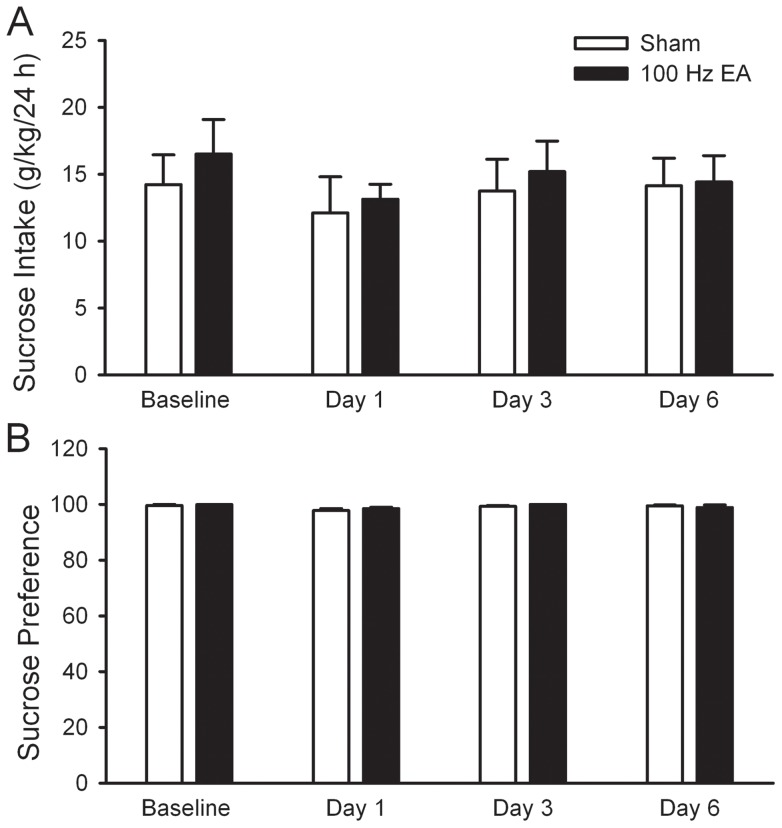
New therapies are needed for alcohol abuse, a major public health problem in the U.S. and worldwide. There are only three FDA-approved drugs for treatment of alcohol abuse (naltrexone, acamprosate and disulfuram). On average these drugs yield only moderate success in reducing long-term alcohol consumption. Electroacupuncture has been shown to alleviate various drugs of abuse, including alcohol. Although previous studies have shown that electroacupuncture reduced alcohol consumption, the underlying mechanisms have not been fully elucidated. ΔFosB and FosB are members of the Fos family of transcription factors implicated in neural plasticity in drug addiction; a connection between electroacupuncture's treatment of alcohol abuse and the Fos family has not been established. In this study, we trained rats to drink large quantities of ethanol in a modified intermittent access two-bottle choice drinking procedure. When rats achieved a stable baseline of ethanol consumption, electroacupuncture (100 Hz or 2 Hz, 30 min each day) was administered at Zusanli (ST36) for 6 consecutive days. The level of FosB/ΔFosB in reward-related brain regions was assessed by immunohistochemistry. We found that the intake of and preference for ethanol in rats under 100 Hz, but not 2 Hz electroacupuncture regiment were sharply reduced. The reduction was maintained for at least 72 hours after the termination of electroacupuncture treatment. Conversely, 100 Hz electroacupuncture did not alter the intake of and preference for the natural rewarding agent sucrose. Additionally, FosB/ΔFosB levels in the prefrontal cortex, striatal region and the posterior region of ventral tegmental area were increased following excessive ethanol consumption, but were reduced after six-day 100 Hz electroacupuncture. Thus, this study demonstrates that six-day 100 Hz electroacupuncture treatment effectively reduces ethanol consumption and preference in rats that chronically drink excessive amount of ethanol. This effect of electroacupuncture may be mediated by down-regulation of FosB/ΔFosB in reward-related brain regions.
需要新的疗法来治疗酒精滥用,这是美国和全球的一个主要公共卫生问题。目前仅有三种获得美国食品和药物管理局(FDA)批准的药物可用于治疗酒精滥用(纳曲酮、安非他酮和双硫仑)。这些药物平均只能在减少长期饮酒量方面取得适度成功。电针对各种滥用药物,包括酒精,都有缓解作用。尽管先前的研究表明电针可减少酒精消耗,但尚未完全阐明其潜在机制。ΔFosB 和 FosB 是转录因子 Fos 家族的成员,与药物成瘾中的神经可塑性有关;电针对酒精滥用的治疗作用与 Fos 家族之间的联系尚未建立。在这项研究中,我们通过改良的间歇性两瓶选择饮用程序训练大鼠大量饮用乙醇。当大鼠达到稳定的乙醇消耗基线时,在足三里(ST36)每天给予电针(100 Hz 或 2 Hz,每次 30 分钟)治疗,共 6 天。通过免疫组织化学评估与奖励相关的大脑区域中的 FosB/ΔFosB 水平。我们发现,100 Hz 电针治疗组大鼠的乙醇摄入量和偏好明显降低,但 2 Hz 电针治疗组则没有。这种减少在电针治疗结束后至少 72 小时内保持不变。相反,100 Hz 电针不会改变大鼠对天然奖励性物质蔗糖的摄入量和偏好。此外,在过度饮酒后,前额叶皮层、纹状体区域和腹侧被盖区的后区中的 FosB/ΔFosB 水平增加,但在经过六天的 100 Hz 电针治疗后则降低。因此,这项研究表明,六天的 100 Hz 电针治疗可有效减少慢性大量饮酒大鼠的乙醇摄入量和偏好。电针的这种作用可能是通过下调与奖励相关的大脑区域中的 FosB/ΔFosB 来介导的。