Waggoner Center for Alcoholism and Addiction Research, Institute for Neuroscience, University of Texas at Austin, Austin, TX 78712, USA.
BMC Neurosci. 2012 Oct 29;13:130. doi: 10.1186/1471-2202-13-130.
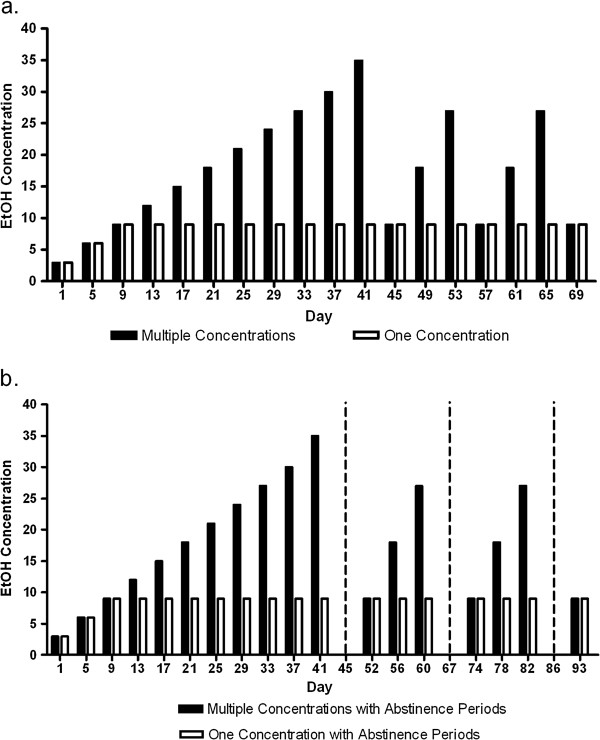
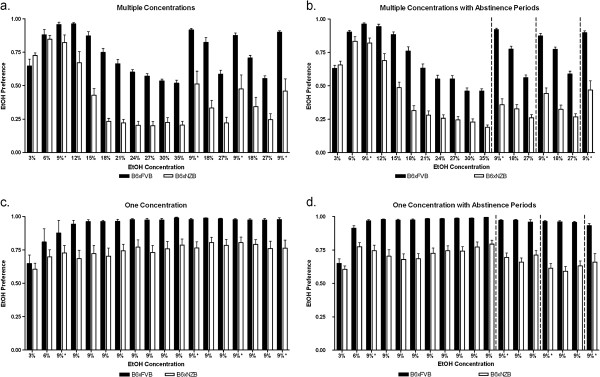
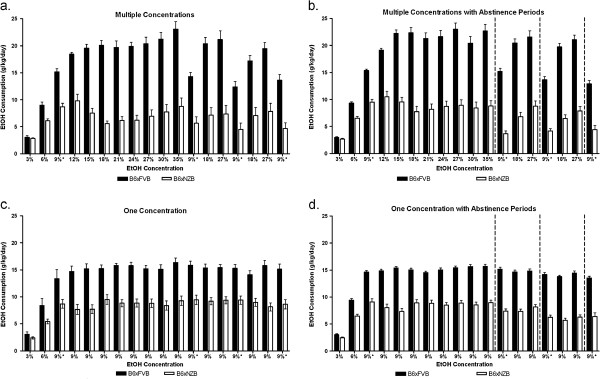
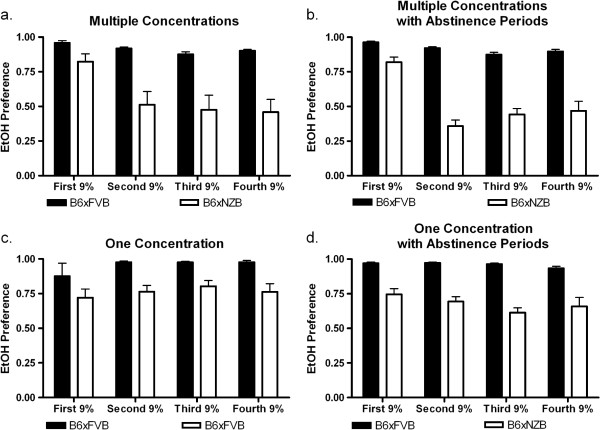
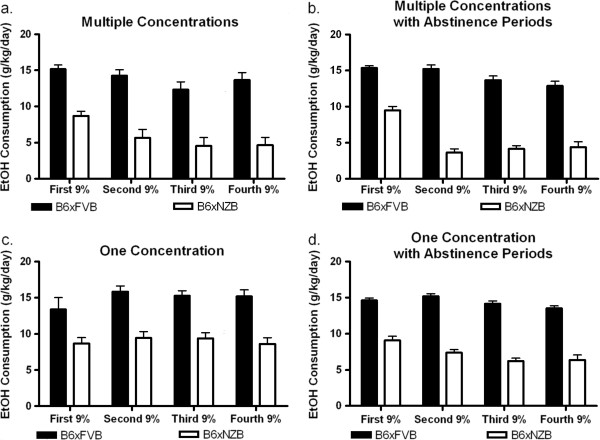
The inability to reduce or regulate alcohol intake is a hallmark symptom for alcohol use disorders. Research on novel behavioral and genetic models of experience-induced changes in drinking will further our knowledge on alcohol use disorders. Distinct alcohol self-administration behaviors were previously observed when comparing two F1 hybrid strains of mice: C57BL/6J x NZB/B1NJ (BxN) show reduced alcohol preference after experience with high concentrations of alcohol and periods of abstinence while C57BL/6J x FVB/NJ (BxF) show sustained alcohol preference. These phenotypes are interesting because these hybrids demonstrate the occurrence of genetic additivity (BxN) and overdominance (BxF) in ethanol intake in an experience dependent manner. Specifically, BxF exhibit sustained alcohol preference and BxN exhibit reduced alcohol preference after experience with high ethanol concentrations; however, experience with low ethanol concentrations produce sustained alcohol preference for both hybrids. In the present study, we tested the hypothesis that these phenotypes are represented by differential production of the inducible transcription factor, ΔFosB, in reward, aversion, and stress related brain regions.
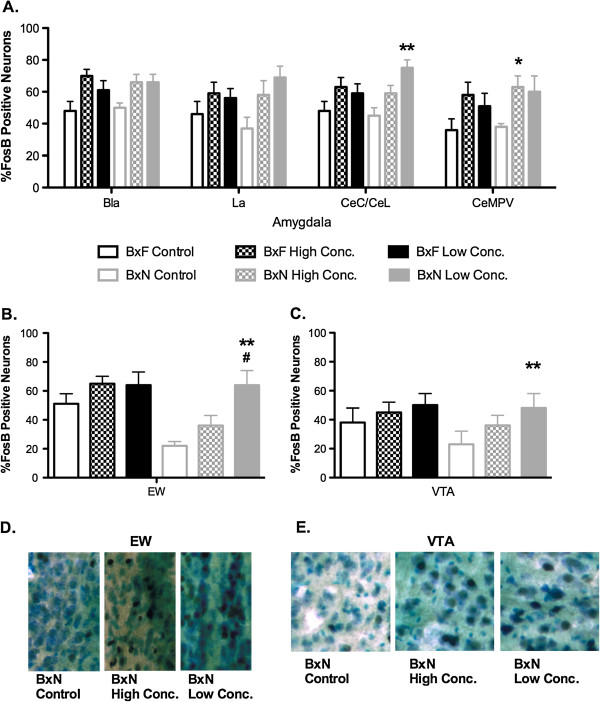
Changes in neuronal plasticity (as measured by ΔFosB levels) were experience dependent, as well as brain region and genotype specific, further supporting that neuronal circuitry underlies motivational aspects of ethanol consumption. BxN mice exhibiting reduced alcohol preference had lower ΔFosB levels in the Edinger-Westphal nucleus than mice exhibiting sustained alcohol preference, and increased ΔFosB levels in central medial amygdala as compared with control mice. BxN mice showing sustained alcohol preference exhibited higher ΔFosB levels in the ventral tegmental area, Edinger-Westphal nucleus, and amygdala (central and lateral divisions). Moreover, in BxN mice ΔFosB levels in the Edinger-Westphal nucleus and ventral tegmental regions significantly positively correlated with ethanol preference and intake. Additionally, hierarchical clustering analysis revealed that many ethanol-naïve mice with overall low ΔFosB levels are in a cluster, whereas many mice displaying sustained alcohol preference with overall high ΔFosB levels are in a cluster together.
By comparing and contrasting two alcohol phenotypes, this study demonstrates that the reward- and stress-related circuits (including the Edinger-Westphal nucleus, ventral tegmental area, amygdala) undergo significant plasticity that manifests as reduced alcohol preference.
无法减少或控制饮酒量是酒精使用障碍的一个标志性症状。对经验诱导的饮酒变化的新型行为和遗传模型的研究将进一步增进我们对酒精使用障碍的认识。当比较两种 F1 杂交品系的小鼠时,观察到不同的酒精自我给药行为:C57BL/6J x NZB/B1NJ(BxN)在经历高浓度酒精和禁欲期后表现出酒精偏好减少,而 C57BL/6J x FVB/NJ(BxF)则表现出持续的酒精偏好。这些表型很有趣,因为这些杂种以经验依赖的方式表现出乙醇摄入的遗传加性(BxN)和超显性(BxF)。具体来说,BxF 在经历高乙醇浓度后表现出持续的酒精偏好,而 BxN 在经历高乙醇浓度后表现出酒精偏好减少;然而,在经历低乙醇浓度时,两种杂种都表现出持续的酒精偏好。在本研究中,我们检验了以下假设:这些表型是由奖励、厌恶和应激相关脑区诱导型转录因子ΔFosB 的不同产生所代表的。
神经元可塑性的变化(如 ΔFosB 水平所示)是经验依赖性的,也是脑区和基因型特异性的,进一步支持了神经元回路是乙醇消费动机方面的基础。表现出酒精偏好减少的 BxN 小鼠的 Edinger-Westphal 核中的 ΔFosB 水平低于表现出持续酒精偏好的小鼠,并且与对照小鼠相比,中央内侧杏仁核中的 ΔFosB 水平增加。表现出持续酒精偏好的 BxN 小鼠的腹侧被盖区、Edinger-Westphal 核和杏仁核(中央和外侧部分)中的 ΔFosB 水平较高。此外,在 BxN 小鼠中,Edinger-Westphal 核和腹侧被盖区中的 ΔFosB 水平与乙醇偏好和摄入量呈显著正相关。此外,层次聚类分析显示,许多整体 ΔFosB 水平较低的乙醇-naive 小鼠聚集在一起,而许多整体 ΔFosB 水平较高的表现出持续酒精偏好的小鼠聚集在一起。
通过比较和对比两种酒精表型,本研究表明,与奖励和应激相关的回路(包括 Edinger-Westphal 核、腹侧被盖区、杏仁核)经历了显著的可塑性,表现为酒精偏好减少。