Department of Anesthesiology, Medical College of Wisconsin, Milwaukee, WI 53226, USA.
Eur J Pharmacol. 2012 Sep 5;690(1-3):149-57. doi: 10.1016/j.ejphar.2012.07.003. Epub 2012 Jul 11.
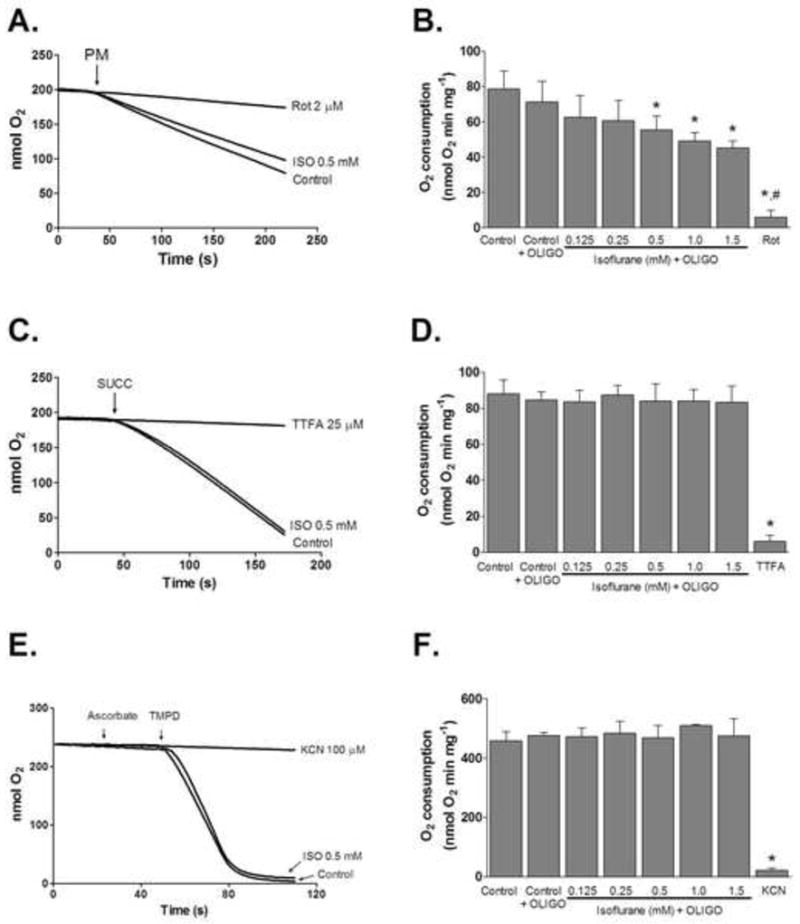
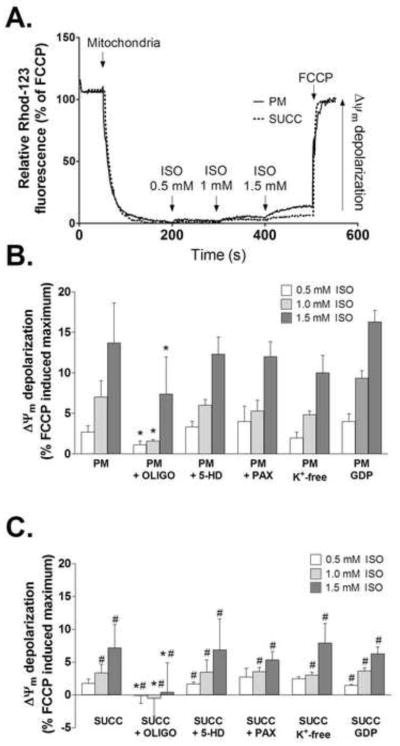
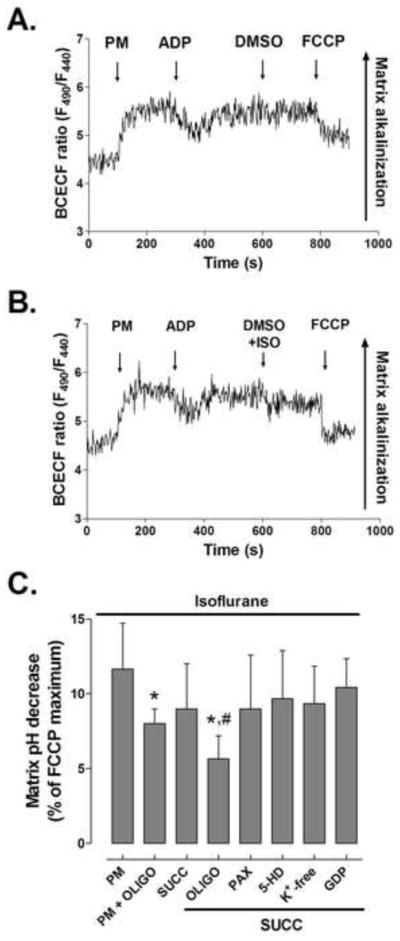
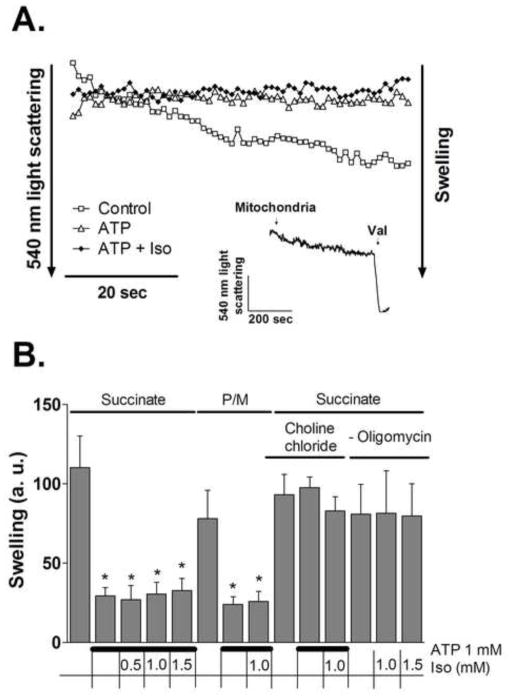
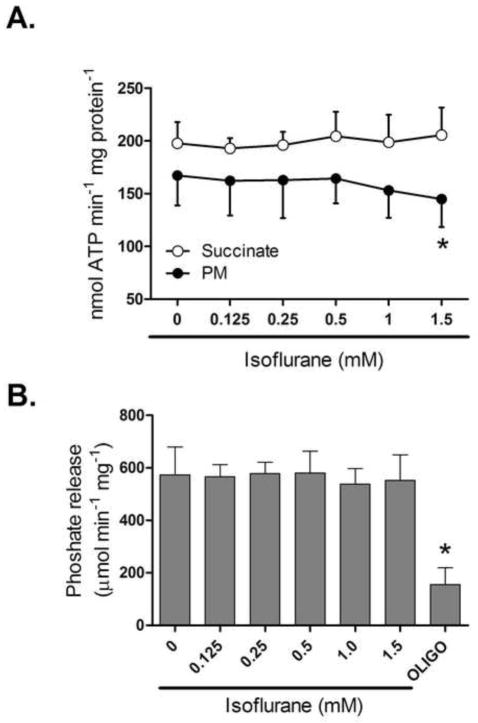
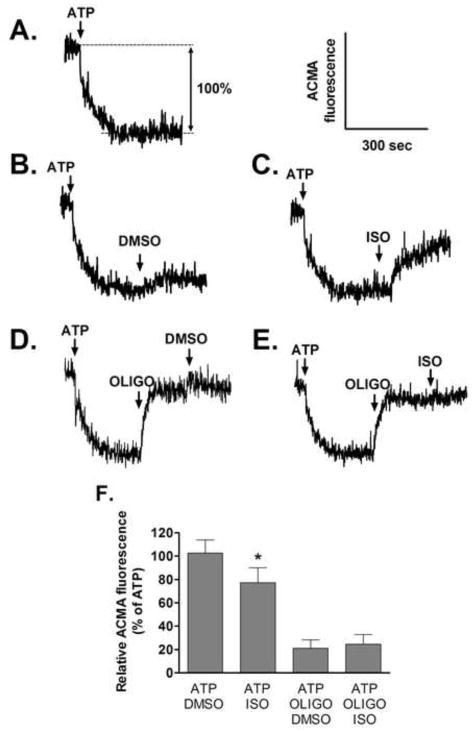
Short application of the volatile anesthetic isoflurane at reperfusion after ischemia exerts strong protection of the heart against injury. Mild depolarization and acidification of the mitochondrial matrix are involved in the protective mechanisms of isoflurane, but the molecular basis for these changes is not clear. In this study, mitochondrial respiration, membrane potential, matrix pH, matrix swelling, ATP synthesis and -hydrolysis, and H(2)O(2) release were assessed in isolated mitochondria. We hypothesized that isoflurane induces mitochondrial depolarization and matrix acidification through direct action on both complex I and ATP synthase. With complex I-linked substrates, isoflurane (0.5mM) inhibited mitochondrial respiration by 28 ± 10%, and slightly, but significantly depolarized membrane potential and decreased matrix pH. With complex II- and complex IV-linked substrates, respiration was not changed, but isoflurane still decreased matrix pH and depolarized mitochondrial membrane potential. Depolarization and matrix acidification were attenuated by inhibition of ATP synthase with oligomycin, but not by inhibition of mitochondrial ATP- and Ca(2+)-sensitive K(+) channels or uncoupling proteins. Isoflurane did not induce matrix swelling and did not affect ATP synthesis and hydrolysis, but decreased H(2)O(2) release in the presence of succinate in an oligomycin- and matrix pH-sensitive manner. Isoflurane modulated H(+) flux through ATP synthase in an oligomycin-sensitive manner. Our results indicate that isoflurane-induced mitochondrial depolarization and acidification occur due to inhibition of the electron transport chain at the site of complex I and increased proton flux through ATP synthase. K(+) channels and uncoupling proteins appear not to be involved in the direct effects of isoflurane on mitochondria.
短时间应用挥发性麻醉剂异氟醚在缺血后再灌注时对心肌具有强烈的保护作用,防止损伤。轻度去极化和基质酸化涉及异氟醚的保护机制,但这些变化的分子基础尚不清楚。在这项研究中,评估了分离线粒体中的线粒体呼吸、膜电位、基质 pH 值、基质肿胀、ATP 合成和水解以及 H2O2 释放。我们假设异氟醚通过直接作用于复合物 I 和 ATP 合酶诱导线粒体去极化和基质酸化。使用与复合物 I 相关的底物,异氟醚(0.5mM)抑制线粒体呼吸 28±10%,并轻微但显著地去极化膜电位并降低基质 pH 值。使用与复合物 II 和复合物 IV 相关的底物,呼吸没有改变,但异氟醚仍然降低基质 pH 值并去极化线粒体膜电位。用寡霉素抑制 ATP 合酶可减弱去极化和基质酸化,但用抑制线粒体 ATP 和 Ca2+-敏感 K+通道或解偶联蛋白则不能。异氟醚不会诱导基质肿胀,也不会影响 ATP 合成和水解,但在琥珀酸存在下以寡霉素和基质 pH 值敏感的方式降低 H2O2 的释放。异氟醚以寡霉素敏感的方式调节通过 ATP 合酶的 H+通量。我们的结果表明,异氟醚诱导的线粒体去极化和酸化是由于复合物 I 部位的电子传递链抑制和通过 ATP 合酶的质子通量增加所致。K+通道和解偶联蛋白似乎不参与异氟醚对线粒体的直接作用。