Howard Hughes Medical Institute, Department of Molecular Biology and Genetics, Johns Hopkins University School of Medicine, Baltimore, MD, USA.
Nat Chem Biol. 2012 Sep;8(9):759-68. doi: 10.1038/nchembio.1021. Epub 2012 Jul 15.
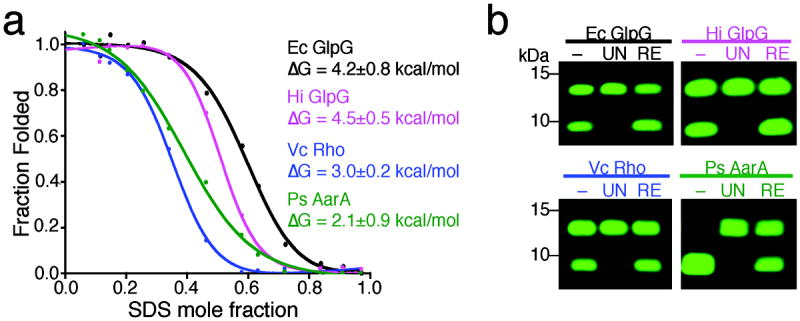
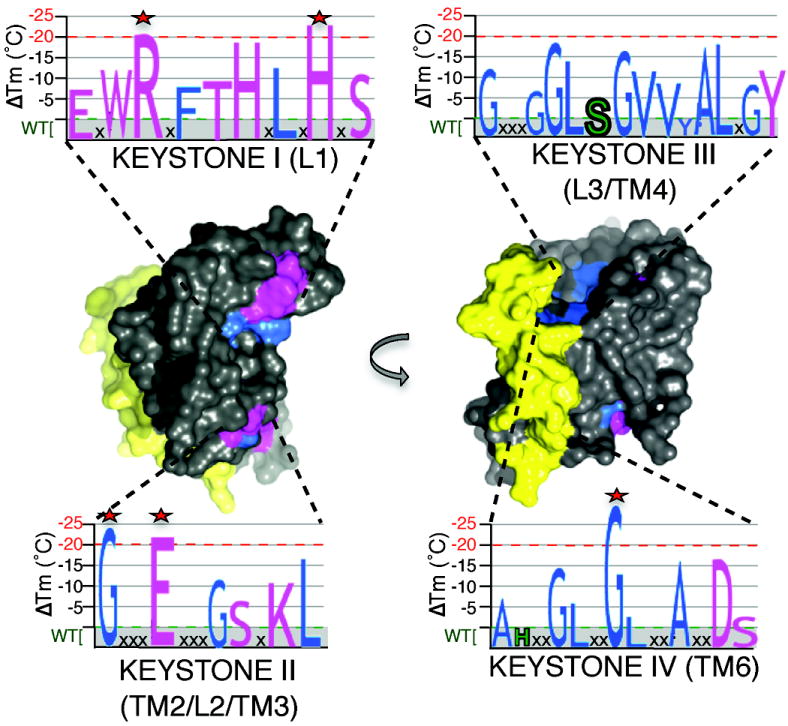
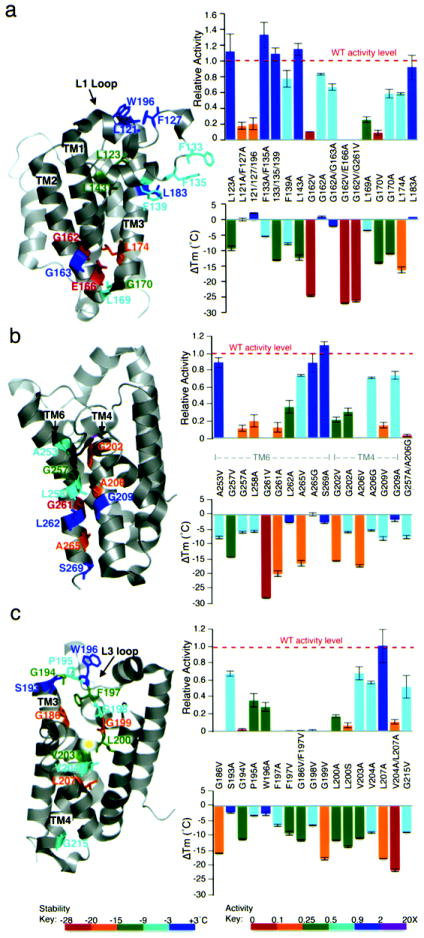
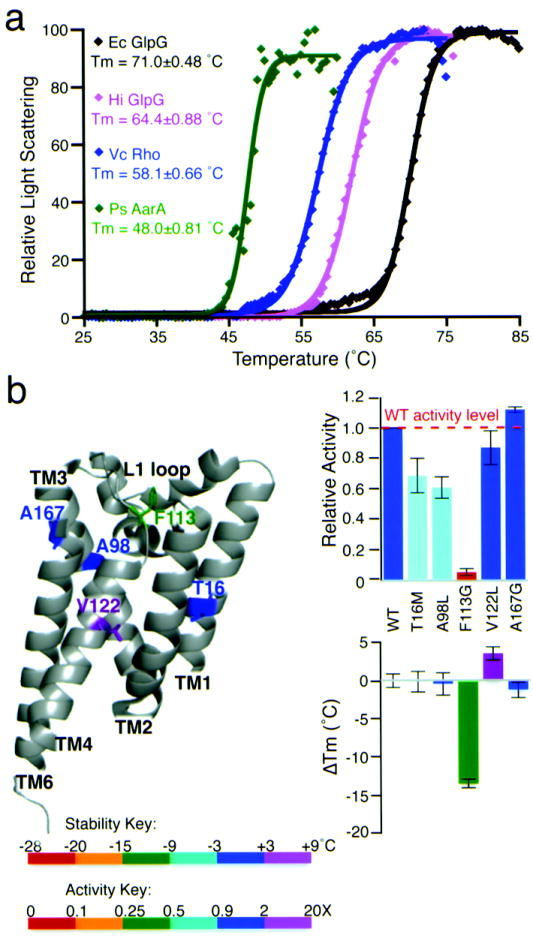
Intramembrane proteases hydrolyze peptide bonds within the membrane as a signaling paradigm universal to all life forms and with implications in disease. Deciphering the architectural strategies supporting intramembrane proteolysis is an essential but unattained goal. We integrated new, quantitative and high-throughput thermal light-scattering technology, reversible equilibrium unfolding and refolding and quantitative protease assays to interrogate rhomboid architecture with 151 purified variants. Rhomboid proteases maintain low intrinsic thermodynamic stability (ΔG = 2.1-4.5 kcal mol(-1)) resulting from a multitude of generally weak transmembrane packing interactions, making them highly responsive to their environment. Stability is consolidated by two buried glycines and several packing leucines, with a few multifaceted hydrogen bonds strategically deployed to two peripheral regions. Opposite these regions lie transmembrane segment 5 and connected loops that are notably exempt of structural responsibility, suggesting intramembrane proteolysis involves considerable but localized protein dynamics. Our analyses provide a comprehensive 'heat map' of the physiochemical anatomy underlying membrane-immersed enzyme function at, what is to our knowledge, unprecedented resolution.
跨膜蛋白酶作为一种普遍存在于所有生命形式中的信号范例,在疾病中具有重要意义,其可以水解膜内的肽键。阐明支持跨膜蛋白水解的结构策略是一个必要但尚未实现的目标。我们整合了新的、定量的高通量热光散射技术、可逆平衡展开和重折叠以及定量蛋白酶测定法,用 151 种纯化变体来研究菱形蛋白酶的结构。菱形蛋白酶的固有热力学稳定性(ΔG = 2.1-4.5 kcal/mol)较低,这是由于大量通常较弱的跨膜包装相互作用所致,这使得它们对环境高度敏感。稳定性由两个埋藏的甘氨酸和几个包装的亮氨酸来巩固,还有几个多方面的氢键被战略性地部署到两个外围区域。与这些区域相对的是跨膜片段 5 和连接环,这些区域明显没有结构责任,这表明跨膜蛋白水解涉及相当大但局部的蛋白质动力学。我们的分析提供了一个全面的“热图”,说明了在我们所知的前所未有的分辨率下,膜内酶功能的物理化学解剖结构。