Laboratory of Malaria Immunology and Vaccinology, NIAID, National Institutes of Health, Bethesda, MD, USA.
Adv Nutr. 2012 Jul 1;3(4):570-8. doi: 10.3945/an.111.001156.
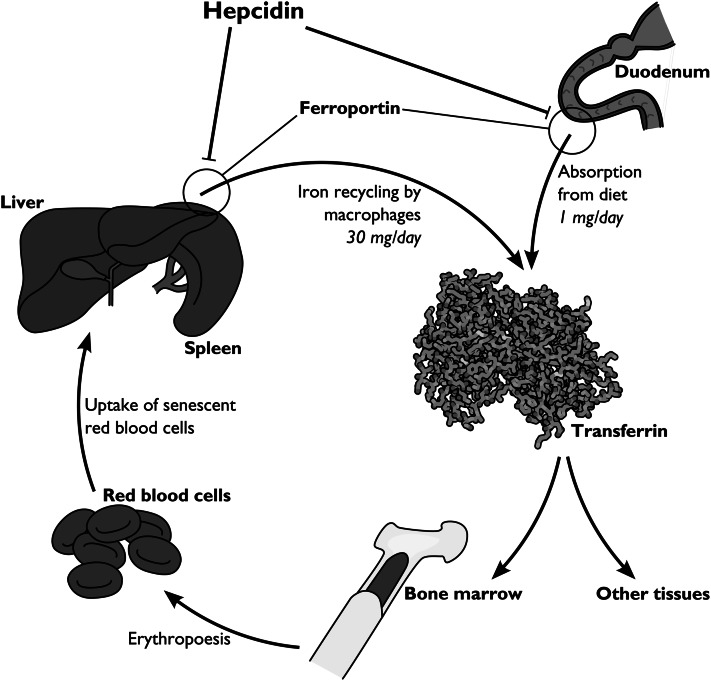
The populations in greatest need of iron supplementation are also those at greatest risk of malaria: pregnant women and young children. Iron supplementation has been shown to increase malaria risk in these groups in numerous studies, although this effect is likely diminished by factors such as host immunity, host iron status, and effective malaria surveillance and control. Conversely, the risk of anemia is increased by malaria infections and preventive measures against malaria decrease anemia prevalence in susceptible populations without iron supplementation. Studies have shown that subjects with malaria experience diminished absorption of orally administered iron, so that as a consequence, iron supplementation may have generally reduced efficacy in malarious populations. A possible mechanistic link between malaria, poor absorption of iron, and anemia is provided by recent research on hepcidin, the human iron control hormone. Our improved understanding of iron metabolism may contribute to the control of malaria and the treatment of anemia. Malaria surveillance and control are necessary components of programs to control iron deficiency and may enhance the efficacy of iron supplementation.
孕妇和幼儿。许多研究表明,补铁会增加这些人群患疟疾的风险,尽管这种影响可能因宿主免疫力、宿主铁状态以及有效的疟疾监测和控制等因素而减弱。相反,疟疾感染会增加贫血的风险,而预防疟疾的措施会降低无补铁的易感人群的贫血患病率。研究表明,疟疾患者口服铁的吸收会减少,因此,补铁可能会降低疟疾人群的疗效。最近对人类铁调节激素——铁调素的研究为疟疾、铁吸收不良和贫血之间的可能机制联系提供了依据。我们对铁代谢的理解的提高可能有助于控制疟疾和治疗贫血。疟疾监测和控制是控制缺铁和提高补铁效果的必要组成部分。