Am J Trop Med Hyg. 2012 Sep;87(3):407-411. doi: 10.4269/ajtmh.2012.11-0331. Epub 2012 Jul 16.
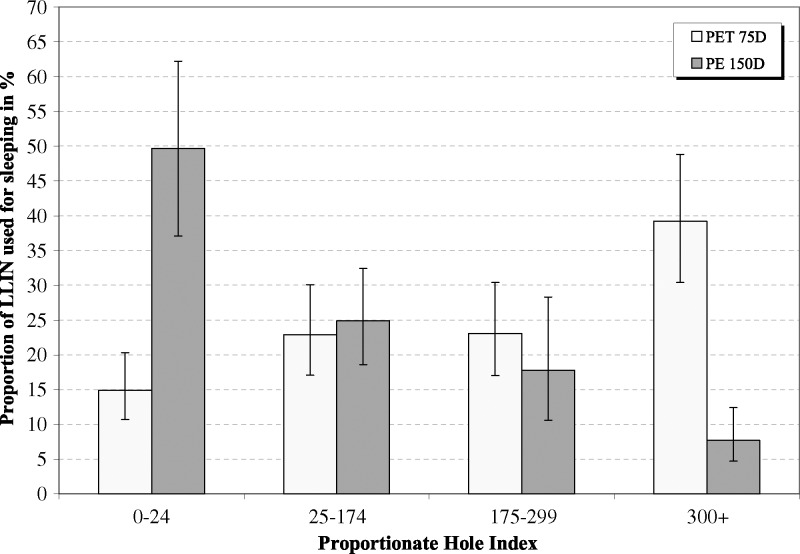
A total of 876 nets (229 Interceptor(®), 363 Olyset(®), and 284 PermaNet(®)) were collected 14 months post-distribution of long-lasting insecticidal nets (LLINs) from 811 households of internally displaced and host communities in Dar Sila District in eastern Chad to examine their physical condition. Holes were recorded by using three hole categories (average diameter = 2, 3.5, and 15 cm) and a Proportionate Hole Index (pHI). A total of 69.5% were in poor or very poor condition. There was no significant difference in the performance between the polyester 75 denier LLINs, but they had 4.22 times the odds of having a pHI ≥ 175 (poor or very poor condition) than polyethylene 150 denier LLINs; and 39.2% were unserviceable (pHI ≥ 300) compared with only 7.7% of the polyethylene LLINs. These results provide the first comparative data on LLIN material durability to guide procurement and replacement practice, and to inform urgently needed changes in LLIN international minimum specifications and product standards.
共收集了 876 顶蚊帐(229 顶Interceptor(®)、363 顶 Olyset(®)和 284 顶 PermaNet(®)),这些蚊帐是在乍得东部达萨拉地区分发长效驱虫蚊帐 14 个月后,从 811 户国内流离失所者和收容社区家庭中收集的,以检查其物理状况。使用三个孔类别(平均直径=2、3.5 和 15 厘米)和比例孔指数(pHI)记录孔。结果表明,69.5%的蚊帐状况不佳或非常差。聚酯 75 旦尼尔长寿命蚊帐的性能没有显著差异,但它们出现 pHI≥175(状况不佳或非常差)的几率是聚乙烯 150 旦尼尔长寿命蚊帐的 4.22 倍;39.2%的蚊帐无法使用(pHI≥300),而聚乙烯蚊帐只有 7.7%无法使用。这些结果提供了长寿命蚊帐材料耐久性的第一批比较数据,以指导采购和更换实践,并为迫切需要修改长寿命蚊帐国际最低规格和产品标准提供信息。