Ghimire Prakash, Rijal Komal Raj, Adhikari Nabaraj, Thakur Garib Das, Marasini Baburam, Thapa Shrestha Upendra, Banjara Megha Raj, Pant Shishir Kumar, Adhikari Bipin, Dumre Shyam Prakash, Singh Nihal, Pigeon Olivier, Chareonviriyaphap Theeraphap, Chavez Irwin, Ortega Leonard, Hii Jeffrey
1Central Department of Microbiology, Tribhuvan University, Kathmandu, Nepal.
World Health Organization Country Office for Nepal, Pulchowk, Lalitpur, Nepal.
Trop Med Health. 2020 May 19;48:36. doi: 10.1186/s41182-020-00223-w. eCollection 2020.
Understanding and improving the durability of long-lasting insecticidal nets (LLINs) in the field are critical for planning future implementation strategies including behavioral change for care and maintenance. LLIN distribution at high coverage is considered to be one of the adjunctive transmission reduction strategies in Nepal's Malaria Strategic Plan 2014-2025. The main objective of this study was to assess the durability through assessment of community usage, physical integrity, residual bio-efficacy, and chemical retention in LLINs: Interceptor®, Yorkool®, and PermaNet ®2.0 which were used in Nepal during 2009 through 2013.
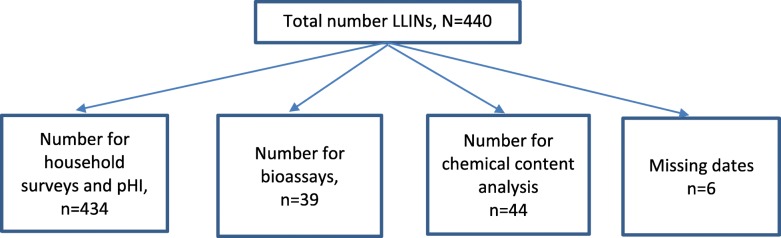
Assessments were conducted on random samples ( = 440) of LLINs from the eleven districts representing four ecological zones: Terai plain region (Kailali and Kanchanpur districts), outer Terai fluvial ecosystem (Surkhet, Dang, and Rupandhei districts), inner Terai forest ecosystem (Mahhothari, Dhanusa, and Illam districts), and Hills and river valley (Kavrepalanchock and Sindhupalchok districts). For each LLIN, fabric integrity in terms of proportionate hole index (pHI) and residual bio-efficacy were assessed. However, for chemical retention, a representative sample of 44 nets (15 Yorkool®, 10 Permanet®2.0, and 19 Interceptor®) was evaluated. Data were analyzed using descriptive statistics stratified by LLINs brand, districts, and duration of exposure.
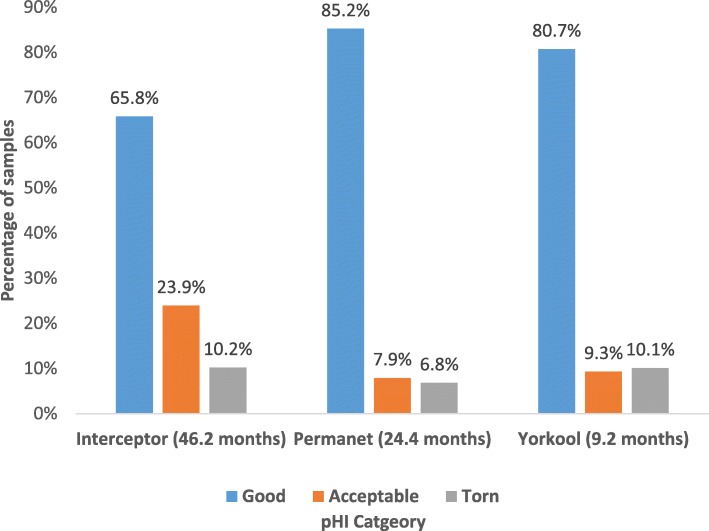
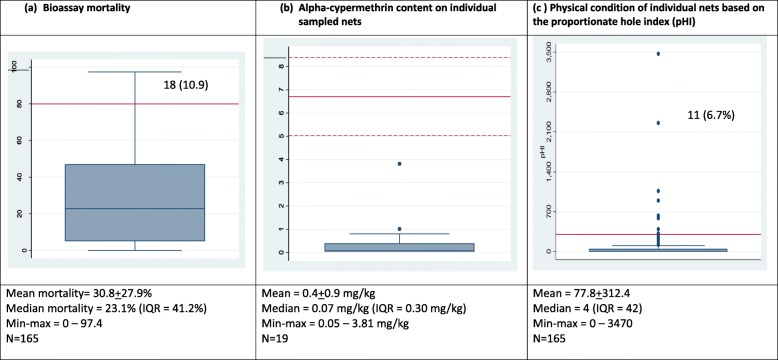
On average, duration of use of LLINs was shortest for the Yorkool® samples, followed by PermaNet® 2.0 and Interceptor® with median ages of 8.9 (IQR = 0.4), 23.8 (IQR = 3.2), and 50.1 (IQR = 3.2) months, respectively. Over 80% of field distributed Yorkool® and PermaNet® 2.0 nets were in good condition (pHI< 25) compared to Interceptor® (66%). Bio-efficacy analysis showed that average mortality rates of Interceptor and Yorkool were below World Health Organization (WHO) optimal effectiveness of ≥ 80% compared to 2-year-old PermaNet 2.0 which attained 80%. Chemical retention analysis was consistent with bio-efficacy results.
This study shows that distribution of LLINs is effective for malaria control; however, serviceable life of LLINs should be considered in terms of waning residual bio-efficacy that warrants replacement. As an adjunctive malaria control tool, National Malaria Control Program of Nepal can benefit by renewing the distribution of LLINs in an appropriate time frame in addition to utilizing durable and effective LLINs.
了解并提高长效驱虫蚊帐(LLINs)在实际使用中的耐用性,对于规划未来的实施策略(包括护理和维护方面的行为改变)至关重要。高覆盖率的 LLIN 分发被视为尼泊尔《2014 - 2025 年疟疾战略计划》中的辅助传播减少策略之一。本研究的主要目的是通过评估社区使用情况、物理完整性、残留生物效力以及 LLINs(Interceptor®、Yorkool® 和 PermaNet® 2.0)中的化学残留来评估其耐用性,这些 LLINs 在 2009 年至 2013 年期间在尼泊尔使用。
对来自代表四个生态区的 11 个区的 LLINs 随机样本(n = 440)进行评估:特莱平原地区(凯拉利和坎昌普尔区)、外特莱河流生态系统(苏尔凯特、当和鲁潘德希区)、内特莱森林生态系统(马哈托哈里、达努沙和伊拉姆区)以及山区和河谷(卡夫雷帕兰乔克和辛杜帕尔乔克区)。对于每个 LLIN,评估了织物完整性(以比例孔指数(pHI)表示)和残留生物效力。然而,对于化学残留,评估了 44 顶蚊帐的代表性样本(15 顶 Yorkool®、10 顶 Permanet® 2.0 和 19 顶 Interceptor®)。使用按 LLINs 品牌、地区和暴露持续时间分层的描述性统计方法对数据进行分析。
平均而言,Yorkool® 样本的 LLINs 使用时间最短,其次是 PermaNet® 2.0 和 Interceptor®,中位年龄分别为 8.9(IQR = 0.4)、23.8(IQR = 3.2)和 50.1(IQR = 3.2)个月。与 Interceptor®(66%)相比,超过 80% 的现场分发的 Yorkool® 和 PermaNet® 2.0 蚊帐状况良好(pHI < 25)。生物效力分析表明,Interceptor 和 Yorkool 的平均死亡率低于世界卫生组织(WHO)≥ 80% 的最佳效力,而 2 年的 PermaNet 2.0 达到了 80%。化学残留分析与生物效力结果一致。
本研究表明,LLINs 的分发对疟疾控制有效;然而,应根据残留生物效力的减弱情况考虑 LLINs 的使用寿命,这需要进行更换。作为辅助疟疾控制工具,尼泊尔国家疟疾控制计划除了使用耐用且有效的 LLINs 外,还可以通过在适当的时间范围内更新 LLINs 的分发而受益。