VISN-22 Mental Illness, Research, Education, and Clinical Center (MIRECC), San Diego VA Health Care System, La Jolla, California, United States of America.
PLoS One. 2012;7(7):e39434. doi: 10.1371/journal.pone.0039434. Epub 2012 Jul 3.
Endophenotypes are quantitative, laboratory-based measures representing intermediate links in the pathways between genetic variation and the clinical expression of a disorder. Ideal endophenotypes exhibit deficits in patients, are stable over time and across shifts in psychopathology, and are suitable for repeat testing. Unfortunately, many leading candidate endophenotypes in schizophrenia have not been fully characterized simultaneously in large cohorts of patients and controls across these properties. The objectives of this study were to characterize the extent to which widely-used neurophysiological and neurocognitive endophenotypes are: 1) associated with schizophrenia, 2) stable over time, independent of state-related changes, and 3) free of potential practice/maturation or differential attrition effects in schizophrenia patients (SZ) and nonpsychiatric comparison subjects (NCS). Stability of clinical and functional measures was also assessed.
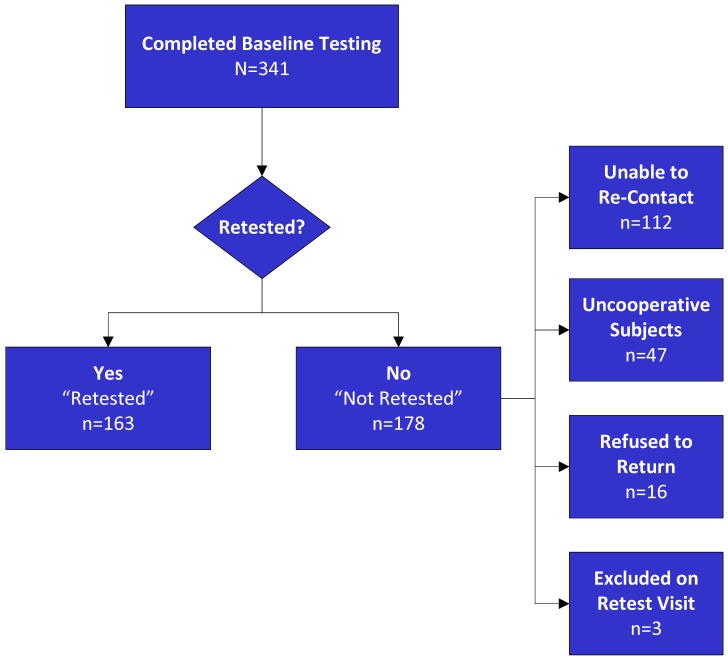
Participants (SZ n = 341; NCS n = 205) completed a battery of neurophysiological (MMN, P3a, P50 and N100 indices, PPI, startle habituation, antisaccade), neurocognitive (WRAT-3 Reading, LNS-forward, LNS-reorder, WCST-64, CVLT-II). In addition, patients were rated on clinical symptom severity as well as functional capacity and status measures (GAF, UPSA, SOF). 223 subjects (SZ n = 163; NCS n = 58) returned for retesting after 1 year.
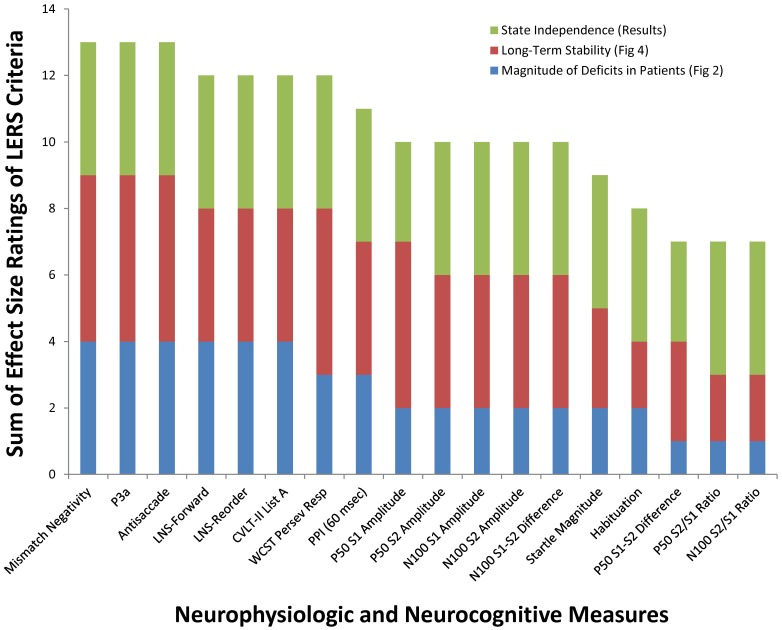
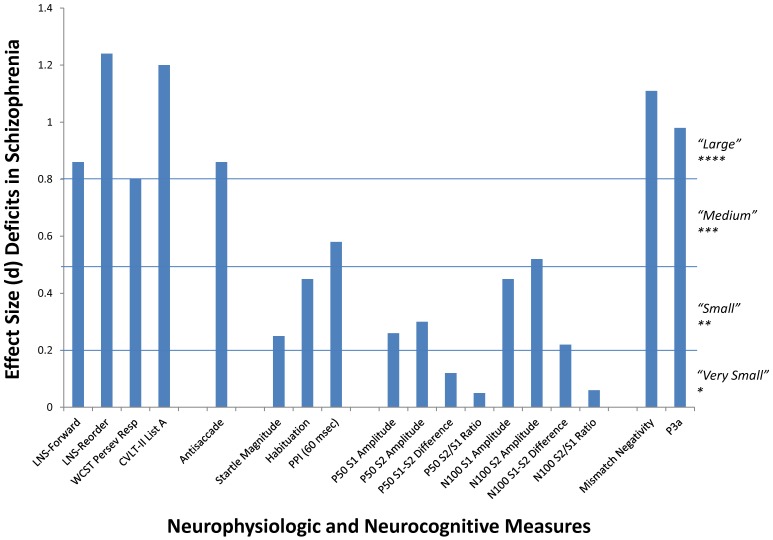
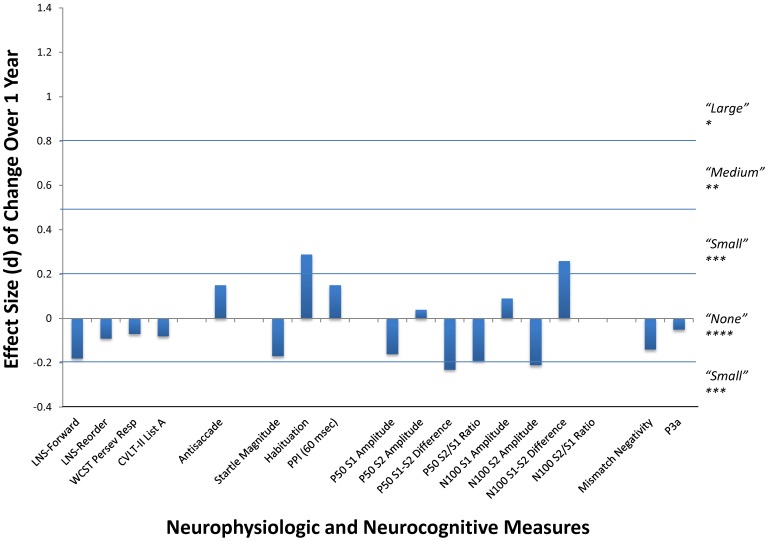
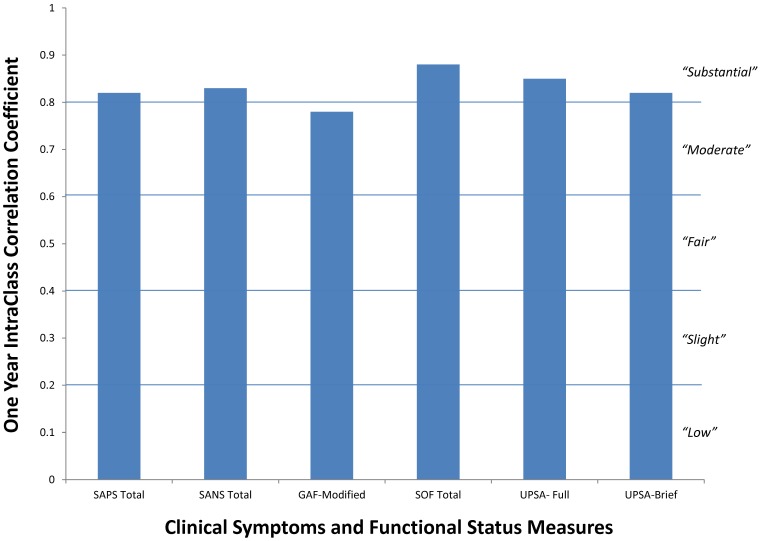
Most neurophysiological and neurocognitive measures exhibited medium-to-large deficits in schizophrenia, moderate-to-substantial stability across the retest interval, and were independent of fluctuations in clinical status. Clinical symptoms and functional measures also exhibited substantial stability. A Longitudinal Endophenotype Ranking System (LERS) was created to rank neurophysiological and neurocognitive biomarkers according to their effect sizes across endophenotype criteria.
The majority of neurophysiological and neurocognitive measures exhibited deficits in patients, stability over a 1-year interval and did not demonstrate practice or time effects supporting their use as endophenotypes in neural substrate and genomic studies. These measures hold promise for informing the "gene-to-phene gap" in schizophrenia research.
内表型是定量的、基于实验室的测量指标,代表遗传变异与疾病临床表现之间途径的中间环节。理想的内表型在患者中表现出缺陷,在时间上和精神病理学的转变中保持稳定,并且适合重复测试。不幸的是,精神分裂症的许多主要候选内表型在这些属性方面尚未在大量患者和对照组中得到全面描述。本研究的目的是描述广泛使用的神经生理学和神经认知内表型在多大程度上具有以下特征:1)与精神分裂症相关,2)随时间稳定,独立于与状态相关的变化,3)在精神分裂症患者(SZ)和非精神病对照受试者(NCS)中没有潜在的练习/成熟或差异性失访效应。临床和功能测量的稳定性也进行了评估。
参与者(SZ n=341;NCS n=205)完成了一系列神经生理学(MMN、P3a、P50 和 N100 指数、PPI、惊跳习惯化、反扫视)和神经认知(WRAT-3 阅读、LNS-前向、LNS-重新排序、WCST-64、CVLT-II)测试。此外,患者还根据临床症状严重程度以及功能能力和状态测量(GAF、UPSA、SOF)进行了评分。223 名受试者(SZ n=163;NCS n=58)在 1 年后进行了重新测试。
大多数神经生理学和神经认知测试在精神分裂症中表现出中等至较大的缺陷,在重测间隔内具有中等至较大的稳定性,并且与临床状态的波动无关。临床症状和功能测量也表现出较大的稳定性。创建了一个纵向内表型排名系统(LERS),根据它们在神经内表型标准下的效应大小对神经生理学和神经认知生物标志物进行排名。
大多数神经生理学和神经认知测试在患者中表现出缺陷,在 1 年间隔内具有稳定性,并且没有表现出练习或时间效应,支持将其用作神经基质和基因组研究中的内表型。这些措施有望为精神分裂症研究中的“基因到表型差距”提供信息。