Departamento de Bioquímica e Imunologia, Instituto de Ciências Biológicas, Universidade Federal de Minas Gerais, Belo Horizonte, Minas Gerais, Brazil.
PLoS Negl Trop Dis. 2012;6(7):e1722. doi: 10.1371/journal.pntd.0001722. Epub 2012 Jul 10.
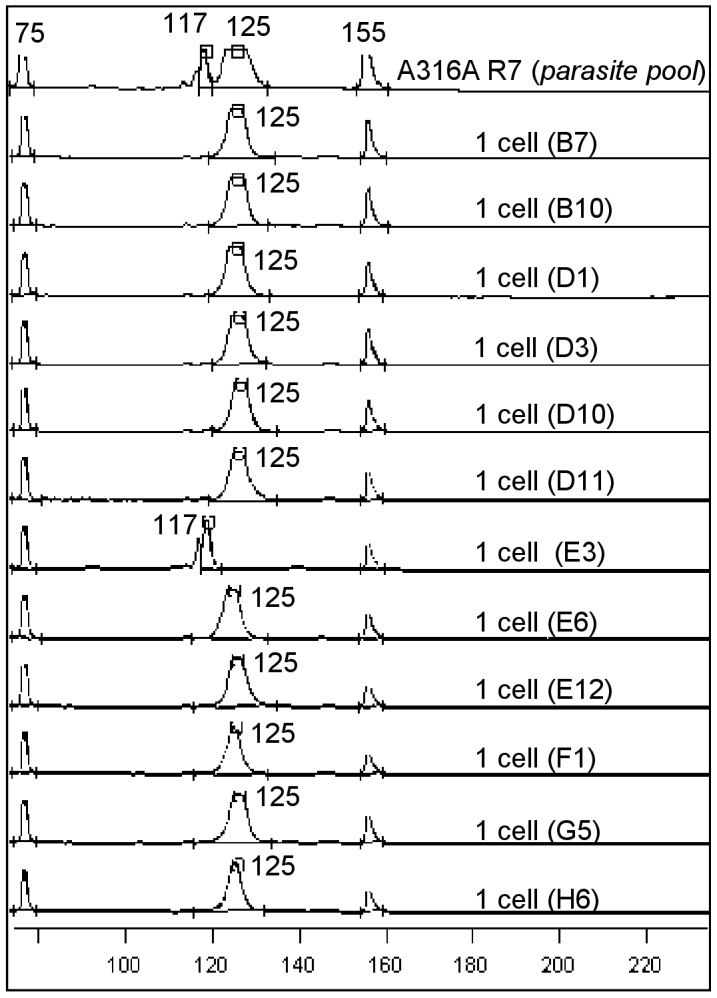
Trypanosoma cruzi, the etiological agent of Chagas disease, is a polymorphic species. Evidence suggests that the majority of the T. cruzi populations isolated from afflicted humans, reservoir animals, or vectors are multiclonal. However, the extent and the complexity of multiclonality remain to be established, since aneuploidy cannot be excluded and current conventional cloning methods cannot identify all the representative clones in an infection. To answer this question, we adapted a methodology originally described for analyzing single spermatozoids, to isolate and study single T. cruzi parasites. Accordingly, the cloning apparatus of a Fluorescence-Activated Cell Sorter (FACS) was used to sort single T. cruzi cells directly into 96-wells microplates. Cells were then genotyped using two polymorphic genomic markers and four microsatellite loci. We validated this methodology by testing four T. cruzi populations: one control artificial mixture composed of two monoclonal populations--Silvio X10 cl1 (TcI) and Esmeraldo cl3 (TcII)--and three naturally occurring strains, one isolated from a vector (A316A R7) and two others derived from the first reported human case of Chagas disease. Using this innovative approach, we were able to successfully describe the whole complexity of these natural strains, revealing their multiclonal status. In addition, our results demonstrate that these T. cruzi populations are formed of more clones than originally expected. The method also permitted estimating of the proportion of each subpopulation of the tested strains. The single-cell genotyping approach allowed analysis of intrapopulation diversity at a level of detail not achieved previously, and may thus improve our comprehension of population structure and dynamics of T. cruzi. Finally, this methodology is capable to settle once and for all controversies on the issue of multiclonality.
克氏锥虫,恰加斯病的病原体,是一个多态物种。有证据表明,从受感染的人类、储存宿主动物或媒介中分离出的大多数克氏锥虫种群都是多克隆的。然而,多克隆的程度和复杂性仍有待确定,因为不能排除非整倍性,并且当前的常规克隆方法不能识别感染中的所有代表性克隆。为了回答这个问题,我们改编了一种最初用于分析单个精子的方法,以分离和研究单个克氏锥虫寄生虫。相应地,荧光激活细胞分选器(FACS)的克隆装置用于直接将单个克氏锥虫细胞分选到 96 孔微孔板中。然后使用两个多态性基因组标记和四个微卫星位点对细胞进行基因分型。我们通过测试四个克氏锥虫种群验证了这种方法:一个由两个单克隆群体——Silvio X10 cl1(TcI)和 Esmeraldo cl3(TcII)组成的人工对照混合物,以及三个天然菌株,一个从媒介中分离出来的菌株(A316A R7)和另外两个源自第一个报告的恰加斯病人类病例的菌株。使用这种创新方法,我们成功地描述了这些天然菌株的整体复杂性,揭示了它们的多克隆状态。此外,我们的结果表明,这些克氏锥虫种群由比最初预期更多的克隆组成。该方法还允许估计测试菌株的每个亚群的比例。单细胞基因分型方法允许在以前无法达到的细节水平上分析种群内的多样性,从而可以提高我们对克氏锥虫种群结构和动态的理解。最后,这种方法能够一劳永逸地解决多克隆性问题上的争议。