Centro de Investigaciones en Microbiología y Parasitología Tropical (CIMPAT), Universidad de Los Andes, Bogotá, Colombia.
BMC Genet. 2013 Sep 30;14:96. doi: 10.1186/1471-2156-14-96.
Chagas disease is a systemic pathology caused by Trypanosoma cruzi. This parasite reveals remarkable genetic variability, evinced in six Discrete Typing Units (DTUs) named from T. cruzi I to T. cruzi VI (TcI to TcVI). Recently newly identified genotypes have emerged such as TcBat in Brazil, Colombia and Panama associated to anthropogenic bats. The genotype with the broadest geographical distribution is TcI, which has recently been associated to severe cardiomyopathies in Argentina and Colombia. Therefore, new studies unraveling the genetic structure and natural history of this DTU must be pursued.
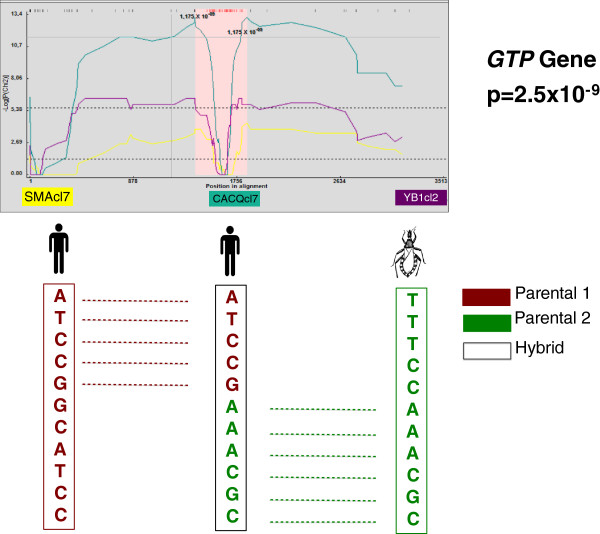
We conducted a spatial and temporal analysis on 50 biological clones of T. cruzi I (TcI) isolated from humans with different clinical phenotypes, triatomine bugs and mammal reservoirs across three endemic regions for Chagas disease in Colombia. These clones were submitted to a nuclear Multilocus Sequence Typing (nMLST) analysis in order to elucidate its genetic diversity and clustering. After analyzing 13 nuclear housekeeping genes and obtaining a 5821 bp length alignment, we detected two robust genotypes within TcI henceforth named TcIDOM (associated to human infections) and a second cluster associated to peridomestic and sylvatic populations. Additionaly, we detected putative events of recombination and an intriguing lack of linkage disequilibrium.
These findings reinforce the emergence of an enigmatic domestic T. cruzi genotype (TcIDOM), and demonstrates the high frequency of recombination at nuclear level across natural populations of T. cruzi. Therefore, the need to pursue studies focused on the diferential virulence profiles of TcI strains. The biological and epidemiological implications of these findings are herein discussed.
恰加斯病是一种由克氏锥虫引起的系统性疾病。该寄生虫表现出显著的遗传变异性,体现在六个离散型单元(DTU)中,分别命名为克氏锥虫 I 至克氏锥虫 VI(TcI 至 TcVI)。最近出现了一些新的基因型,如巴西、哥伦比亚和巴拿马与人为蝙蝠相关的 TcBat。分布范围最广的基因型是 TcI,它最近与阿根廷和哥伦比亚的严重心肌病有关。因此,必须开展新的研究,以揭示该 DTU 的遗传结构和自然史。
我们对来自哥伦比亚三个恰加斯病流行地区的不同临床表型的人类、三锥虫和哺乳动物储主中分离的 50 个 T. cruzi I(TcI)生物克隆进行了时空分析。这些克隆被提交进行核多位点序列分型(nMLST)分析,以阐明其遗传多样性和聚类。在分析了 13 个核管家基因并获得了 5821bp 的比对后,我们在 TcI 内检测到了两个强大的基因型,分别命名为 TcIDOM(与人类感染相关)和与家庭和森林种群相关的第二个聚类。此外,我们还检测到了可能的重组事件和令人好奇的连锁不平衡缺失。
这些发现加强了一个神秘的家庭 T. cruzi 基因型(TcIDOM)的出现,并证明了在 T. cruzi 的自然种群中核水平上重组的高频发生。因此,有必要开展研究,重点关注 TcI 株的差异毒力特征。本文讨论了这些发现的生物学和流行病学意义。