Lykissas Marios G, Gelalis Ioannis D, Kostas-Agnantis Ioannis P, Vozonelos Georgios, Korompilias Anastasios V
Division of Orthopaedic Surgery, Cincinnati Children's Hospital Medical Center, Cincinnati, OH, USA;
Orthop Rev (Pavia). 2012 May 9;4(2):e17. doi: 10.4081/or.2012.e17. Epub 2012 May 29.
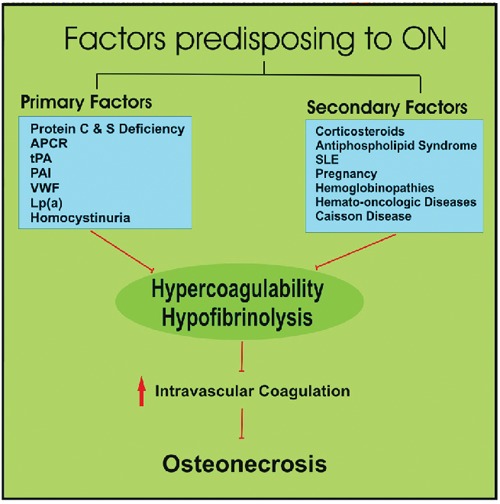
Despite the large number of the outstanding researches, pathogenesis of osteonecrosis remains unknown. During the last decades the hypothesis that increased intravascular coagulation may be the pathogenetic mechanism which leads to osteonecrosis is gaining constantly support. Both primary factors of hyper-coagulability, such as resistance to activated protein C, protein C and protein S deficiency, low levels of tissue plasminogen activator, high levels of plasminogen activator inhibitor, von Willebrand factor, lipoprotein (a), and secondary factors of hypercoagulability with factors potentially activating intravascular coagulation, such as pregnancy, antiphospholipid antibodies, systemic lupus erythematosus, hemoglobinopathies and sickle cell disease, and hemato-oncologic diseases are discussed in this article. Although coagulation abnormalities in patients with hip osteonecrosis might represent increased risk factors for the development of bone necrosis by predisposing the patient to thromboembolic phenomena, further investigation is needed to indicate the definite correlation between factors leading to increased intravascular coagulation and pathogenesis of osteonecrosis.
尽管有大量出色的研究,但骨坏死的发病机制仍然不明。在过去几十年里,血管内凝血增加可能是导致骨坏死的发病机制这一假说不断得到支持。本文讨论了高凝状态的原发性因素,如对活化蛋白C的抵抗、蛋白C和蛋白S缺乏、组织纤溶酶原激活物水平低、纤溶酶原激活物抑制剂水平高、血管性血友病因子、脂蛋白(a),以及高凝状态的继发性因素,包括可能激活血管内凝血的因素,如妊娠、抗磷脂抗体、系统性红斑狼疮、血红蛋白病和镰状细胞病,还有血液肿瘤性疾病。虽然髋部骨坏死患者的凝血异常可能通过使患者易发生血栓栓塞现象而增加骨坏死发生的危险因素,但仍需要进一步研究以明确导致血管内凝血增加的因素与骨坏死发病机制之间的确切关联。