Department of Exercise and Sport Science, University of Utah, Salt Lake City, UT, USA.
Eur J Appl Physiol. 2013 Feb;113(2):479-88. doi: 10.1007/s00421-012-2455-0. Epub 2012 Jul 18.
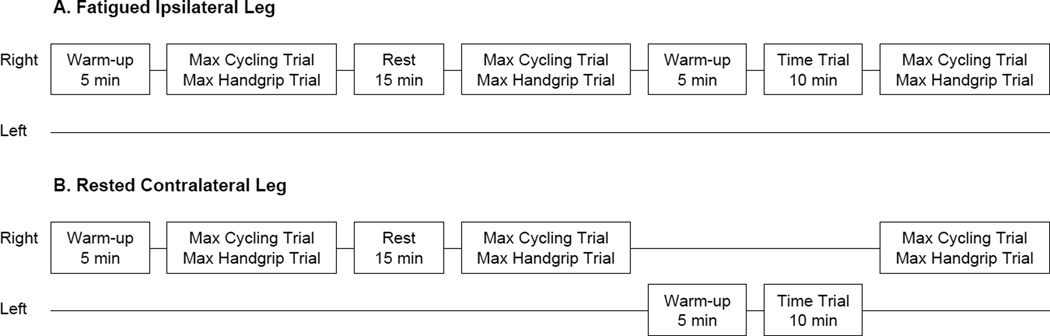
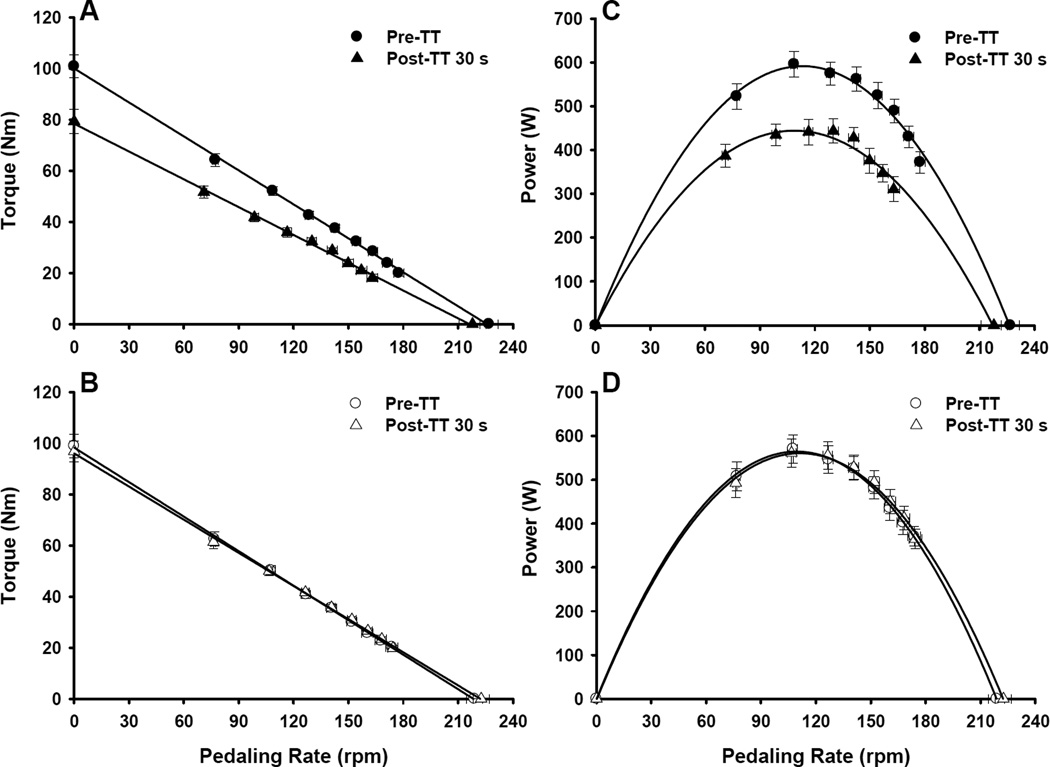
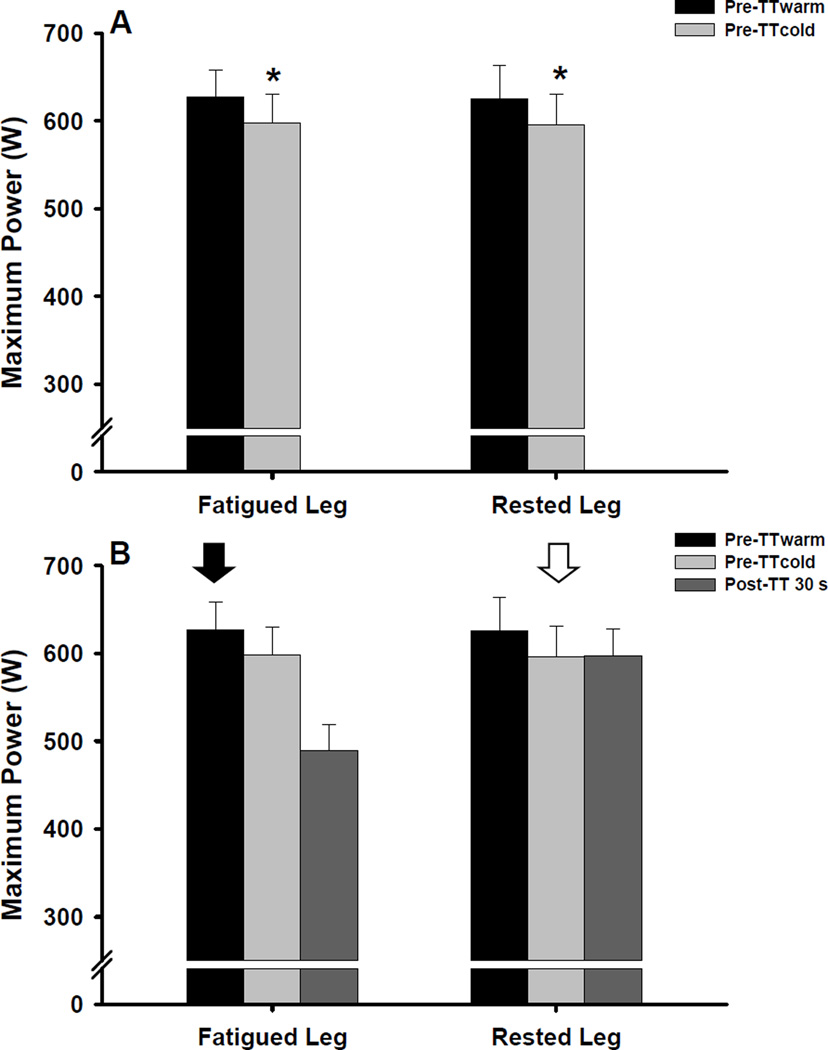
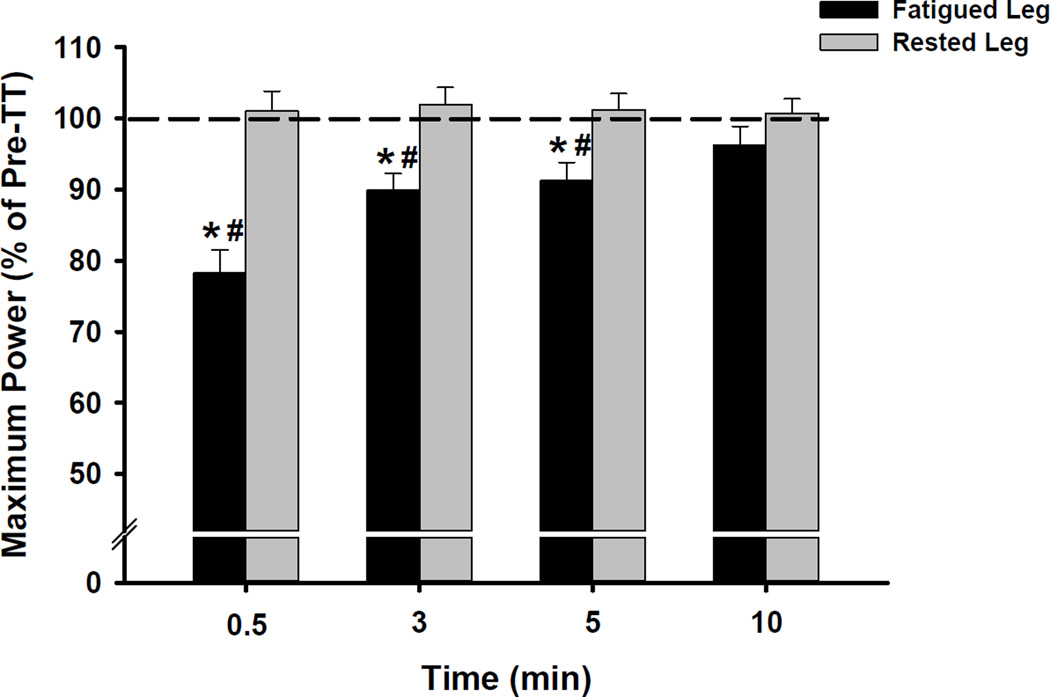
Fatigue induced via a maximal isometric contraction of a single limb muscle group can evoke a "cross-over" of fatigue that reduces voluntary muscle activation and maximum isometric force in the rested contralateral homologous muscle group. We asked whether a cross-over of fatigue also occurs when fatigue is induced via high-intensity endurance exercise involving a substantial muscle mass. Specifically, we used high-intensity single-leg cycling to induce fatigue and evaluated associated effects on maximum cycling power (P (max)) in the fatigued ipsilateral leg (FAT(leg)) as well as the rested contralateral leg (REST(leg)). On separate days, 12 trained cyclists performed right leg P (max) trials before and again 30 s, 3, 5, and 10 min after a cycling time trial (TT, 10 min) performed either with their right or left leg. Fatigue was estimated by comparing exercise-induced changes in P (max) and maximum handgrip isometric force (F (max)). Mean power produced during the right and left leg TTs did not differ (203 ± 8 vs. 199 ± 8 W). Compared to pre-TT, FAT(leg) P (max) was reduced by 22 ± 3 % at 30 s post-TT and remained reduced by 9 ± 2 % at 5 min post-TT (both P < 0.05). Despite considerable power loss in the FAT(leg), post-TT REST(leg) P (max) (596-603 W) did not differ from pre-TT values (596 ± 35 W). There were no alterations in handgrip F (max) (529-547 N). Our data suggest that any potential cross-over of fatigue, if present at all, was not sufficient to measurably compromise REST(leg) P (max) in trained cyclists. These results along with the lack of changes in handgrip F (max) indicate that impairments in maximal voluntary neuromuscular function were specific to working muscles.
疲劳通过单肢肌肉群的最大等长收缩引起时,会导致疲劳的“交叉”,从而降低休息时对侧同源肌肉群的自愿肌肉激活和最大等长力。我们想知道,当疲劳是通过高强度耐力运动引起的,涉及大量肌肉时,是否也会出现疲劳的交叉。具体来说,我们使用高强度单腿自行车运动来引起疲劳,并评估其对疲劳侧腿(FAT(leg))的最大自行车功率(P(max))以及休息对侧腿(REST(leg))的相关影响。在不同的日子里,12 名训练有素的自行车手在右腿 P(max)试验前和右腿 30 秒、3 分钟、5 分钟和 10 分钟后再次进行试验,试验时右腿或左腿进行自行车时间试验(TT,10 分钟)。疲劳通过比较运动引起的 P(max)和最大握力等长力(F(max)的变化来估计。右和左腿 TT 的平均功率输出没有差异(203±8 与 199±8 W)。与 TT 前相比,FAT(leg)P(max)在 TT 后 30 秒时降低了 22±3%,在 TT 后 5 分钟时仍降低了 9±2%(均 P<0.05)。尽管 FAT(leg)中的功率损失很大,但 TT 后 REST(leg)P(max)(596-603 W)与 TT 前值(596±35 W)没有差异。握力 F(max)没有变化(529-547 N)。我们的数据表明,即使存在任何潜在的疲劳交叉,在训练有素的自行车手中也不足以明显损害 REST(leg)P(max)。这些结果以及握力 F(max)没有变化表明,最大自愿神经肌肉功能的损伤是针对工作肌肉的。