Department of Microbiology, Tumor and Cell Biology, Karolinska Institutet, Stockholm, Sweden.
PLoS One. 2012;7(7):e40743. doi: 10.1371/journal.pone.0040743. Epub 2012 Jul 13.
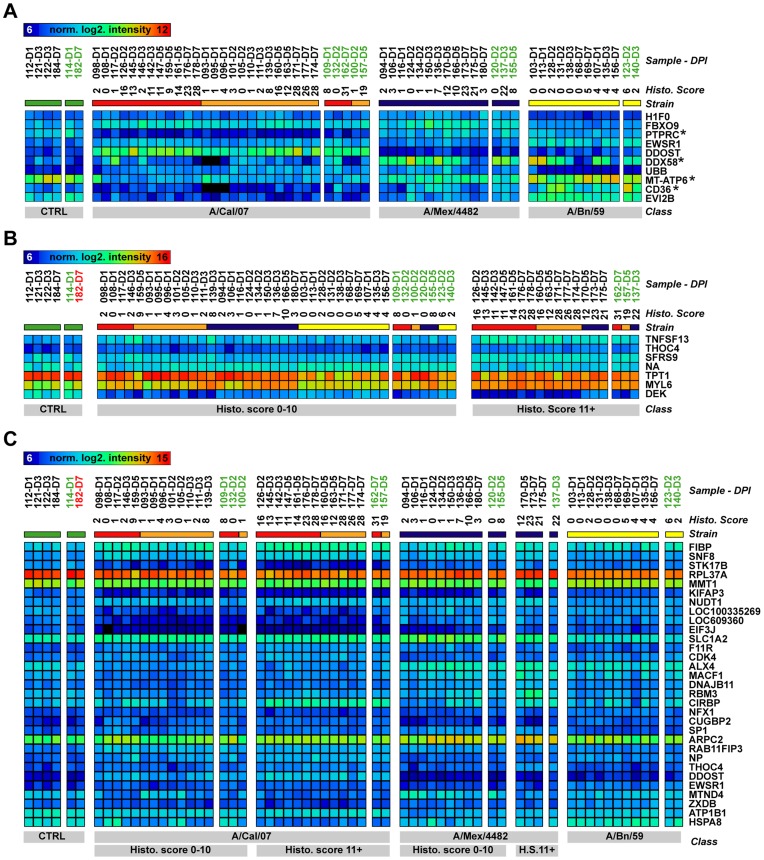
Different respiratory viruses induce virus-specific gene expression in the host. Recent evidence, including those presented here, suggests that genetically related isolates of influenza virus induce strain-specific host gene regulation in several animal models. Here, we identified systemic strain-specific gene expression signatures in ferrets infected with pandemic influenza A/California/07/2009, A/Mexico/4482/2009 or seasonal influenza A/Brisbane/59/2007. Using uncorrelated shrunken centroid classification, we were able to accurately identify the infecting influenza strain with a combined gene expression profile of 10 selected genes, independent of the severity of disease. Another gene signature, consisting of 7 genes, could classify samples based on lung pathology. Furthermore, we identified a gene expression profile consisting of 31 probes that could classify samples based on both strain and severity of disease. Thus, we show that expression-based analysis of non-infected tissue enables distinction between genetically related influenza viruses as well as lung pathology. These results open for development of alternative tools for influenza diagnostics.
不同的呼吸道病毒会在宿主中诱导病毒特异性基因表达。最近的证据表明,包括本文提供的证据表明,流感病毒的遗传相关分离株在几种动物模型中诱导宿主基因的特异性调节。在这里,我们在感染大流行性流感病毒 A/加利福尼亚/07/2009、A/墨西哥/4482/2009 或季节性流感病毒 A/布里斯班/59/2007 的雪貂中鉴定了全身性的、具有菌株特异性的基因表达特征。使用不相关的收缩质心分类法,我们能够使用 10 个选定基因的组合基因表达谱,独立于疾病的严重程度,准确地识别出感染的流感株。另一个由 7 个基因组成的基因特征可以根据肺部病理学对样本进行分类。此外,我们确定了一个由 31 个探针组成的基因表达谱,该谱可以根据菌株和疾病的严重程度对样本进行分类。因此,我们表明,非感染组织的基于表达的分析可以区分遗传相关的流感病毒以及肺部病理学。这些结果为流感诊断的替代工具的开发开辟了道路。