Dalla Lana School of Public Health, University of Toronto, Toronto, Ontario, Canada.
PLoS One. 2012;7(7):e40917. doi: 10.1371/journal.pone.0040917. Epub 2012 Jul 13.
Research has shown that people from higher socioeconomic status (SES) have better hepatocellular carcinoma (HCC) survival outcomes, although no such research has been carried out in Canada. We aimed to assess if an association between SES and HCC survival existed in the Canadian context.
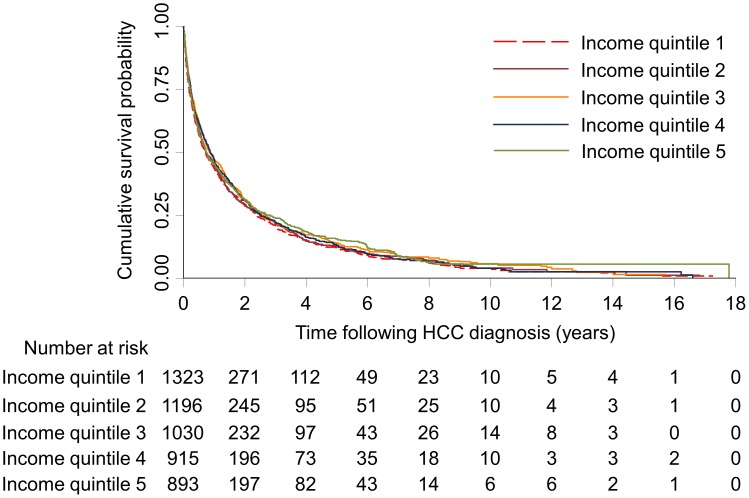
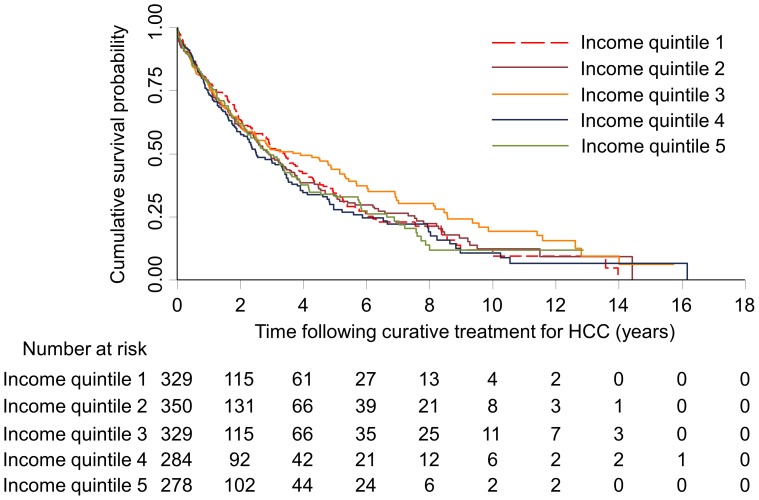
METHODOLOGY/PRINCIPAL FINDINGS: We conducted a population-based cohort study linking HCC cases identified in the Ontario Cancer Registry between 1990 and 2009 to administrative and hospital data. Logistic regression and chi-squared tests were used to evaluate associations between SES (income quintile) and covariates. The Kaplan-Meier method was used to estimate survival. Sequential analysis of the proportional-hazards models were used to determine the association between SES and HCC survival controlling for potential prognostic covariates. During the period 1990-2009, 5,481 cases of HCC were identified. A significant association was found between SES and curative treatment (p = 0.0003), but no association was found between SES and non-curative treatment (p = 0.064), palliative treatment (p = 0.680), or ultrasound screening (p = 0.615). The median survival for the lowest SES was 8.5 months, compared to 8.8 months for the highest SES group. The age- and sex-adjusted proportional-hazards model showed statistically significant difference in HCC survival among the SES groups, with hazard ratio 0.905 (95% confidence intervals 0.821, 0.998) when comparing highest to lowest SES group. Further adjustments indicated that potentially curative treatment was the likely explanation for the association between SES and HCC survival.
CONCLUSIONS/SIGNIFICANCE: Our findings suggest that a 10% HCC survival advantage exists for the higher SES groups. This association between SES and HCC survival is most likely a reflection of lack of access to care for low SES groups, revealing inequities in the Canadian healthcare system.
研究表明,社会经济地位(SES)较高的人群肝细胞癌(HCC)的生存结果更好,尽管在加拿大尚未开展此类研究。我们旨在评估在加拿大背景下 SES 与 HCC 生存之间是否存在关联。
方法/主要发现:我们进行了一项基于人群的队列研究,将 1990 年至 2009 年间安大略癌症登记处确定的 HCC 病例与行政和医院数据相关联。使用逻辑回归和卡方检验评估 SES(五分位数收入)与协变量之间的关联。Kaplan-Meier 方法用于估计生存。序贯分析比例风险模型,以确定 SES 与 HCC 生存之间的关联,同时控制潜在的预后协变量。在 1990-2009 年期间,共确定了 5481 例 HCC 病例。SES 与根治性治疗之间存在显著关联(p = 0.0003),但 SES 与非根治性治疗(p = 0.064)、姑息性治疗(p = 0.680)或超声筛查(p = 0.615)之间无关联。SES 最低组的中位生存期为 8.5 个月,而 SES 最高组为 8.8 个月。年龄和性别调整的比例风险模型显示 SES 组之间 HCC 生存存在统计学显著差异,与 SES 最低组相比,SES 最高组的危险比为 0.905(95%置信区间 0.821,0.998)。进一步调整表明,潜在的根治性治疗可能是 SES 与 HCC 生存之间关联的原因。
结论/意义:我们的研究结果表明,SES 较高的人群 HCC 生存优势为 10%。SES 与 HCC 生存之间的这种关联很可能反映了低 SES 群体获得医疗保健的机会不足,揭示了加拿大医疗保健系统中的不平等现象。