Veterinary Research Institute, Hudcova Brno, Czech Republic.
BMC Vet Res. 2012 Jul 20;8:115. doi: 10.1186/1746-6148-8-115.
Within the last decade, macrophages have been shown to be capable of differentiating toward a classically activated phenotype (M1) with a high antimicrobial potential or an alternatively activated phenotype (M2). Some pathogens are capable of interfering with differentiation in order to down-regulate the anti-microbial activity and enhance their survival in the host.
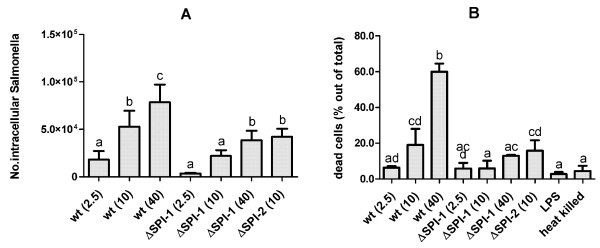
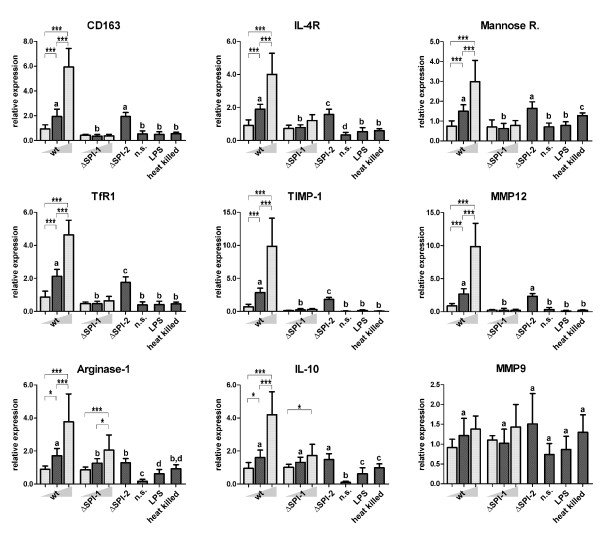
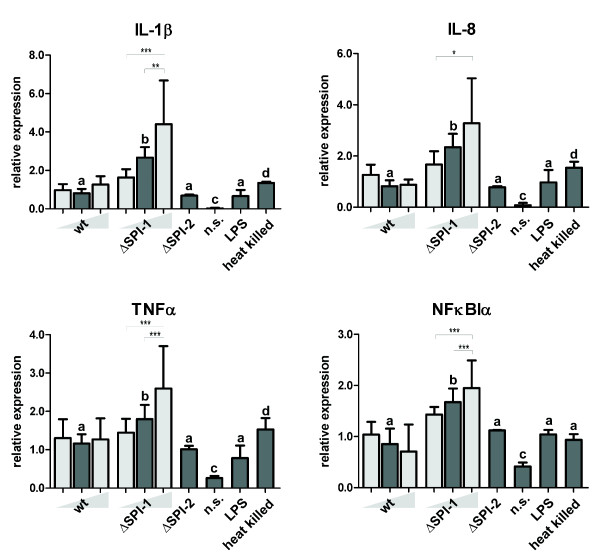
To test this ability in Salmonella enterica serovar Typhimurium, we infected porcine alveolar macrophages with wild-type Salmonella Typhimurium and its isogenic mutants devoid of two major pathogenicity islands, SPI-1 and SPI-2. The induction of genes linked with M1 or M2 polarization was determined by quantification of gene expression by RT-qPCR. The ΔSPI-1 mutant induced a high, dose-dependent M1 response but a low M2 response in infected macrophages. On the other hand, wild-type Salmonella Typhimurium induced a low M1 response but a high, dose-dependent M2 response in infected macrophages. The response to ΔSPI-2 mutant infection was virtually the same as the wild-type strain.
We therefore propose that Salmonella Typhimurium DT104 studied here can polarize macrophages towards the less bactericidal M2 phenotype and that this polarization is dependent on the type III secretion system encoded by SPI-1.
在过去的十年中,已经证实巨噬细胞能够向具有高抗菌潜力的经典激活表型(M1)或替代激活表型(M2)分化。一些病原体能够干扰分化,以下调抗菌活性并增强其在宿主中的存活能力。
为了测试沙门氏菌血清型鼠伤寒沙门氏菌(Salmonella enterica serovar Typhimurium)中的这种能力,我们用野生型鼠伤寒沙门氏菌及其缺乏两个主要致病性岛 SPI-1 和 SPI-2 的同源突变体感染猪肺泡巨噬细胞。通过 RT-qPCR 定量基因表达来确定与 M1 或 M2 极化相关的基因的诱导。ΔSPI-1 突变体在感染的巨噬细胞中诱导高剂量依赖性的 M1 反应,但诱导的 M2 反应较低。另一方面,野生型鼠伤寒沙门氏菌在感染的巨噬细胞中诱导低 M1 反应,但诱导高剂量依赖性的 M2 反应。ΔSPI-2 突变体感染的反应几乎与野生型菌株相同。
因此,我们提出,此处研究的鼠伤寒沙门氏菌 DT104 可以将巨噬细胞极化向杀菌能力较低的 M2 表型,并且这种极化依赖于 SPI-1 编码的 III 型分泌系统。