Veterinary Research Institute, Brno, Czech Republic.
Vet Res. 2011 Jan 24;42(1):16. doi: 10.1186/1297-9716-42-16.
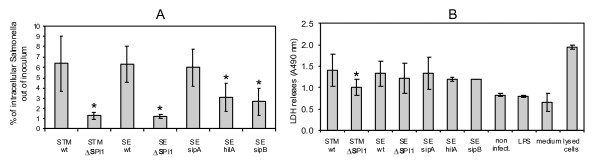
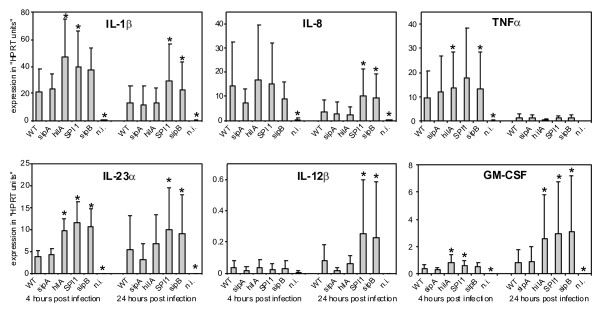
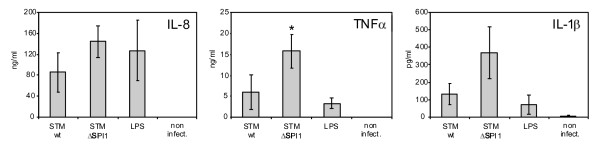
Genes localized at Salmonella pathogenicity island-1 (SPI-1) are involved in Salmonella enterica invasion of host non-professional phagocytes. Interestingly, in macrophages, SPI-1-encoded proteins, in addition to invasion, induce cell death via activation of caspase-1 which also cleaves proIL-1β and proIL-18, precursors of 2 proinflammatory cytokines. In this study we were therefore interested in whether SPI-1-encoded type III secretion system (T3SS) may influence proinflammatory response of macrophages. To test this hypothesis, we infected primary porcine alveolar macrophages with wild-type S. Typhimurium and S. Enteritidis and their isogenic SPI-1 deletion mutants. ΔSPI1 mutants of both serovars invaded approx. 5 times less efficiently than the wild-type strains and despite this, macrophages responded to the infection with ΔSPI1 mutants by increased expression of proinflammatory cytokines IL-1β, IL-8, TNFα, IL-23α and GM-CSF. Identical macrophage responses to that induced by the ΔSPI1 mutants were also observed to the infection with sipB but not the sipA mutant. The hilA mutant exhibited an intermediate phenotype between the ΔSPI1 mutant and the wild-type S. Enteritidis. Our results showed that the SPI-1-encoded T3SS is required not only for cell invasion but in macrophages also for the suppression of early proinflammatory cytokine expression.
位于沙门氏菌致病性岛-1(SPI-1)的基因参与沙门氏菌对宿主非专业吞噬细胞的入侵。有趣的是,在巨噬细胞中,SPI-1 编码的蛋白质除了入侵外,还通过激活半胱天冬酶-1诱导细胞死亡,半胱天冬酶-1还切割 proIL-1β 和 proIL-18,这是两种前炎症细胞因子的前体。因此,在本研究中,我们感兴趣的是 SPI-1 编码的 III 型分泌系统(T3SS)是否会影响巨噬细胞的前炎症反应。为了验证这一假设,我们用野生型鼠伤寒沙门氏菌和肠炎沙门氏菌及其同源 SPI-1 缺失突变体感染原代猪肺泡巨噬细胞。与野生型菌株相比,两种血清型的 ΔSPI1 突变体的入侵效率约低 5 倍,但尽管如此,巨噬细胞对 ΔSPI1 突变体的感染反应表现为前炎症细胞因子 IL-1β、IL-8、TNFα、IL-23α 和 GM-CSF 的表达增加。对 ΔSPI1 突变体诱导的巨噬细胞反应与 sipB 感染诱导的反应相同,但与 sipA 突变体不同。hilA 突变体表现出介于 ΔSPI1 突变体和野生型肠炎沙门氏菌之间的中间表型。我们的结果表明,SPI-1 编码的 T3SS 不仅是细胞入侵所必需的,而且在巨噬细胞中也需要抑制早期前炎症细胞因子的表达。