Fazel-Rezai Reza, Allison Brendan Z, Guger Christoph, Sellers Eric W, Kleih Sonja C, Kübler Andrea
Biomedical Signal and Image Processing Laboratory, Department of Electrical Engineering, University of North Dakota, Grand Forks ND, USA.
Front Neuroeng. 2012 Jul 17;5:14. doi: 10.3389/fneng.2012.00014. eCollection 2012.
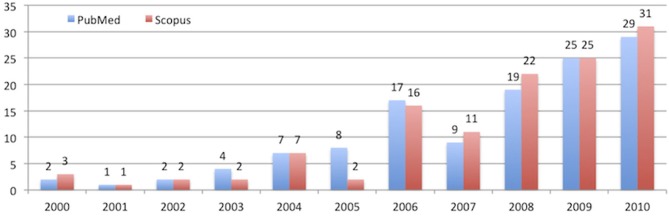
A brain-computer interface (BCI) enables communication without movement based on brain signals measured with electroencephalography (EEG). BCIs usually rely on one of three types of signals: the P300 and other components of the event-related potential (ERP), steady state visual evoked potential (SSVEP), or event related desynchronization (ERD). Although P300 BCIs were introduced over twenty years ago, the past few years have seen a strong increase in P300 BCI research. This closed-loop BCI approach relies on the P300 and other components of the ERP, based on an oddball paradigm presented to the subject. In this paper, we overview the current status of P300 BCI technology, and then discuss new directions: paradigms for eliciting P300s; signal processing methods; applications; and hybrid BCIs. We conclude that P300 BCIs are quite promising, as several emerging directions have not yet been fully explored and could lead to improvements in bit rate, reliability, usability, and flexibility.
脑机接口(BCI)能够基于通过脑电图(EEG)测量的脑信号实现无动作的通信。BCI通常依赖于三种类型的信号之一:P300和事件相关电位(ERP)的其他成分、稳态视觉诱发电位(SSVEP)或事件相关去同步化(ERD)。尽管P300脑机接口在二十多年前就已被引入,但在过去几年中,P300脑机接口的研究有了显著增长。这种闭环脑机接口方法基于向受试者呈现的oddball范式,依赖于P300和ERP的其他成分。在本文中,我们概述了P300脑机接口技术的现状,然后讨论了新的方向:诱发P300的范式、信号处理方法、应用以及混合脑机接口。我们得出结论,P300脑机接口很有前景,因为几个新兴方向尚未得到充分探索,可能会带来比特率、可靠性、可用性和灵活性方面的改进。